
Short Answer
Overview
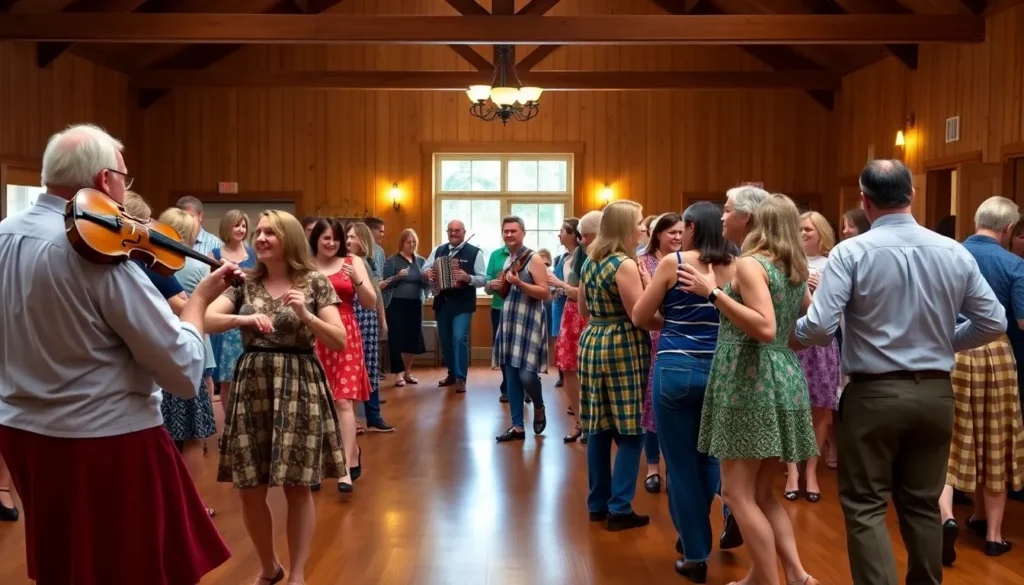
Contra dance is a type of social folk dance in which couples line up in two facing lines and perform a sequence of dance figures in coordination with music. Originating from European country dances, it has evolved primarily in North America and is characterized by its communal and participatory nature. The dance is typically called out by a “caller,” guiding dancers through a series of moves that repeat throughout the dance.
Detailed Explanation
Contra dance involves long lines of couples, usually arranged in pairs facing each other. The dance is performed to live or recorded music, often featuring instruments like fiddles, guitars, and accordions, playing traditional tunes or folk-inspired compositions. A caller provides instructions to the dancers between musical phrases, ensuring that even beginners can participate without prior preparation.
The dance choreography consists of a series of figures—such as promenades, swings, and dos-à-dos—that repeat as couples progress up or down the set. This progression allows dancers to interact with multiple partners over the course of an evening, fostering a strong sense of community and social engagement.
How It Works
Contra dances begin with couples arranged in two parallel lines, with each individual facing their partner. The caller announces or teaches the sequence of dance moves, which typically last for 64 beats, corresponding to the structure of the music. Dancers perform these moves in time with the music, repeating the sequence as they move through the lines.
The dance is inclusive and adaptable, with some variations for different skill levels or regional styles. The caller may adjust the pace or complexity of the figures based on the participants’ experience. As the dance progresses, couples “progress” by moving up or down the set, dancing with new neighbors, which creates dynamic social interaction.
Examples
- The Rights of Man: A popular traditional contra dance with a lively sequence involving swings, allemande lefts, and promenades.
- Jenny on the Railroad: Another classic dance featuring turns, dos-à-dos, and progression movements.
- St. Anne’s Reel: A Scottish-influenced contra dance known for its fast tempo and intricate figures.
Why It Matters
Contra dance plays an important cultural role by preserving and adapting folk dance traditions, fostering social connections, and encouraging physical activity. Its inclusive nature helps build community bonds across diverse groups of people. Additionally, the dance supports the continuation of traditional music forms and live performance arts.
Common Misconceptions
Misconception: Contra dance is only for experienced dancers.
Correction: Contra dance is designed to be accessible to all skill levels, with callers guiding participants through the moves.
Misconception: Contra dance is the same as square dancing.
Correction: While both are folk dances involving callers and figures, contra dancing arranges dancers in lines rather than squares.
Pros and Cons
Pros: Encourages social interaction; accessible to beginners; promotes physical fitness; preserves cultural traditions; adaptable to various musical styles.
Cons: May be intimidating for those uncomfortable with group settings; requires coordination with others; some regional variations can be confusing for newcomers.
Comparison Table
| Aspect | Contra Dance | Square Dance |
|---|---|---|
| Meaning | Lines of couples dancing choreographed figures with progression | Dancers arranged in squares performing set figures with a caller |
| Formation | Two long lines facing each other | Four couples forming a square |
| Music | Traditional folk or contemporary folk music | Traditional folk, country, or western music |
| Caller Role | Calls out figures between musical phrases | Calls out figures continuously during the dance |
| Social Interaction | Progression allows dancing with many partners | Partners generally remain fixed throughout a dance |
Decision Checklist
What is the easiest way to understand Contra Dance?
The easiest way to understand contra dance is to attend a beginner-friendly dance event where a caller explains the moves step-by-step, allowing participants to learn by doing in a supportive environment. Observing the basic formation of lines and progression helps grasp the social and choreographic structure quickly.
FAQ
What is the role of the caller in contra dance?
The caller provides verbal instructions to dancers, announcing or teaching the sequence of moves in time with the music to help participants follow the choreography.
Do I need to bring a partner to a contra dance?
No, contra dance is designed so individuals can participate without a fixed partner. Dancers regularly progress to new partners through the dance.
Is contra dance suitable for beginners?
Yes, contra dance is accessible to beginners as the caller explains moves clearly, and the steps are typically easy to learn with practice.





Leave a Reply