
Short Answer
Overview
Fire extinguishers on boats are critical safety devices designed to combat onboard fires and protect passengers, crew, and property. Regulatory bodies, such as the United States Coast Guard (USCG) and other international maritime authorities, have established specific requirements that dictate the type, number, size, and placement of fire extinguishers on various vessels. These requirements depend on factors including the boat’s length, propulsion type, and intended use.
Detailed Explanation
Fire extinguisher regulations for boats generally mandate that vessels carry an appropriate number of extinguishers that are suitable for the types of fires most likely to occur onboard. The regulations differentiate between boats powered by inboard engines, outboard motors, and boats without motors. Additionally, the size and class of the extinguisher are specified to ensure adequate fire suppression capability.
For example, in the United States, the USCG requires that recreational boats must have at least one B-I type fire extinguisher if they are less than 26 feet in length and powered by an inboard engine. Larger boats or those with multiple engines may require more extinguishers or higher-class ratings. Boats without enclosed engine compartments might have different requirements or exemptions. The extinguishers must be readily accessible and maintained in good working order.
How It Works
Fire extinguishers on boats operate by discharging an extinguishing agent to suppress fires. The typical classes of fires on boats include Class B (flammable liquids such as gasoline) and Class C (electrical fires). Therefore, marine fire extinguishers are often rated for these types and sometimes include Class A (ordinary combustibles) as well.
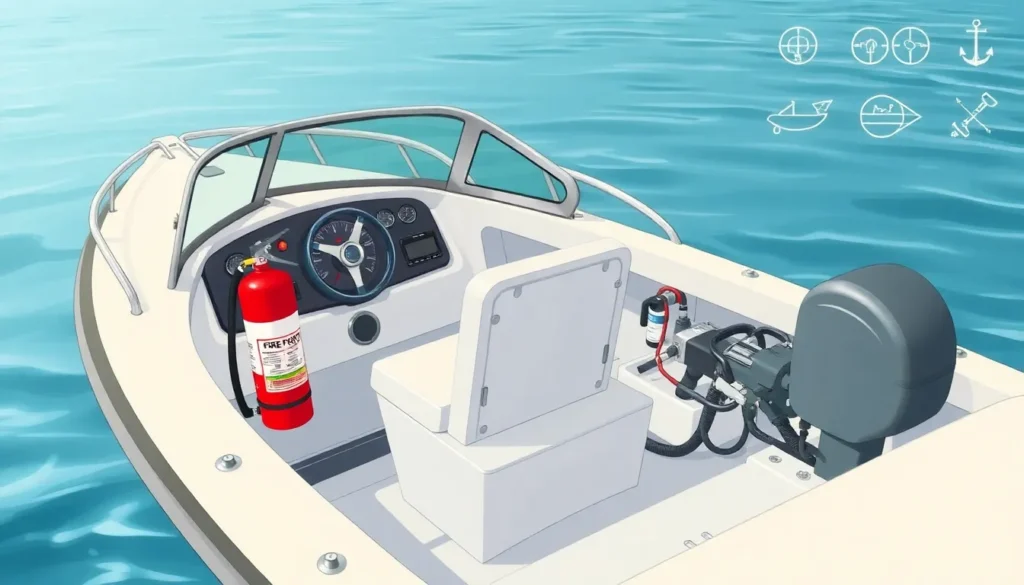
The extinguishers are designed to be mounted in easily accessible locations, such as near the helm, engine compartments, or galley, to allow quick response in an emergency. Regular inspection and servicing are required to ensure functionality, including checking pressure gauges, seals, and expiration dates.
Examples
- Small Recreational Boat (Under 26 feet): Typically requires at least one USCG-approved B-I type fire extinguisher if powered by an inboard engine or if the boat has an enclosed engine compartment.
- Medium-sized Boat (26 to 40 feet): Requires at least two B-I or one B-II extinguisher, depending on engine type and fuel system configuration.
- Sailboats: Sailboats with no enclosed engine compartment may be exempt from carrying extinguishers, but having them is recommended for safety.
- Commercial Vessels: Commercial boats have more stringent requirements, often needing multiple extinguishers of higher ratings and specific placement per maritime safety regulations.
Pros and Cons
- Pros:
- Enhances onboard safety by enabling fire suppression.
- Compliance with legal and insurance requirements.
- Potentially reduces damage and loss in fire emergencies.
- Cons:
- Requires regular maintenance and inspection.
- Improper placement or lack of knowledge on usage can reduce effectiveness.
- Additional weight and space considerations onboard.
Comparison Table
| Aspect | Fire Extinguisher Requirements on Boats | General Fire Extinguisher Requirements (Buildings) |
|---|---|---|
| Meaning | Specific regulations for maritime vessels concerning number, type, and placement of extinguishers. | Regulations for fixed structures emphasizing coverage of multiple fire classes and occupancy types. |
| Regulatory Authority | Maritime agencies such as the US Coast Guard, SOLAS, and local maritime authorities. | Fire codes administered by local fire departments and national standards organizations (e.g., NFPA). |
| Types Required | Primarily Class B and C extinguishers suitable for flammable liquids and electrical fires. | Varies widely depending on building use; often requires Class A, B, C, and sometimes D or K extinguishers. |
| Placement | Strategically located near potential fire hazards such as engine compartments and galleys. | Near exit points, kitchens, mechanical rooms, and other high-risk areas. |
Decision Checklist
- Use this if you own or operate a boat and want to ensure compliance with safety regulations and protect lives and property.
- Avoid this if your vessel is not subject to maritime fire extinguisher regulations (e.g., non-powered small craft), though carrying extinguishers is still advisable.
- Check this first by consulting local maritime safety authorities or the USCG for specific requirements based on your vessel type and size.
What is the easiest way to understand fire extinguisher requirements on boats?
The simplest approach is to identify your boat’s size and engine type, then refer to the relevant maritime safety authority’s guidelines or regulations. These documents typically provide clear tables or charts indicating the minimum number, type, and placement of fire extinguishers required. Additionally, purchasing USCG-approved fire extinguishers designed for marine use ensures compliance and optimal effectiveness.
FAQ
Are fire extinguishers required on all boats?
Fire extinguisher requirements depend on the boat's size, engine type, and regulations of the jurisdiction. Most powered boats and those with enclosed engine compartments must carry approved extinguishers.
What type of fire extinguisher should be used on a boat?
Marine fire extinguishers rated for Class B and Class C fires are recommended, as they are effective against flammable liquids and electrical fires commonly found on boats.
How often should boat fire extinguishers be inspected?
Boat fire extinguishers should be inspected monthly for pressure gauge readings and physical condition, with professional servicing or replacement typically required every 5 years or according to manufacturer guidelines.



Leave a Reply