
Short Answer
Overview
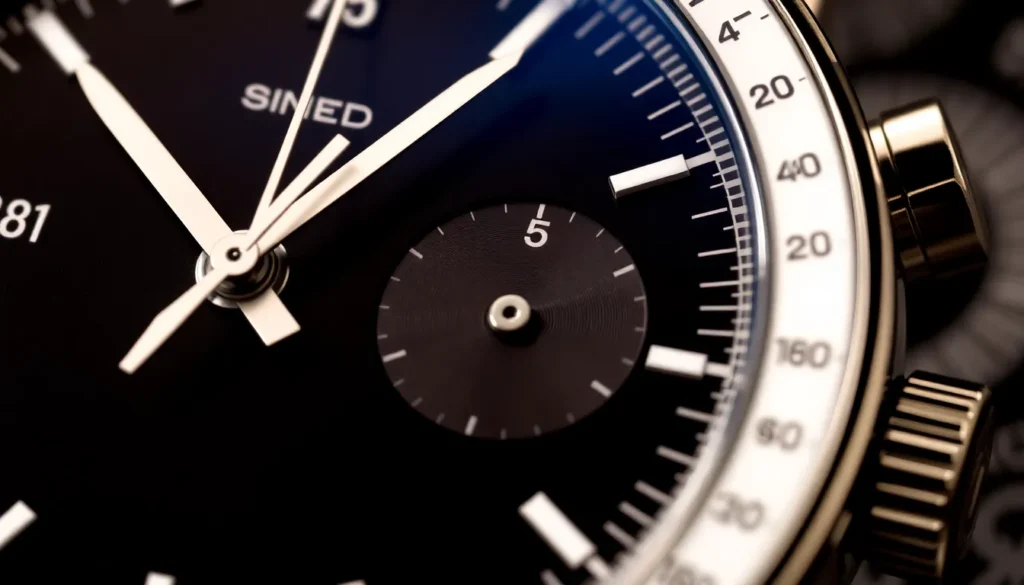
A tachymeter is a specialized scale found on some wristwatches, usually positioned around the outer edge of the dial or bezel. It is designed to measure speed or other rates over a fixed distance or unit of time. Although most commonly associated with chronograph watches, the tachymeter can be used for various timing-related calculations where converting elapsed time to a rate is necessary.
Detailed Explanation
The tachymeter scale is calibrated to convert elapsed time, typically measured in seconds, into speed expressed as units per hour. This is possible because the scale is logarithmic and inversely related to time. The most familiar application of a tachymeter is in measuring the speed of a moving object, such as a car, over a known distance, usually one mile or one kilometer. However, it can also be employed to determine production rates, heart rates, or other repetitive actions per hour.
The tachymeter scale usually starts at around 500 or 400 units per hour and decreases as the elapsed time increases, down to approximately 60 units per hour. This range corresponds to elapsed times between roughly 7.2 seconds and 60 seconds. If the timing event takes longer than 60 seconds, the tachymeter scale is no longer applicable without using additional calculations.
How It Works
To use a tachymeter, the wearer starts the chronograph function when the event begins and stops it when the event ends after traveling a known distance or completing a particular action. The position of the chronograph second hand then points to a number on the tachymeter scale, which indicates the speed or rate per hour.
For example, if a car travels one kilometer and the chronograph is stopped at 30 seconds, the tachymeter scale will show 120, indicating the car is moving at 120 kilometers per hour. The calculation is based on the formula: Speed = 3600 / elapsed time in seconds (3600 being the number of seconds in an hour).
Examples
- Measuring Speed: A user times a vehicle over a one kilometer stretch. If the chronograph hand stops at 45 seconds, the tachymeter reading approximately shows 80 units, indicating the vehicle’s speed is about 80 kilometers per hour.
- Calculating Production Rate: If a factory produces one unit in 20 seconds, the tachymeter scale would indicate 180, meaning 180 units can be produced in one hour.
- Heart Rate Estimation: By counting the seconds between heartbeats and using the tachymeter scale, it is possible to estimate beats per hour, though this use is less common and less precise than modern devices.
Common Misconceptions
Misconception: A tachymeter can measure speed without knowing the distance.
Correction: A tachymeter requires a known distance to calculate speed accurately since it converts elapsed time over that distance into units per hour.
Misconception: The tachymeter scale can measure any elapsed time.
Correction: Tachymeter scales are typically effective only for events that last between about 7 and 60 seconds. Events outside this range require alternative methods or calculations.
Pros and Cons
Pros: Enables quick, analog measurement of speed or rates without additional tools; integrated into the watch; useful for pilots, racers, and engineers.
Cons: Limited to events within a specific time range; requires a known distance for speed measurements; less practical with modern digital devices and GPS technology.
Comparison Table
| Aspect | Tachymeter | Chronograph |
|---|---|---|
| Meaning | Scale to convert elapsed time into speed or rate per hour | Stopwatch function to measure elapsed time |
| Functionality | Requires known distance or unit for calculations | Measures elapsed time intervals |
| Application | Speed, production rates, other rates per hour | General timing of events |
| Limitations | Effective only for events lasting 7-60 seconds | No intrinsic conversion to speed or rate |
Decision Checklist
What is the easiest way to understand a Tachymeter on a Watch?
The easiest way to understand a tachymeter is to think of it as a tool that translates how long something takes (in seconds) into how fast it is moving (units per hour) when you know the distance covered. It essentially answers the question: “If it takes this many seconds to cover a set distance, what is the speed per hour?”
FAQ
Can a tachymeter measure speed without a known distance?
No. A tachymeter requires a known distance to accurately calculate speed because it converts elapsed time over that specific distance into units per hour.
What is the time range suitable for using a tachymeter?
Tachymeters are generally effective for timing events that last between approximately 7 and 60 seconds. Events outside this range are not easily measured using the tachymeter scale.
Is a tachymeter useful for measuring heart rate?
While a tachymeter can be used to estimate heart rate by timing intervals between beats, it is less precise and less commonly used for this purpose compared to dedicated medical devices or pulsometer scales.





Leave a Reply