
Short Answer
Overview
A retaining wall is a structure engineered to restrain soil or rock from moving downhill or eroding away. These walls are commonly used in areas with steep gradients to create level surfaces and prevent the displacement of earth. Retaining walls can be constructed from a variety of materials such as concrete, stone, brick, timber, or metal, depending on the application and environmental conditions.
Detailed Explanation
Retaining walls serve the primary function of resisting lateral pressure from soil when there is a desired change in ground elevation that exceeds the angle of repose of the soil. They are a critical civil engineering feature in hillside construction, roadway embankments, landscaping, and erosion control. The design of a retaining wall takes into consideration factors such as soil type, slope angle, water drainage, and load from structures or vehicles above.
How It Works
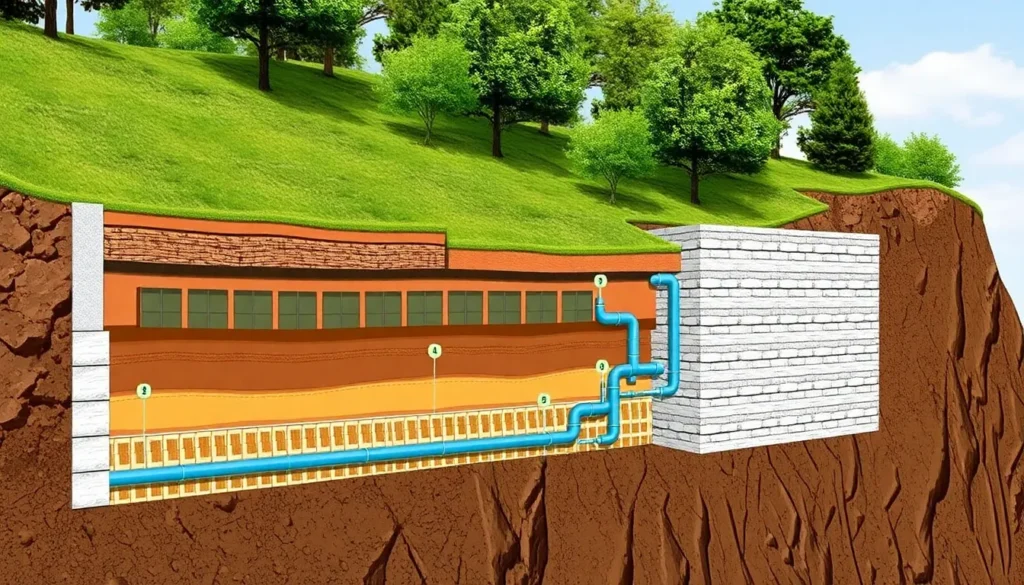
A retaining wall works by counteracting the forces exerted by the retained material, which include soil pressure, hydrostatic pressure from water, and any surcharge loads. The wall must have sufficient strength and stability to withstand these forces without overturning, sliding, or failing structurally. Drainage behind the wall is essential to relieve water pressure which can otherwise increase the load significantly. Depending on its design, the wall may rely on its own weight (gravity walls), structural reinforcement (cantilevered walls), or anchoring systems (anchored walls) to maintain stability.
Examples
- Gravity Walls: Constructed primarily from heavy materials like concrete or stone, these walls resist soil pressure through their own weight.
- Cantilever Walls: Made usually from reinforced concrete, they use a cantilevered structure to resist lateral pressure, often reinforced with steel.
- Sheet Pile Walls: Thin walls driven into the ground, typically used in soft soils and tight spaces, often made of steel or vinyl.
- Segmental Retaining Walls: Modular blocks stacked without mortar, relying on interlocking designs and gravity for stability, common in landscaping.
Why It Matters
Retaining walls play a significant role in civil engineering and landscaping by enabling the creation of usable land on slopes, protecting structures and roads from landslides and erosion, and managing water runoff. Without retaining walls in appropriate settings, soil erosion and slope failure could lead to property damage, environmental degradation, and safety hazards.
Common Misconceptions
Misconception: All retaining walls are simple, decorative structures.
Correction: Retaining walls are complex engineering structures designed to resist significant lateral earth pressures and often require detailed design and construction methods.
Misconception: Any material can be used to build a retaining wall without concern.
Correction: The choice of material depends on the wall’s height, load, soil conditions, and environmental factors to ensure stability and longevity.
Pros and Cons
Comparison Table
| Aspect | Retaining Wall | Alternative/Related Topic |
|---|---|---|
| Meaning | Structure that holds back soil or rock to prevent erosion and maintain elevation changes. | Gabion Wall: A wall made of cages filled with rocks, used for erosion control and retaining. |
| Materials | Concrete, stone, brick, timber, metal. | Terracing: Landscaping technique using stepped levels without rigid walls. |
| Purpose | Soil stabilization, slope management, erosion prevention. | Sheet Piling: Thin vertical barriers driven into the ground for earth retention. |
Decision Checklist
- Use this if you need to prevent soil erosion, create level ground on a slope, or protect structures from earth movement.
- Avoid this if the slope is minimal and natural ground stabilization is sufficient or if cost constraints prevent proper design and construction.
- Check this first the soil type, water drainage conditions, load requirements, and local regulations before planning a retaining wall.
What is the easiest way to understand a Retaining Wall?
The easiest way to understand a retaining wall is to imagine a barrier built to hold back soil on a hillside to keep it from sliding down, similar to how a dam holds back water. It’s essentially a support to keep uneven ground stable and usable.
FAQ
What is the primary purpose of a retaining wall?
The primary purpose of a retaining wall is to hold back soil or rock to prevent erosion or landslides and to create usable flat areas on sloped terrain.
What materials are commonly used for retaining walls?
Materials commonly used include concrete, stone, brick, timber, and metal, chosen based on design requirements and environmental conditions.
How does drainage affect retaining wall design?
Proper drainage is critical to reduce hydrostatic pressure behind the wall, which can otherwise cause failure; drainage systems like weep holes or pipes are often incorporated.

Leave a Reply