
Short Answer
Overview
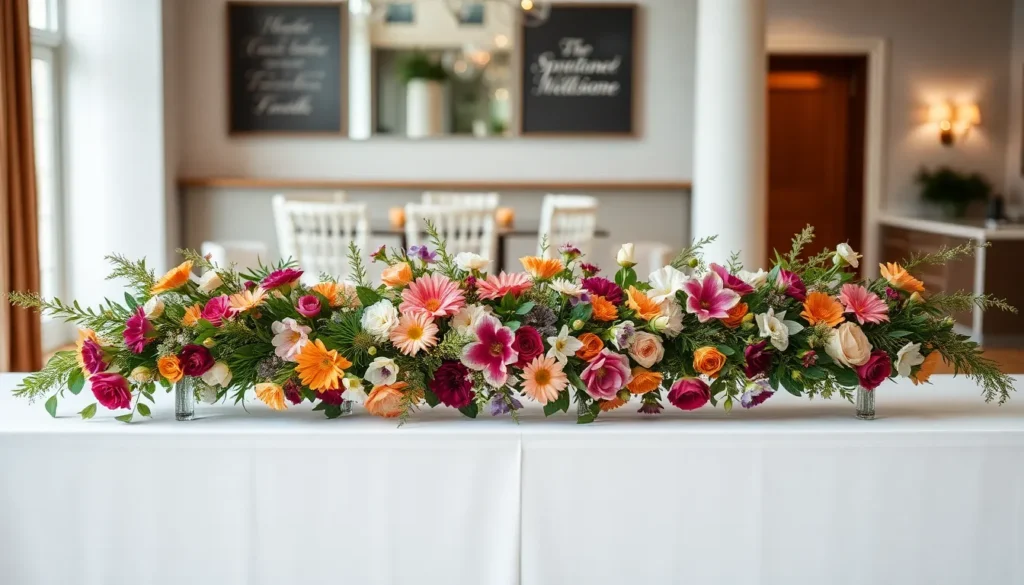
A horizontal floral arrangement is a floral design style where the composition extends predominantly in a horizontal direction. This arrangement typically features flowers and foliage arranged in a low, elongated shape that emphasizes width rather than height. The design is often symmetrical or asymmetrical, depending on the desired aesthetic effect, and is commonly used to decorate tables, mantels, or other flat surfaces where a broad, balanced display is preferred.
Detailed Explanation
In floral design, arrangements can be categorized by their shape and directional emphasis. A horizontal floral arrangement prioritizes lateral expansion, often maintaining a relatively low profile to avoid obstructing sightlines or overwhelming the space. This style is distinct from vertical arrangements, which emphasize height, and round arrangements, which focus on symmetry in all directions.
Horizontal arrangements typically utilize a combination of flowers, greenery, and filler materials that complement the elongated form. Designers often use floral foam or other mechanics to secure stems in a linear fashion. The arrangement’s length can vary widely, from modest centerpieces to expansive displays spanning several feet.
How It Works
The creation of a horizontal floral arrangement involves several key design principles:
- Line and Direction: The arrangement’s primary visual flow runs horizontally, guiding the viewer’s eye along its length.
- Balance: Whether symmetrical or asymmetrical, the arrangement maintains visual balance across its horizontal axis.
- Proportion: The flowers and foliage are selected and placed to fit the intended length and height, ensuring the arrangement complements the space.
- Focal Points: Designers may incorporate focal flowers at intervals to create visual interest along the arrangement.
- Support: Mechanical support such as floral foam, chicken wire, or other structures help maintain the shape and stability.
Examples
- Dining Table Centerpiece: A horizontal floral arrangement designed to run along the center of a long dining table, low enough to allow guests to see each other across the table.
- Reception Desk Decoration: Floral arrangements placed along the length of a reception desk, creating a welcoming atmosphere without obstructing interaction.
- Window Ledge Display: Arrangements designed to fit the dimensions of a window ledge, offering a horizontal visual accent visible both inside and outside.
Why It Matters
Horizontal floral arrangements are valuable for their ability to enhance spaces without dominating them. Their low profile makes them particularly suitable for social settings where visibility and communication are important, such as dining or conference tables. Additionally, their emphasis on width can complement architectural features or furniture, adding a decorative element that integrates seamlessly with the environment.
Common Misconceptions
Misconception: Horizontal floral arrangements are only simple or less elaborate than vertical arrangements.
Correction: While horizontal arrangements often have a lower profile, they can be highly intricate and artistically complex, employing advanced design principles and a variety of flowers and textures.
Misconception: Horizontal arrangements are only suitable for small spaces.
Correction: These arrangements can be scaled to fit large tables or venues, sometimes spanning several feet to create impactful displays.
Pros and Cons
Comparison Table
| Aspect | Horizontal Floral Arrangement | Vertical Floral Arrangement |
|---|---|---|
| Meaning | Floral design emphasizing width and low height, extending laterally. | Floral design emphasizing height and upward movement. |
| Typical Use | Table centerpieces, mantel decorations, window ledges. | Stand-alone displays, altar arrangements, tall vases. |
| Visual Impact | Balanced, broad, and unobtrusive. | Bold, prominent, and attention-grabbing. |
| Design Challenges | Maintaining balance over length, avoiding flatness. | Ensuring stability, achieving height without drooping. |
Decision Checklist
- Use this if: You need a floral arrangement that complements social settings without blocking views.
- Avoid this if: You want a dramatic statement piece that draws attention vertically.
- Check this first: The dimensions of the surface where the arrangement will be placed to ensure appropriate length and height.
What is the easiest way to understand Horizontal Floral Arrangements?
Think of a horizontal floral arrangement as a floral centerpiece that stretches out wide rather than standing tall. It is designed to fit along surfaces like tables or countertops, providing beauty and decoration without blocking sightlines or dominating the space vertically.
FAQ
What is a horizontal floral arrangement?
It is a type of flower arrangement where the design extends mostly sideways, focusing on width and often maintaining a low profile.
Where are horizontal floral arrangements commonly used?
They are commonly used on dining tables, mantels, reception desks, and other flat surfaces where a broad, unobtrusive decoration is desired.
How does a horizontal floral arrangement differ from a vertical one?
A horizontal arrangement emphasizes width and low height, while a vertical arrangement focuses on height and upward movement, often creating a taller display.


Leave a Reply