
Short Answer
Overview
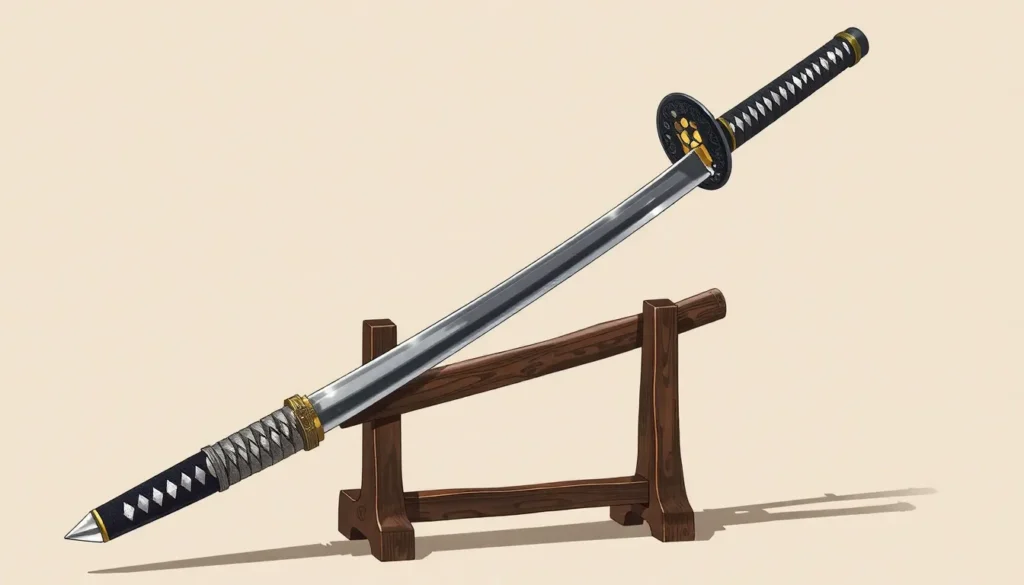
The katana is a type of traditional Japanese sword distinguished by its curved, slender, single-edged blade, circular or squared guard (tsuba), and a long grip designed for two-handed use. It emerged during the Muromachi period (approximately 14th to 16th centuries) and became the iconic weapon of the samurai class in feudal Japan. Known for its sharpness and cutting ability, the katana is both a weapon and a cultural symbol, representing the martial spirit and craftsmanship of Japan.
Detailed Explanation
The katana typically measures between 60 to 80 centimeters (24 to 31 inches) in blade length. It is forged using a specialized process that involves folding and hammering the steel repeatedly to create layers that enhance strength and flexibility. The blade’s curvature allows for quick drawing and cutting in a single motion, a technique known as iaijutsu. The handle (tsuka) is traditionally wrapped in ray skin (samegawa) and then bound with silk or cotton cord (tsuka-ito) to ensure a secure grip.
The katana is usually paired with a shorter companion sword called the wakizashi, and together they form a daishō, symbolizing the social status and honor of the samurai. The blade’s edge is hardened through differential heat treatment, resulting in a visible temper line (hamon), which is both functional and decorative.
How It Works
The katana’s design facilitates swift, precise cutting motions. Its curvature enables the wielder to draw the blade and strike simultaneously, an advantage in combat. The blade’s differential hardening creates a hard edge for sharpness and a softer spine for flexibility, preventing breakage. The long handle allows for leverage and control, while the tsuba protects the hand. Proper maintenance, including regular cleaning and oiling, is essential to preserve the blade’s condition and performance.
Examples
- Muromachi Period Katana: Early examples of katana blades from this era show the development of curvature and refined forging techniques.
- Edo Period Katana: Produced during a time of relative peace, these swords often emphasized craftsmanship and aesthetic qualities.
- Modern Reproductions: Contemporary smiths continue to produce katana using traditional methods, often for martial arts practice or collectors.
Pros and Cons
- Pros: Highly effective cutting weapon; balanced design for speed and precision; strong cultural and historical significance; exceptional craftsmanship.
- Cons: Requires regular maintenance; specialized forging is labor-intensive and costly; less effective against armored opponents compared to thrusting weapons.
Comparison Table
| Aspect | Katana | Alternative/Related Topic |
|---|---|---|
| Meaning | Traditional Japanese curved, single-edged sword used by samurai | Wakizashi – shorter companion sword worn alongside katana |
| Blade Length | Typically 60–80 cm | Tanto – usually less than 30 cm |
| Blade Shape | Curved, single-edged | Chokutō – straight blade |
Decision Checklist
- Use this if: You are studying traditional Japanese weapons, martial arts, or Japanese history.
- Avoid this if: You require a modern combat weapon optimized for contemporary conditions.
- Check this first: Authenticity and craftsmanship quality if acquiring a katana for collection or practice.
What is the easiest way to understand a Katana Sword?
The easiest way to understand a katana sword is to recognize it as a symbol of Japanese samurai culture characterized by its curved, sharp blade and two-handed grip, designed for swift and precise cutting. Appreciating its traditional forging process and historical context helps in grasping its significance beyond its function as a weapon.
FAQ
What distinguishes a katana from other Japanese swords?
The katana is distinguished by its curved, slender, single-edged blade, long two-handed grip, and specific forging techniques that give it a unique combination of sharpness and flexibility.
Why is the katana curved?
The curvature of the katana blade facilitates quick drawing and cutting motions, allowing a samurai to strike efficiently in combat with a smooth, continuous action.
Is a katana effective against armor?
While the katana is excellent for cutting and slashing unarmored or lightly armored opponents, it is less effective against heavily armored foes where thrusting or blunt weapons may perform better.



Leave a Reply