
Short Answer
Overview
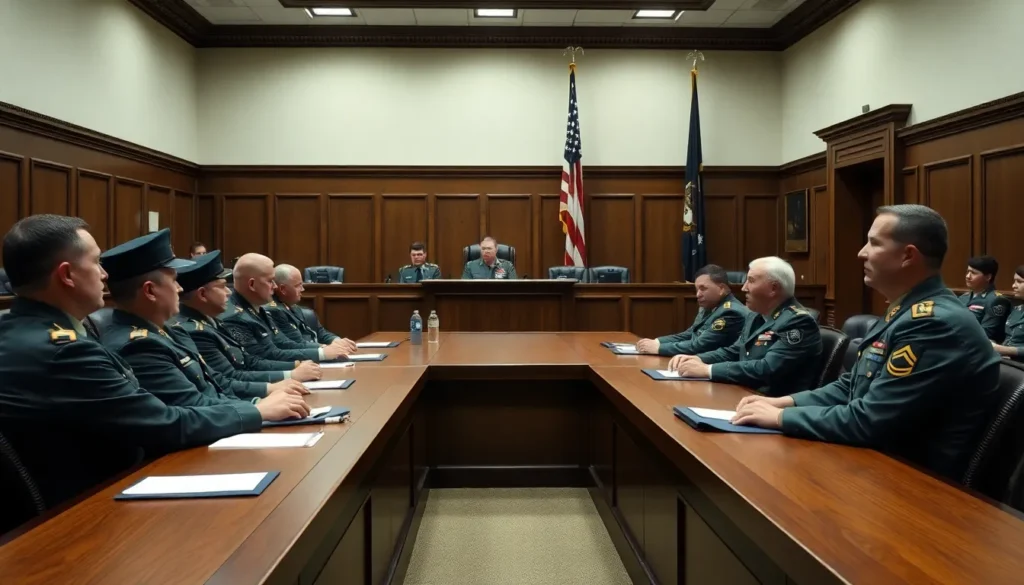
A court martial is a legal proceeding used by military organizations to try members of the armed forces who are accused of violating military laws and regulations. It serves as a specialized judicial process distinct from civilian courts, designed to uphold discipline and order within the military. Courts martial can address a range of offenses, from minor disciplinary infractions to serious criminal acts.
Detailed Explanation
Court martials are governed by military law, which varies by country but generally includes specific codes such as the Uniform Code of Military Justice (UCMJ) in the United States. The court martial system typically includes various types of trials, such as summary, special, and general courts martial, each differing in formality, severity of charges handled, and potential punishments.
Unlike civilian courts, courts martial often include military officers as judges and jurors, though legal officers and defense counsel may also participate. The procedures balance the need for military discipline with protections for the accused, including rights to counsel, presenting evidence, and appeals.
How It Works
The process begins with an investigation and charges being brought against a service member. Depending on the offense’s severity, the case may be handled administratively, through non-judicial punishment, or by a court martial. If a court martial is convened, the accused is formally tried before a panel or a military judge.
There are generally three types of courts martial:
- Summary Court Martial: The least formal, used for minor offenses, typically involving one officer acting as judge and jury.
- Special Court Martial: Intermediate form, with a military judge and a panel of officers, addressing moderate offenses.
- General Court Martial: The most formal, similar to a civilian felony trial, with a military judge and a panel that may include enlisted members, handling serious crimes.
After the trial, the court martial panel deliberates and issues a verdict. If the accused is found guilty, the court determines the sentence, which may include penalties such as confinement, reduction in rank, fines, or dismissal from service. Decisions can often be appealed within the military justice system.
Examples
- During World War II, courts martial were used extensively to try soldiers accused of desertion or insubordination.
- In modern times, courts martial may try service members for crimes such as theft, assault, or conduct unbecoming an officer.
- High-profile cases, such as those involving allegations of war crimes or serious breaches of military conduct, are often adjudicated by general courts martial.
Pros and Cons
- Pros: Courts martial maintain military discipline, provide a legal framework tailored to military needs, and ensure accused service members have access to defense and appeal rights.
- Cons: Critics argue that courts martial may lack complete impartiality due to military hierarchy involvement, and the procedures can be viewed as less transparent than civilian courts.
Comparison Table
| Aspect | Court Martial | Civilian Criminal Court |
|---|---|---|
| Meaning | Military judicial proceeding for service members accused of military offenses. | Judicial proceeding for civilians accused of crimes under civil law. |
| Jurisdiction | Applies to military personnel and certain offenses under military law. | Applies to civilians and crimes under civilian legal codes. |
| Participants | Military judges and panels, often including officers and enlisted members. | Civilian judges and juries. |
| Types | Summary, special, and general courts martial. | Varies by crime severity, includes trial courts, appellate courts. |
| Purpose | Maintain military discipline and enforce military justice. | Administer justice according to civil and criminal law. |
Decision Checklist
- Use this if: The accused is an active member of the armed forces and the offense falls under military law.
- Avoid this if: The accused is a civilian or the offense is outside military jurisdiction.
- Check this first: Whether the alleged conduct violates military regulations and if the case merits a court martial versus non-judicial punishment.
What is the easiest way to understand Court Martial?
The easiest way to understand a court martial is to view it as a specialized military trial designed to enforce discipline among service members, functioning similarly to civilian courts but operating under military law and procedures specific to the armed forces.
FAQ
Who can be tried by a court martial?
Typically, active members of the armed forces can be tried by a court martial for violations of military law. In some cases, civilians accompanying the military or military retirees can also be subject to court martial jurisdiction depending on the circumstances and applicable laws.
What types of offenses are handled by courts martial?
Courts martial handle a range of offenses including disciplinary infractions, insubordination, theft, assault, desertion, and serious crimes such as murder or war crimes if committed by service members.
How does a court martial differ from a civilian criminal trial?
A court martial is conducted under military law and typically involves military judges and panels composed of officers and enlisted personnel. It focuses on maintaining military discipline and may have different procedural rules and sentencing options compared to civilian courts.





Leave a Reply