
Short Answer
Overview
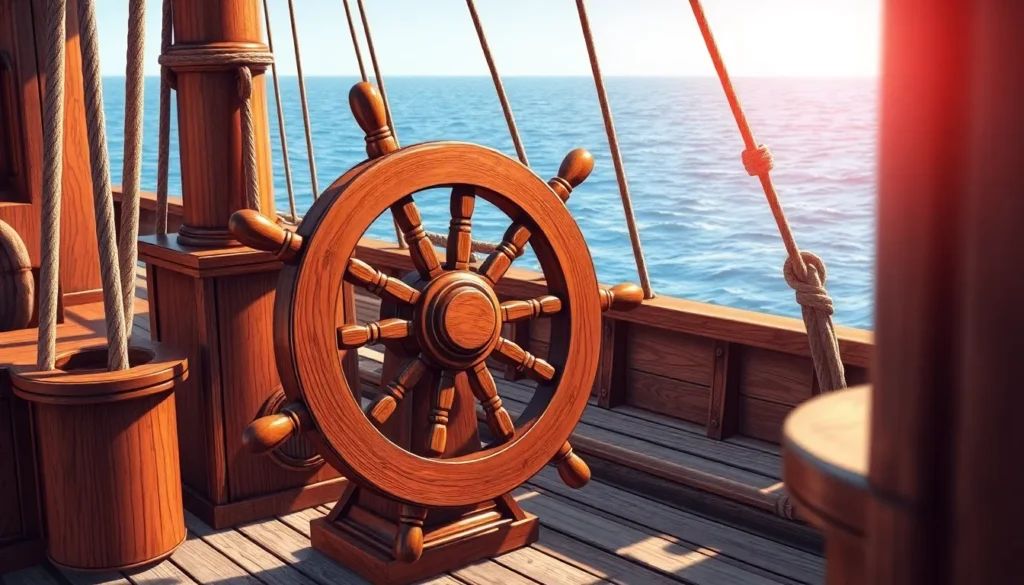
A ship’s steering wheel is traditionally called the “helm” or the “ship’s wheel.” It is a critical component in maritime navigation, used by the helmsman or the ship’s pilot to control the direction of the vessel. The steering wheel is connected to the rudder, which alters the ship’s course when turned. While the term “helm” can refer to the physical wheel itself, it also broadly encompasses the entire steering mechanism and the act of steering.
Detailed Explanation
The steering wheel of a ship, often made from wood or metal, is designed with multiple spokes radiating from a central hub. This design allows the helmsman to exert greater control and leverage over the steering mechanism. Historically, the ship’s wheel was connected to the rudder via a system of ropes, chains, or mechanical linkages. Modern vessels typically use hydraulic or electronic systems for steering, but the traditional wheel remains a symbolic and functional feature on many ships.
The term “helm” originates from the Old English word “helma,” meaning a device to steer a ship. Today, the helm can refer not only to the steering wheel but to the entire command station where the ship is steered, including the controls and instruments used for navigation.
How It Works
When the helmsman turns the ship’s wheel, this motion is transmitted through mechanical or hydraulic linkages to the rudder, a flat piece of wood, metal, or composite material mounted on the stern of the ship. Adjusting the angle of the rudder changes the direction of water flow around it, causing the ship’s bow to turn left (port) or right (starboard).
In older sailing vessels, the wheel was connected by ropes or chains to the tiller, which directly moved the rudder. In modern ships, the wheel often sends electrical signals to hydraulic systems that actuate the rudder, allowing for smoother and more precise control, especially in larger vessels.
Examples
- Traditional Sailing Ships: These vessels use a large wooden wheel connected by a system of ropes and pulleys to the tiller and rudder.
- Modern Motor Vessels: The wheel is typically connected to hydraulic or electronic steering systems, allowing for automated or assisted steering.
- Submarines and Aircraft Carriers: These use more complex steering mechanisms, often controlled electronically from a bridge or control room, but the term “helm” is still used.
Pros and Cons
- Pros: The ship’s wheel provides intuitive and direct control over the vessel’s steering. Its design allows for fine adjustments and strong leverage.
- Cons: In large vessels, mechanical linkages can introduce latency or require considerable physical effort without power assistance. Modern electronic systems have largely supplanted manual steering wheels in large commercial ships.
Comparison Table
| Aspect | Ship’s Steering Wheel (Helm) | Alternative/Related Topic (Tiller) |
|---|---|---|
| Meaning | A wheel-shaped device used to steer a ship by controlling the rudder. | A lever attached directly to the rudder for steering, commonly used on smaller vessels. |
| Control Mechanism | Connected via ropes, chains, hydraulics, or electronics to the rudder. | Direct manual movement of the rudder through the tiller arm. |
| Usage | Common on larger ships and vessels requiring precise steering. | More common on small boats and traditional sailing craft. |
Decision Checklist
- Use this if: You want to describe or understand the traditional and modern steering device on a ship.
- Avoid this if: You are referring specifically to small boats or craft where a tiller is used instead of a wheel.
- Check this first: The size and type of the vessel to determine whether it uses a steering wheel (helm) or a tiller.
What is the easiest way to understand a ship’s steering wheel?
The simplest way to understand a ship’s steering wheel is to think of it as a specialized wheel that the ship’s operator turns to control the rudder, which in turn changes the ship’s direction. Its design allows the helmsman to steer the vessel with precision, similar to how a car’s steering wheel controls the front wheels, but with adaptations for maritime use.
FAQ
Is the ship's steering wheel always called a helm?
Yes, the term 'helm' generally refers to the ship's steering wheel and the overall mechanism used for steering the vessel.
How does the ship's wheel control the rudder?
Turning the ship's wheel adjusts the rudder angle through mechanical linkages, hydraulics, or electronic systems, thereby changing the ship's direction.
What is the difference between a helm and a tiller?
A helm is a wheel-based steering device common on larger ships, while a tiller is a lever directly attached to the rudder, typically used on smaller boats.






Leave a Reply