
Short Answer
Overview
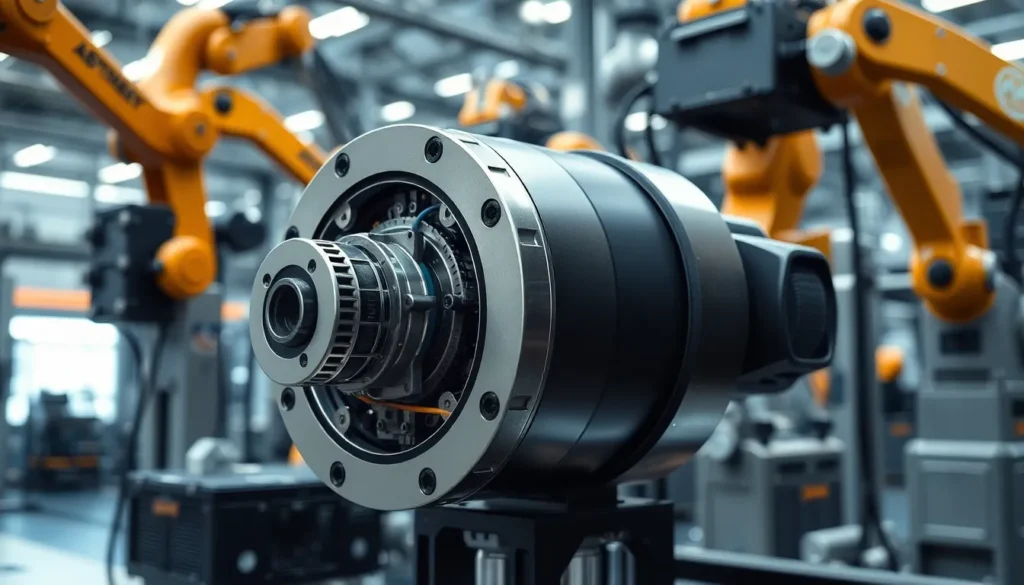
A servo motor is a specialized type of motor that incorporates a feedback system to enable precise control over its angular or linear position, velocity, and acceleration. Unlike standard motors, which operate at a fixed speed or torque, servo motors are designed to move to and hold specific positions accurately. This capability makes them fundamental components in robotics, automation, aerospace, manufacturing, and other fields that require exact motion control.
Detailed Explanation
Servo motors consist of three primary components: a motor (usually DC or AC), a control circuit, and a feedback sensor. The feedback sensor monitors the motor’s actual position and sends this data back to the controller. The controller then compares the actual position with the desired position, adjusting the motor’s movement accordingly to minimize any error. This closed-loop operation allows the servo motor to maintain precise control over its output shaft or linear actuator.
Servo motors come in various types, including brushed, brushless, AC, and DC variants. They differ in construction, power requirements, and control methods but share the common feature of closed-loop feedback for positional accuracy. The size and torque capacity of servo motors range widely, from small units used in hobbyist robotics to large industrial servo motors capable of moving heavy machinery.

How It Works
The operation of a servo motor relies on a control system that continuously monitors and adjusts the motor’s position. The process begins with a command signal specifying the target position. The controller translates this command into electrical signals sent to the motor, causing it to rotate.
The feedback sensor, often an encoder or potentiometer, measures the current position of the motor shaft and sends this information back to the controller. The controller then calculates the difference between the target and actual positions (the error) and adjusts the motor’s input power accordingly. This cycle repeats rapidly, allowing the motor to move smoothly and accurately to the desired position and maintain it despite external forces or load variations.
Examples
- Robotics: Servo motors are essential for articulating robotic arms, enabling precise joint movement and positioning.
- Remote-Controlled Vehicles: They control steering mechanisms and throttle, providing accurate control over vehicle movement.
- CNC Machinery: In computer numerical control machines, servo motors drive tool positioning systems with high precision.
- Aerospace: Used in flight control surfaces and antenna positioning systems requiring reliable and accurate motion.
- Industrial Automation: Employed in conveyor belts, packaging machines, and assembly lines to achieve controlled motion and positioning.
Why It Matters
Servo motors are critical to modern automation and precision engineering because they provide controlled, repeatable, and accurate motion. Their ability to adjust position, speed, and acceleration dynamically allows for complex and delicate operations that would be difficult or impossible with simple motors. This precision improves efficiency, product quality, and safety in various industries, making servo motors indispensable components in many technological systems.
Common Misconceptions
Misconception: Servo motors are just regular motors with a fancy name.
Correction: Servo motors differ from regular motors by integrating a feedback mechanism and control circuitry that enable precise position and speed control.
Misconception: All servo motors are the same size and power.
Correction: Servo motors come in a wide range of sizes and power ratings, from small hobby servos to large industrial units, each suited to different applications.
Pros and Cons
Pros: Precise position control, high torque at low speeds, dynamic response to load changes, repeatability, and integration with control systems.
Cons: Higher cost compared to standard motors, complexity in control and installation, and potential maintenance requirements for feedback components.
Comparison Table
| Aspect | Servo Motor | Stepper Motor |
|---|---|---|
| Meaning | Motor with feedback for precise position and speed control. | Motor that moves in discrete steps without feedback. |
| Control | Closed-loop, using feedback sensors. | Open-loop, without feedback in most cases. |
| Precision | High, due to feedback correction. | Moderate, depends on step resolution. |
| Torque | High torque at low speeds. | Torque decreases at higher speeds. |
| Cost | Generally higher due to control electronics. | Lower cost and simpler control. |
Decision Checklist
What is the easiest way to understand a Servo Motor?
The easiest way to understand a servo motor is to think of it as a motor combined with a sensor and a controller that constantly communicates to ensure the motor’s shaft moves exactly where it is commanded to go and stays there, even if forces try to move it away. This precise feedback loop is what distinguishes servo motors from ordinary motors.
FAQ
What is the main difference between a servo motor and a regular motor?
The main difference is that a servo motor includes a feedback mechanism and control circuitry that allow it to precisely control position, velocity, and acceleration, whereas a regular motor generally runs continuously without positional feedback or precise control.
Can servo motors be used for linear motion?
Yes, some servo motors are designed as linear actuators to provide precise linear positioning by converting rotational motion into linear movement.
Why do servo motors require feedback sensors?
Feedback sensors are necessary to monitor the actual position or speed of the motor shaft, enabling the control system to correct any deviations from the desired position, thereby ensuring precise and accurate operation.






Leave a Reply