
Short Answer
Overview
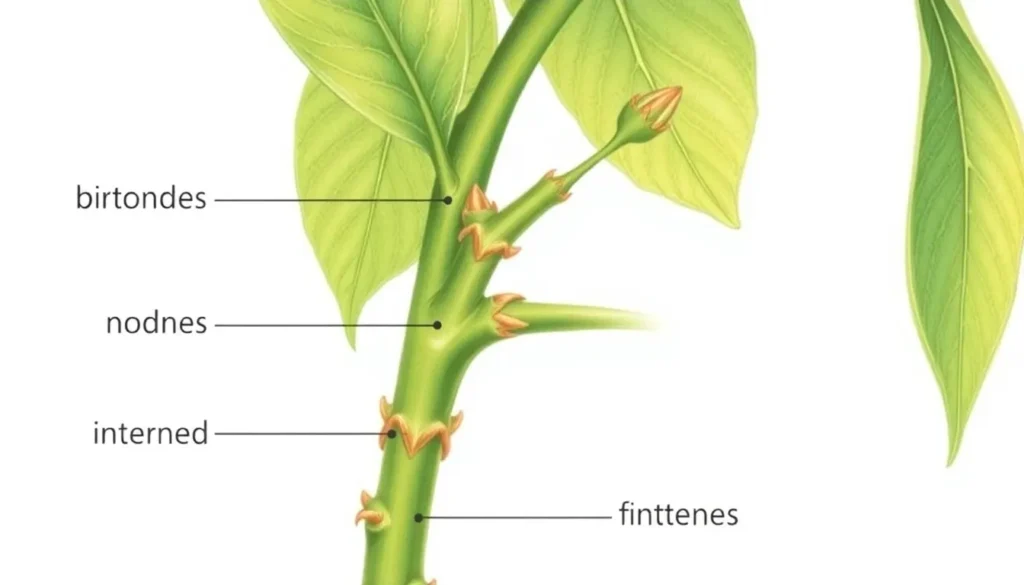
A node on a plant is a specific part of the stem where leaves, branches, and buds are formed. These points are essential for the structural organization and growth of the plant. Nodes serve as the site from which new shoots and leaves develop, making them integral to the plant’s ability to expand and reproduce. The sections of the stem between nodes are called internodes.
Detailed Explanation
Nodes are anatomically distinct regions on the plant stem, marked by the presence of leaf scars or bud scales in some species. They contain meristematic tissues capable of cell division, which allows for the formation of lateral shoots or flowers. The arrangement of nodes along the stem influences the plant’s overall architecture and branching pattern. Additionally, nodes often house vascular connections that facilitate the transport of water, nutrients, and photosynthates between the stem and the leaves or buds.
How It Works
Each node acts as a growth center where dormant or active buds can develop into leaves, stems, or flowers. The hormonal signals within the plant regulate the activity at nodes, controlling apical dominance and lateral branching. For example, auxins produced at the shoot tip suppress growth at lower nodes, while cytokinins promote cell division at nodes. This hormonal interplay determines the pattern of growth and the plant’s shape. Nodes also serve as important junctions for the transport of nutrients and water through the plant’s vascular system, connecting roots and leaves.

Examples
- Tomato Plant: The tomato stem clearly shows nodes where leaves and branches arise. Gardeners often prune just above a node to encourage bushier growth.
- Bamboo: Bamboo stems have prominent nodes that contribute to their strength and flexibility, with each node marking a segment of the hollow stem.
- Potato Plant: Tubers develop from underground nodes called stolons, illustrating the role of nodes in vegetative propagation.
Why It Matters
Understanding nodes is crucial for horticulture, agriculture, and plant biology because nodes determine where growth occurs and how a plant develops its shape and reproductive structures. This knowledge assists in practices such as pruning, grafting, and propagation, allowing for better crop yields and healthier plants.
Common Misconceptions
Misconception: Nodes are the same as internodes.
Correction: Nodes are distinct points on the stem where leaves and buds form, while internodes are the stem segments between nodes.
Misconception: All plant growth happens at the tips only.
Correction: While apical meristems at the tips are important, lateral growth also occurs at nodes through axillary buds.
Pros and Cons
Pros: Nodes enable branching and leaf formation, essential for photosynthesis and reproduction. They allow for vegetative propagation and structural support.
Cons: Nodes can be sites of vulnerability for pests and diseases, and improper pruning at nodes can damage the plant.
Comparison Table
| Aspect | Node | Internode |
|---|---|---|
| Meaning | A point on a stem where leaves, branches, or buds originate. | The stem segment between two nodes. |
| Function | Supports growth of lateral organs and vascular connections. | Provides stem elongation and spacing between nodes. |
| Location | Located at intervals along the stem. | Between nodes along the stem. |
| Role in Propagation | Can develop into new shoots or roots for vegetative propagation. | Does not typically contribute directly to new growth. |
Decision Checklist
What is the easiest way to understand a Node on a Plant?
The easiest way to understand a node is to think of it as a ‘growth hub’ on the plant stem where leaves, branches, or flowers can sprout. Observing a plant stem closely will reveal these points as slight enlargements or marks where leaves or buds emerge, distinguishing nodes from the smooth stem sections in between.
FAQ
What is the difference between a node and an internode?
A node is the point on a plant stem where leaves and buds grow, whereas an internode is the stem segment between two nodes.
Can new plants grow from nodes?
Yes, many plants can be propagated by cutting stems at nodes, as these regions often contain meristematic cells capable of generating roots and shoots.
Why are nodes important for pruning plants?
Pruning just above a node encourages growth of new branches or leaves from the buds located at the node, shaping the plant’s growth effectively.





Leave a Reply