

Short Answer
Overview
A 3 point turn, also known as a Y-turn, K-turn, or three-point turnabout, is a driving technique used to reverse the direction of a vehicle when the road or space is too narrow for a conventional U-turn. It involves a sequence of controlled movements allowing the vehicle to turn around in a confined area by moving forward, backward, and forward again. This maneuver is fundamental in driver education and is often tested during driving examinations to assess a driver’s control and spatial awareness.
Detailed Explanation
The 3 point turn is performed in three distinct steps, which give the maneuver its name. It is typically executed on narrow roads or streets where turning the vehicle around in one continuous motion is impossible due to space constraints. The process requires the driver to carefully judge distances, control the vehicle at low speeds, and utilize mirrors and signals appropriately. The maneuver is considered a skillful procedure, as it demands precision and awareness of surrounding traffic and obstacles.
How It Works
The 3 point turn consists of the following stages:
- First Point: The driver signals to indicate the intention to turn, checks for traffic, and moves forward while steering the vehicle sharply toward the side of the road. This usually results in the vehicle being angled across the road.
- Second Point: The driver then shifts into reverse, steering the vehicle in the opposite direction while moving backward to the edge of the road or curb, carefully avoiding obstacles or traffic.
- Third Point: Finally, the driver moves forward again, steering into the new direction of travel and completing the turn to face the opposite way.
Throughout the maneuver, the driver must use mirrors and check blind spots to ensure safety, as the vehicle will be moving in both forward and reverse directions.
Examples
- On a narrow residential street where a driver needs to turn around but the road is too tight for a U-turn, they may perform a 3 point turn to reverse direction safely.
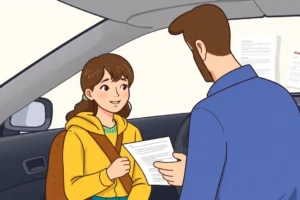
- During a driving test, a learner driver may be required to demonstrate a 3 point turn to show their ability to control the vehicle and navigate confined spaces.
- In rural areas or dead-end roads, drivers often use the 3 point turn to change direction when no designated turning areas exist.
Why It Matters
Mastering the 3 point turn is important for safe and efficient driving in confined or restricted spaces. It enables drivers to reverse direction without requiring additional road space, which is critical in urban environments with narrow streets. Additionally, the skill is a standard component of driver training and licensing tests, helping ensure that drivers possess adequate vehicle control and spatial awareness.
Common Misconceptions
Misconception: A 3 point turn can be done quickly without checking surroundings.
Correction: The maneuver requires careful observation of traffic and surroundings to ensure safety at all stages.
Misconception: A 3 point turn is the same as a U-turn.
Correction: Unlike a U-turn, which is a continuous turning maneuver, a 3 point turn involves stopping, reversing, and steering in multiple steps to accomplish the turn.
Pros and Cons
Pros:
- Allows turning around in limited space where a U-turn is not feasible.
- Develops and demonstrates driver control and spatial awareness.
- Widely taught and recognized in driver education and testing.
Cons:
- Requires stopping and reversing, which can be challenging in high traffic or on busy roads.
- May be intimidating for novice drivers due to need for precise control.
- Potentially hazardous if not executed with proper attention to surroundings.
Comparison Table
| Aspect | 3 Point Turn | U-Turn |
|---|---|---|
| Meaning | A maneuver involving forward, backward, and forward movement to turn a vehicle around in limited space. | A continuous turning maneuver where the vehicle turns around in a single motion, typically in wider spaces. |
| Space Required | Minimal space; suitable for narrow roads or confined areas. | Requires wider road or intersection for continuous turning. |
| Complexity | More complex due to reversing and multiple steps. | Simpler in execution, continuous steering without reversing. |
| Common Usage | Used on narrow streets, during driving tests, or in dead-end roads. | Used on wider roads, intersections, or designated U-turn areas. |
Decision Checklist
What is the easiest way to understand a 3 Point Turn?
The easiest way to understand a 3 point turn is to visualize it as a controlled zigzag maneuver: first steering forward into the opposite side of the road, then reversing back in the opposite direction, and finally moving forward again to complete the turn and face the new direction. It is essentially a method for turning a vehicle around when space is limited.
FAQ
Why is it called a 3 point turn?
It is called a 3 point turn because the maneuver involves three distinct movements: moving forward, reversing backward, and moving forward again to complete the turn.
When should I use a 3 point turn instead of a U-turn?
A 3 point turn should be used when the road is too narrow or space is limited, making a U-turn impossible or unsafe to perform.
Is a 3 point turn required during driving tests?
In many jurisdictions, performing a 3 point turn is a standard requirement during driving tests to demonstrate vehicle control and maneuvering skills.



Leave a Reply