
Short Answer
Overview
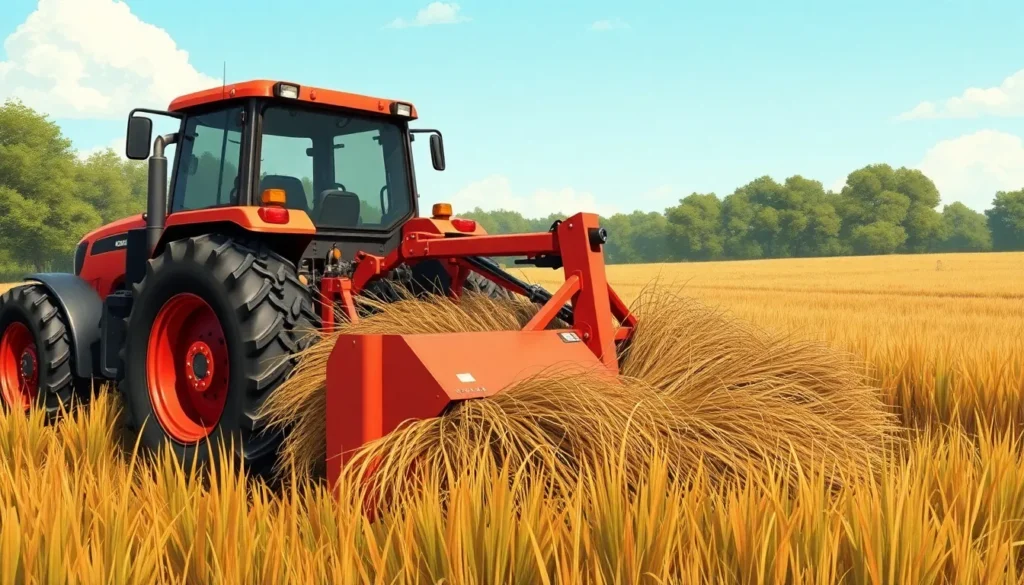
A brush hog, also known as a rotary cutter or bush hog, is a powerful mowing attachment designed for use with tractors to clear dense vegetation such as thick brush, tall grass, weeds, and small saplings. It is especially useful in agricultural, landscaping, and land management contexts where maintaining or reclaiming overgrown fields, pastures, or wooded areas is necessary. Brush hogs are named after a prominent manufacturer, but the term has become generic for this type of equipment.
Detailed Explanation
Brush hogs are heavy-duty rotary mowers that typically feature a large, circular cutting deck with thick, sharp blades mounted underneath. These blades rotate at high speeds to chop through tough plant material. The equipment is usually connected to the rear of a tractor via a three-point hitch and powered by the tractor’s power take-off (PTO) system. Brush hogs come in various sizes and cutting widths, tailored to different scales of land management tasks.
How It Works
The brush hog operates by transferring mechanical power from the tractor’s PTO shaft to the mower’s blades. As the blades spin rapidly within the protective deck, they cut vegetation by striking it with high force. The deck’s heavy construction helps deflect debris and protects the operator and surrounding area. Brush hogs are designed to manage rough terrain and handle materials that standard lawn mowers cannot, such as thick brush and small saplings up to several inches in diameter.
Examples
- Farmers use brush hogs to clear pastures and fields for planting or grazing.
- Landscapers employ brush hogs to maintain large properties with dense undergrowth.
- Municipalities use brush hogs for roadside vegetation control to improve safety and visibility.
Why It Matters
Brush hogs play an essential role in land management by enabling the efficient clearing of overgrown vegetation that would be labor-intensive or impossible to manage manually. They help maintain healthy ecosystems by controlling invasive species and reducing fire hazards. Additionally, brush hogs contribute to agricultural productivity by preparing fields and pastures for planting and grazing.
Common Misconceptions
Misconception: A brush hog is the same as a lawn mower.
Correction: Unlike standard lawn mowers designed for regular grass cutting, brush hogs are built to handle much thicker and tougher vegetation, including woody plants.
Misconception: Brush hogs can cut large trees.
Correction: Brush hogs are intended for clearing brush and small saplings usually up to 3 inches in diameter; they are not suitable for cutting mature trees.
Pros and Cons
Pros: Efficient at clearing dense and tough vegetation; durable and heavy-duty design; versatile for various land management tasks.
Cons: Requires a tractor with adequate power; less precise than specialized mowers; can be heavy and difficult to maneuver in tight spaces.
Comparison Table
| Aspect | Brush Hog | Rotary Lawn Mower |
|---|---|---|
| Meaning | Heavy-duty rotary cutter for dense brush and small trees | Light-duty mower for regular grass and lawns |
| Typical Use | Land clearing, pasture maintenance, roadside vegetation control | Lawn and garden grass mowing |
| Cutting Capacity | Brush, weeds, saplings up to ~3 inches diameter | Grass and light weeds only |
| Power Source | Tractor PTO | Self-propelled or push mowers, gas or electric |
| Weight | Heavy, durable construction | Lighter, designed for maneuverability |
Decision Checklist
What is the easiest way to understand a Brush Hog?
The easiest way to understand a brush hog is to think of it as a robust, tractor-powered mower specifically built to clear overgrown, tough vegetation that standard lawn mowers cannot handle. It is a tool for heavy-duty land maintenance rather than precise or ornamental grass cutting.
FAQ
What is the difference between a brush hog and a rotary mower?
A brush hog is a heavy-duty rotary mower designed to cut through thick brush, weeds, and small saplings, while a rotary mower is generally intended for lighter grass cutting and smaller vegetation.
Can a brush hog cut down trees?
No, brush hogs are designed to clear brush and small saplings typically up to about 3 inches in diameter, but they are not suitable for cutting mature or large trees.
What kind of tractor is needed to operate a brush hog?
A tractor equipped with a power take-off (PTO) system and sufficient horsepower to handle the size of the brush hog is required, with common tractors ranging from 20 to over 100 horsepower depending on the brush hog model.


Leave a Reply