
Short Answer
Overview
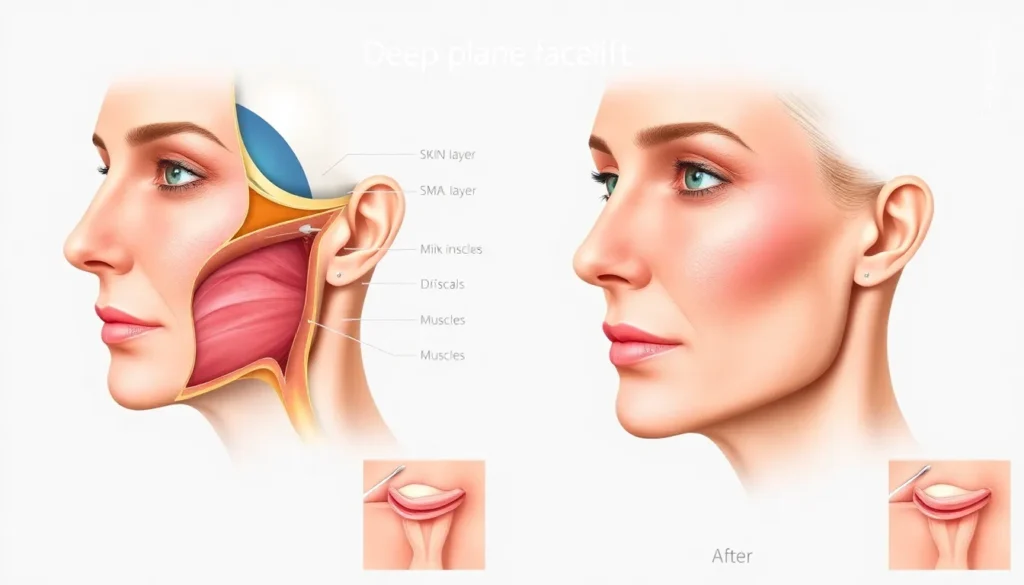
The deep plane facelift is a type of facial cosmetic surgery aimed at reducing signs of aging by repositioning the deeper layers of facial tissue. Unlike traditional facelifts that primarily focus on tightening the skin, the deep plane technique targets the underlying muscles and connective tissue, known as the superficial musculoaponeurotic system (SMAS). This approach is designed to provide more natural-looking results and longer-lasting facial rejuvenation.
Detailed Explanation
In a deep plane facelift, the surgeon lifts the deeper facial structures, including the SMAS and sometimes parts of the facial muscles, to correct sagging and restore youthful contours. This contrasts with more superficial facelift methods that only tighten the skin, which can result in a less natural appearance and shorter duration of effect. The deep plane approach allows for repositioning of the midface, jowls, and neck, addressing multiple areas of facial aging simultaneously.
How It Works
The procedure involves making incisions typically along the hairline and around the ears to access the deeper facial layers. The surgeon carefully separates the skin from the underlying SMAS layer, then lifts and repositions this deeper tissue to a more youthful position. By doing so, the deep plane facelift restores volume and definition to the cheeks, jawline, and neck. The skin is then redraped smoothly over the repositioned tissues and excess skin is removed. This technique preserves the nerve and blood supply better than some other methods, potentially reducing complications.
Examples
- A patient with sagging cheeks and jowls may undergo a deep plane facelift to lift the midface and improve jawline definition.
- Individuals experiencing loose neck skin often benefit from the deep plane technique as it tightens underlying muscles and connective tissues, providing a smoother neck contour.
- Patients who have had a previous traditional facelift but desire longer-lasting and more natural results might opt for a revision using the deep plane approach.
Pros and Cons
Pros:
- More natural and youthful facial appearance
- Longer-lasting results compared to skin-only facelifts
- Improved midface and jawline contour
- Better preservation of facial nerve function and blood supply
Cons:
- More complex and technically demanding surgery requiring specialized expertise
- Longer recovery period than less invasive procedures
- Higher risk of complications if not performed by an experienced surgeon
- Not suitable for all patients depending on anatomy and skin condition
Comparison Table
| Aspect | Deep Plane Facelift | Traditional Facelift |
|---|---|---|
| Meaning | Surgical lifting of deeper facial layers including SMAS and muscles | Surgical tightening primarily of the skin layer |
| Technique Complexity | More complex and technically demanding | Less complex, commonly performed |
| Results | Natural-looking, longer-lasting | May appear tighter but less natural, shorter duration |
| Recovery Time | Longer recovery | Shorter recovery |
| Risks | Higher if performed by inexperienced surgeon | Lower but with limitations in outcome |
Decision Checklist
- Use this if: You seek natural, long-lasting facial rejuvenation and are a good surgical candidate.
- Avoid this if: You prefer minimal downtime or have medical conditions that increase surgical risks.
- Check this first: Consult with a board-certified facial plastic surgeon to assess your anatomy and suitability.
What is the easiest way to understand Deep Plane Facelift?
The deep plane facelift can be understood as a facial surgery that lifts and repositions the deeper layers beneath the skin to restore youthful contours, rather than just stretching the skin surface. This deeper approach tends to produce more natural and longer-lasting results.
FAQ
What is the main difference between a deep plane facelift and a traditional facelift?
A deep plane facelift involves lifting and repositioning the deeper layers of facial tissue including the SMAS and muscles, while a traditional facelift primarily tightens the skin layer only.
How long does the recovery take after a deep plane facelift?
Recovery from a deep plane facelift generally takes longer than traditional facelifts, often several weeks, due to the more extensive tissue manipulation.
Are the results of a deep plane facelift permanent?
While no facelift is permanent, the deep plane facelift tends to provide longer-lasting and more natural results compared to skin-only facelifts, often lasting around 7-10 years depending on individual factors.





Leave a Reply