
Short Answer
Overview
A refraction eye exam is a diagnostic test performed by eye care professionals to measure an individual’s refractive error and determine the appropriate corrective lens prescription. This exam evaluates how light rays are bent (refracted) as they enter the eye and focuses on identifying conditions such as myopia (nearsightedness), hyperopia (farsightedness), astigmatism, and presbyopia.
Detailed Explanation
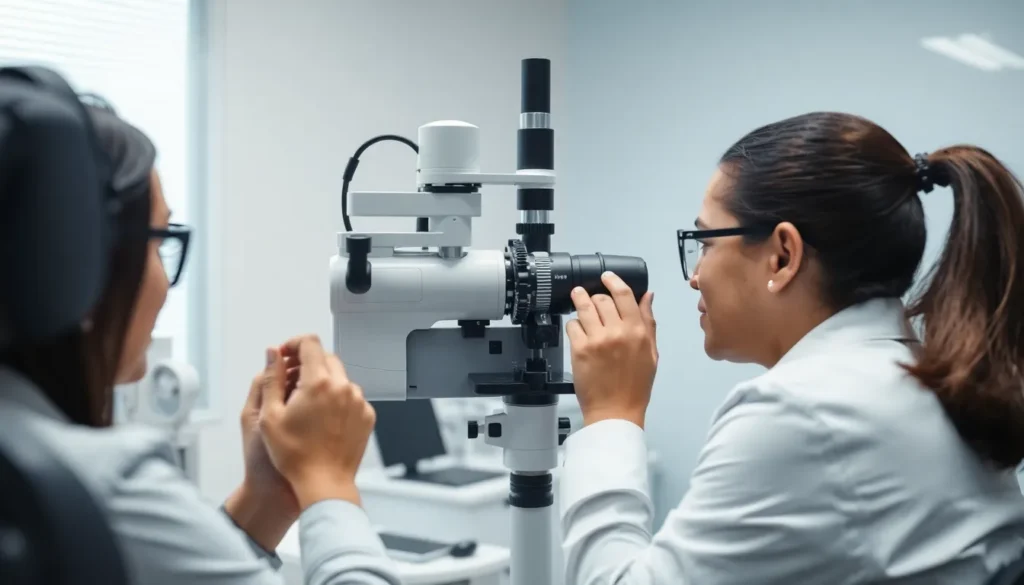
The human eye functions like a camera, focusing light onto the retina to produce clear images. Refractive errors occur when the shape of the eye prevents light from focusing precisely on the retina. A refraction eye exam quantifies these errors to prescribe lenses that compensate for the eye’s inability to focus light correctly. The exam is typically conducted using a combination of subjective and objective assessment tools, including a phoropter, retinoscope, and autorefractor.
How It Works
During the exam, the patient looks through a device called a phoropter, which contains multiple lenses of varying strengths. The eye care professional systematically changes these lenses while asking the patient to read letters on a visual acuity chart. The goal is to find the lens combination that provides the clearest vision. Objective measurements may be obtained using an autorefractor or retinoscopy, which estimate refractive error without relying on patient responses. These measurements are refined through subjective feedback to finalize the prescription.

Examples
- Myopia (Nearsightedness): The refraction exam will reveal a negative lens power prescription, indicating difficulty seeing distant objects clearly.
- Hyperopia (Farsightedness): The exam results in a positive lens power prescription, indicating difficulty focusing on near objects.
- Astigmatism: The exam identifies irregular curvature of the cornea or lens, requiring cylindrical lens correction.
Why It Matters
Refraction eye exams are fundamental in diagnosing and correcting visual impairments, improving quality of life by enabling clear vision. They are essential for prescribing eyeglasses or contact lenses, and they contribute to the early detection of underlying eye conditions that may affect vision.
Common Misconceptions
Misconception: A refraction eye exam can detect all eye diseases.
Correction: While it assesses refractive errors, it does not diagnose diseases like glaucoma or retinal disorders, which require additional testing.
Misconception: The refraction exam is only for people who already wear glasses.
Correction: This exam is suitable for anyone experiencing vision problems or during routine eye health evaluations.
Pros and Cons
Comparison Table
| Aspect | Refraction Eye Exam | Alternative Eye Exams |
|---|---|---|
| Meaning | Assessment of refractive errors to determine lens prescription | Includes tests like slit lamp exam, intraocular pressure measurement for disease detection |
| Purpose | Identify need for corrective lenses | Detect eye diseases and overall ocular health |
| Method | Subjective and objective measurement of lens power | Diagnostic imaging, tonometry, fundoscopy |
Decision Checklist
- Use this if: You experience blurry vision or difficulty focusing at various distances.
- Avoid this if: You require evaluation for eye diseases beyond refractive errors.
- Check this first: Confirm that your vision problems relate to refractive issues before proceeding.
What is the easiest way to understand a Refraction Eye Exam?
Think of the refraction eye exam as a process of finding the right pair of glasses by testing different lens strengths to see which one makes your vision clearest. It’s like adjusting the focus on a camera until the picture is sharp.
FAQ
How often should I have a refraction eye exam?
It is generally recommended to have a refraction eye exam every one to two years, or more frequently if vision changes occur or if prescribed by an eye care professional.
Is the refraction eye exam painful?
No, a refraction eye exam is non-invasive and painless. It involves looking through lenses and responding to visual prompts.
Can a refraction exam detect eye diseases?
No, while it assesses refractive errors, it does not detect eye diseases such as glaucoma or macular degeneration, which require additional diagnostic tests.



Leave a Reply