
Short Answer
Overview
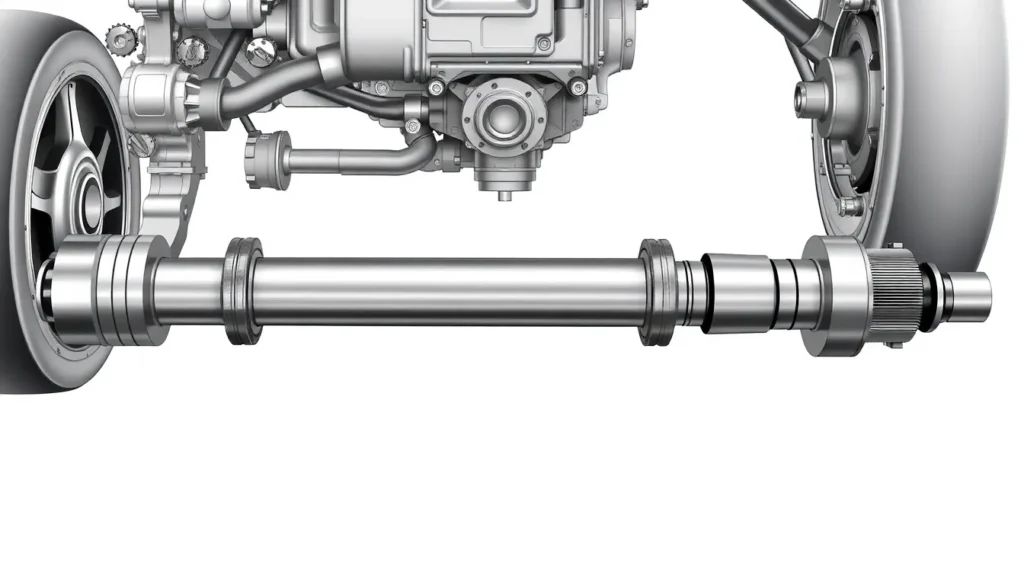
A driving shaft is a fundamental mechanical part designed to transmit rotational force (torque) from a power source, such as an internal combustion engine or electric motor, to other components in a machine. It is commonly found in automotive drivetrains, industrial machinery, and other mechanical systems where rotational power transfer is essential. The driving shaft ensures that the generated power is effectively conveyed to wheels, gears, or other mechanisms to enable movement or function.
Detailed Explanation
Driving shafts are typically cylindrical rods made from strong metals like steel or alloy to withstand the stresses of torque transmission. They connect the engine’s output to the drivetrain components, often passing through intermediate elements like clutches, gearboxes, or differentials. The shaft must accommodate various mechanical demands such as torque fluctuation, vibration, and alignment changes due to suspension or chassis movement.
In automobiles, the driving shaft is sometimes referred to as the driveshaft or propeller shaft, especially in rear-wheel-drive and four-wheel-drive vehicles. It can be a single solid shaft or a segmented assembly with universal joints to allow angular movement. The design varies depending on the vehicle layout and the distance between the engine and driven wheels.
How It Works
The driving shaft functions by rotating synchronously with the engine’s output shaft. When the engine produces torque, this torque is transferred along the driving shaft to the differential or transmission output shaft. Universal joints or constant velocity joints incorporated in the shaft assembly enable it to accommodate changes in alignment and allow smooth torque transmission despite suspension movements or steering angles.
The shaft must maintain balance to avoid vibrations that could damage other drivetrain components. It transmits rotational speed and torque faithfully, ensuring that the wheels or driven components operate efficiently and responsively according to the engine’s input.
Examples
- Automotive Driveshaft: In rear-wheel-drive vehicles, the driving shaft connects the transmission output to the rear differential, transferring power to the rear wheels.
- Industrial Machinery: Driving shafts are used in conveyor systems to transmit mechanical power from motors to the conveyor rollers.
- Aviation: Helicopter tail rotors use driving shafts to transmit power from the main engine to the tail rotor system.
Pros and Cons
- Pros: Efficient power transmission over distances; capable of handling high torque; adaptable with joints for angular movement; relatively simple and durable design.
- Cons: Can be prone to vibration if not balanced properly; maintenance required for joints and bearings; may add weight and complexity to drivetrain assembly.
Comparison Table
| Aspect | Driving Shaft | Alternative/Related Topic (e.g., Belt Drive) |
|---|---|---|
| Meaning | A mechanical shaft that transmits rotational power between engine and driven components. | A flexible loop transmitting power via friction between pulleys. |
| Torque Capacity | High, can transmit significant torque. | Generally lower torque capacity, suited for moderate loads. |
| Flexibility | Uses joints to accommodate angular misalignment. | Highly flexible, can handle complex routing. |
| Maintenance | Requires lubrication and balancing of joints and shaft. | Requires tension adjustment and periodic replacement. |
Decision Checklist
- Use this if you need to transmit high torque over a fixed or semi-flexible distance with minimal power loss.
- Avoid this if the power transmission path requires extreme flexibility or complex routing unsuitable for rigid shafts.
- Check this first for proper alignment and joint condition to prevent vibration and premature failure.
What is the easiest way to understand a Driving Shaft?
The easiest way to understand a driving shaft is to think of it as a rigid mechanical link that spins to transfer engine power to the wheels or other machine parts, much like a bicycle chain transfers pedal power to the wheels but in a solid, tubular form that can handle much higher forces and rotational speeds.
FAQ
What is the main purpose of a driving shaft?
The main purpose of a driving shaft is to transfer rotational power from a power source, such as an engine or motor, to other parts of a machine or vehicle, enabling motion or operation of connected components.
How does a driving shaft differ from a belt drive?
A driving shaft is a rigid, rotating shaft that transmits torque directly, while a belt drive uses a flexible belt that transmits power through friction between pulleys; shafts generally handle higher torque and are less prone to slippage.
Why are universal joints used in driving shafts?
Universal joints are used to allow the driving shaft to transmit torque even when the connected components are not perfectly aligned, accommodating angular changes due to suspension movement or steering without interrupting power transmission.





Leave a Reply