
Short Answer
Overview
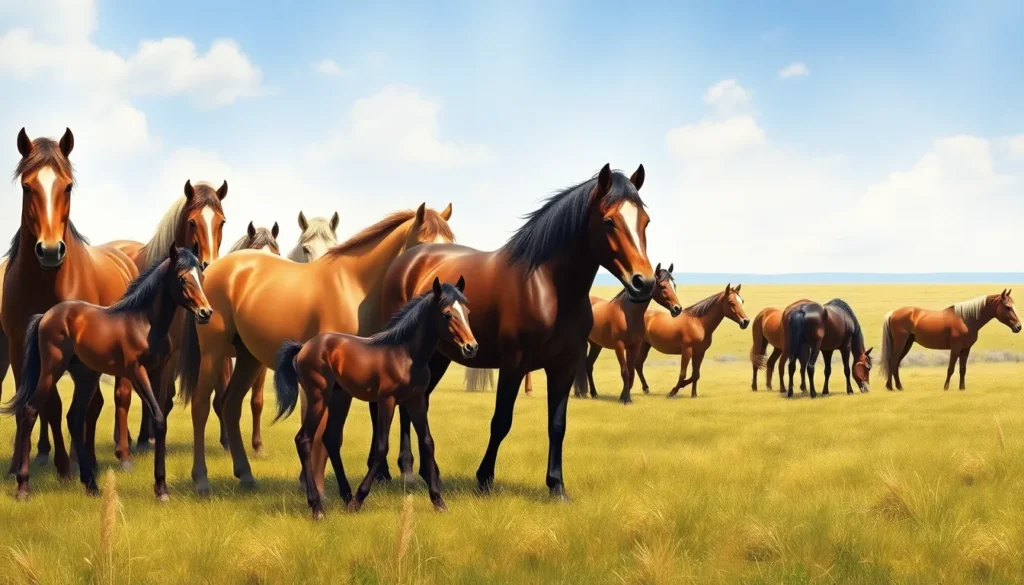
A group of horses is most commonly known as a herd. In both wild and domestic contexts, horses exhibit social behavior by forming groups for protection, mating, and social interaction. These groups can vary in size and composition depending on environmental factors and the horses’ purposes.
Detailed Explanation
The term herd is widely used to describe a collection of horses living together, particularly in wild or semi-wild settings. Typically, a herd consists of several mares (female horses), their foals (young horses), and one dominant stallion (male horse) who leads and protects the group. The structure promotes safety and social bonding.
In domestic or working contexts, other terms may describe groups of horses based on their use or organization. For example, a team refers to horses harnessed together to pull vehicles or heavy loads, while a string can describe a group of horses managed by a single individual, such as a rancher or trainer.
How It Works
In the wild, horses form herds as a survival strategy. The herd provides protection against predators by maintaining vigilance and allowing for coordinated flight responses. Social hierarchies develop within the herd, with dominant individuals leading movements and mating opportunities.
In domesticated settings, grouping horses may serve different functions. A team of horses is arranged and trained for specific tasks such as pulling carriages or plows. A string of horses is often a practical grouping for management, transport, or competition purposes.
Examples
- Wild Herd: Mustangs in the American West form herds with one stallion leading several mares and their offspring.
- Team: A pair or group of draft horses harnessed together to pull a wagon or farm equipment.
- String: A rancher’s collection of riding horses maintained for various activities like cattle herding or trail riding.
Pros and Cons
- Pros: Herds provide security, socialization, and breeding structure; teams offer strength and coordination for work; strings allow efficient management of multiple horses.
- Cons: Herds may lead to competition or aggression within the group; teams require training and coordination; managing strings can be resource-intensive.
Comparison Table
| Aspect | Group of Horses | Alternative/Related Term |
|---|---|---|
| Meaning | Herd: social group of horses living together | Team: horses harnessed for work; String: managed group of horses |
| Context | Wild or free-ranging horses | Domesticated, working, or managed horses |
| Composition | Usually mares, foals, and one stallion | Pairs or groups arranged for specific tasks |
Decision Checklist
- Use this if: Describing a natural social group of horses living together in the wild or pasture.
- Avoid this if: Referring specifically to horses working together in harness or managed individually.
- Check this first: The context and purpose of the group (wild behavior, working, or management) to select the correct term.
What is the easiest way to understand what a group of horses is called?
The simplest approach is to remember that a naturally occurring social group of horses is called a herd. When horses are working together, they may be called a team, and when managed collectively by a person, they form a string. Context clarifies the appropriate terminology.
FAQ
What is the correct term for a group of wild horses?
The correct term for a group of wild horses is a herd, which typically includes a dominant stallion, several mares, and their offspring.
Are there different terms for groups of horses depending on their use?
Yes. While 'herd' refers to a natural social group, 'team' describes horses harnessed together for work, and 'string' refers to a group of horses managed by a single person.
Why do horses form herds in the wild?
Horses form herds primarily for protection against predators, social interaction, and reproductive purposes, benefiting from group vigilance and coordinated movement.






Leave a Reply