
Short Answer
Overview
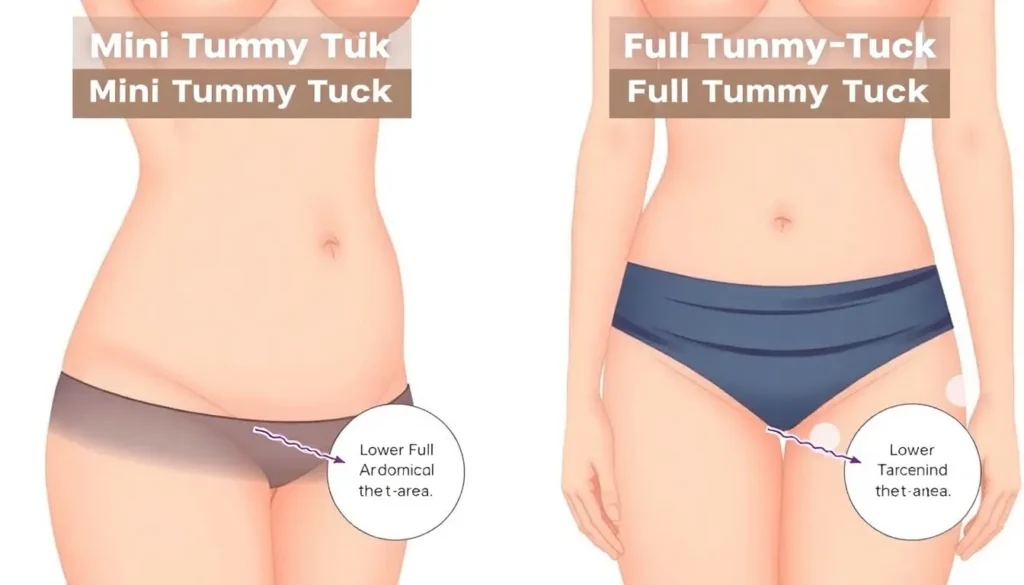
A mini tummy tuck, also known as a partial abdominoplasty, is a cosmetic surgical procedure designed to improve the appearance of the lower abdomen. It targets excess skin and fat below the navel and often includes tightening of the abdominal muscles in this region. Compared to a full tummy tuck, the mini tummy tuck is less invasive, involves a smaller incision, and typically has a shorter recovery period. It is frequently chosen by individuals who have localized lower abdominal laxity without significant skin or muscle laxity above the navel.
Detailed Explanation
The mini tummy tuck procedure focuses specifically on the area beneath the belly button. Unlike the full abdominoplasty, which addresses the entire abdominal wall and involves repositioning of the navel, the mini tummy tuck usually does not require moving the belly button. The surgery involves making a horizontal incision just above the pubic area, through which excess skin and fat are removed. Additionally, the surgeon may tighten the underlying abdominal muscles to create a firmer, flatter lower abdomen. This procedure is often suited for patients who have mild to moderate skin laxity and muscle separation limited to the lower abdomen, often resulting from factors such as aging, minor weight fluctuations, or pregnancy.
How It Works
The surgical process starts with an evaluation of the patient’s abdominal area to determine suitability for the mini tummy tuck. Under anesthesia, a horizontal incision is made above the pubic region, smaller than that used in a full tummy tuck. Excess skin and fat in the targeted lower abdominal region are removed through this incision. The surgeon then tightens the abdominal muscles in the treated area by suturing them closer together, improving muscle tone and abdominal contour. Since the navel is generally left intact and not repositioned, the surgery is less complex. After the procedure, the incision is closed with sutures, and the patient is typically advised to wear compression garments to support healing and reduce swelling. Recovery times vary but are generally shorter than those associated with a full abdominoplasty.
Examples
- A woman who has experienced minor skin laxity below the belly button after childbirth but maintains good muscle tone above the navel may opt for a mini tummy tuck to improve her lower abdominal contour.
- An individual who has lost a moderate amount of weight and has residual excess skin localized to the lower abdomen might choose a mini tummy tuck as a less invasive alternative to a full tummy tuck.
- A patient seeking a quicker recovery and less extensive scarring, and who only requires correction of mild lower abdominal muscle separation, may be a candidate for a mini tummy tuck.
Pros and Cons
- Pros:
- Less invasive than a full tummy tuck
- Smaller incision leading to less visible scarring
- Shorter recovery period
- Lower risk of complications
- Effective for localized lower abdominal issues
- Cons:
- Limited scope; not suitable for significant excess skin or muscle laxity above the navel
- May not provide as dramatic results as a full tummy tuck
- Not effective for extensive abdominal contouring needs
- Results may be less long-lasting if major weight changes occur
Comparison Table
| Aspect | Mini Tummy Tuck | Full Tummy Tuck |
|---|---|---|
| Meaning | Partial abdominoplasty focused on the lower abdomen below the navel | Comprehensive abdominoplasty addressing the entire abdomen including repositioning the navel |
| Incision Size | Smaller horizontal incision above the pubic area | Larger incision extending from hip to hip, plus navel repositioning |
| Muscle Tightening | Typically limited to lower abdominal muscles | Full abdominal muscle tightening from the pubic bone to the ribs |
| Skin Removal | Focused on excess skin below the navel | Removes excess skin both above and below the navel |
| Recovery Time | Generally shorter (1-2 weeks) | Longer (4-6 weeks or more) |
| Suitability | Patients with mild to moderate lower abdominal laxity | Patients with significant skin and muscle laxity throughout the abdomen |
Decision Checklist
- Use this if you have excess skin and mild muscle laxity limited to the lower abdomen, desire a less invasive procedure, and prefer a shorter recovery.
- Avoid this if you have significant skin laxity above the navel, extensive muscle separation, or require comprehensive abdominal contouring.
- Check this first by consulting with a board-certified plastic surgeon to evaluate the extent of abdominal laxity and to determine the most appropriate procedure for your needs.
What is the easiest way to understand a Mini Tummy Tuck?
The easiest way to understand a mini tummy tuck is to think of it as a smaller-scale version of a full tummy tuck that concentrates solely on improving the lower belly area. It removes excess skin and tightens muscles only in the lower abdomen, resulting in a flatter appearance with less surgical impact and a quicker recovery.
FAQ
What is the difference between a mini tummy tuck and a full tummy tuck?
A mini tummy tuck targets only the lower abdomen below the navel, involves a smaller incision, and generally has a shorter recovery period. A full tummy tuck addresses the entire abdominal area, including repositioning the navel and removing more skin and fat.
Who is a good candidate for a mini tummy tuck?
Individuals with mild to moderate excess skin and muscle laxity localized to the lower abdomen, typically without significant issues above the navel, are considered good candidates.
What is the typical recovery time after a mini tummy tuck?
Recovery usually takes about one to two weeks, which is shorter than the recovery time for a full tummy tuck. Patients are advised to avoid strenuous activity during this period.




Leave a Reply