
Short Answer
Overview
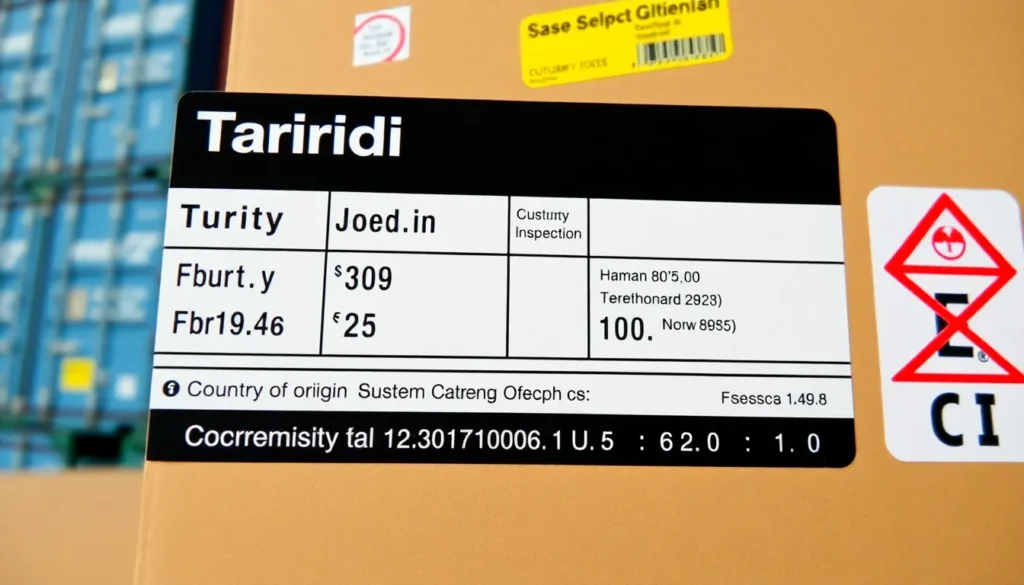
A tariff information label is a type of labeling used primarily in international trade to indicate the tariffs, duties, or taxes applicable to a particular product. These labels provide essential information to consumers, importers, exporters, and customs officials, helping to clarify the cost impact of tariffs on goods. Tariff information labels can be found on imported goods, packaging, or accompanying documentation and are part of broader customs and trade compliance practices.
Detailed Explanation
Tariff information labels detail the financial charges imposed on goods when they cross international borders. These charges are known as tariffs and are typically set by governments to protect domestic industries, generate revenue, or respond to trade policies. The label generally includes information such as tariff codes (Harmonized System codes), duty rates, country of origin, and sometimes additional regulatory information. The purpose is to ensure transparency in pricing and to assist in proper customs classification and valuation.
How It Works
When goods are imported or exported, customs authorities require documentation that specifies applicable tariffs. A tariff information label consolidates this data and attaches it directly to the product or packaging. Customs officials use the label to verify the correct tariff application, while importers and exporters use it to anticipate costs. The label may be generated by manufacturers, exporters, or customs brokers and is often based on internationally standardized classification systems like the Harmonized Commodity Description and Coding System (HS Code).

Examples
- A consumer electronic device imported into a country may carry a tariff information label indicating the HS code, the duty percentage, and the country of manufacture.
- Food products, such as imported cheese, often have tariff labels showing applicable import taxes and any related trade agreements affecting the tariff rate.
- Clothing items imported from overseas might feature a label detailing the tariff classification and duty to inform retailers and consumers of the additional costs involved.
Pros and Cons
Pros: Facilitates transparency regarding tariff costs; assists customs compliance; aids in accurate pricing and cost estimation; supports international trade regulations.
Cons: Can be complex to interpret without knowledge of tariff systems; may increase packaging or administrative costs; potential for errors if tariff information is outdated or incorrect.
Comparison Table
| Aspect | Tariff Information Label | Alternative/Related Topic (Country of Origin Label) |
|---|---|---|
| Meaning | A label indicating tariffs, duties, and taxes applied to a product during import/export. | A label specifying the country where the product was manufactured or assembled. |
| Purpose | To inform about financial charges related to customs and trade policies. | To inform consumers and regulators of the product’s manufacturing origin for compliance and marketing. |
| Content | Tariff codes, duty rates, tax information, regulatory details. | Country name or flag, manufacturing details. |
Decision Checklist
- Use this if you need to clearly communicate tariff-related costs on imported or exported goods.
- Avoid this if your focus is solely on product origin without tariff details.
- Check this first to ensure that tariff classifications and rates are current and accurately applied.
What is the easiest way to understand Tariff Information Labels?
The simplest way to understand tariff information labels is to view them as tags that communicate additional costs imposed by governments on imported or exported goods. By identifying codes and percentages, these labels help clarify how much extra a product costs due to tariffs, making it easier for businesses and consumers to anticipate final prices.
FAQ
What information is typically included on a tariff information label?
A tariff information label usually includes the tariff or duty rate, the Harmonized System (HS) code that classifies the product, the country of origin, and sometimes additional customs or regulatory details.
Who is responsible for creating and applying tariff information labels?
Manufacturers, exporters, importers, or customs brokers often prepare these labels as part of trade documentation to ensure compliance with customs regulations.
Are tariff information labels mandatory for all imported products?
Requirements vary by country and product type; while not always mandatory, these labels are commonly used to facilitate customs clearance and inform stakeholders of tariff costs.






Leave a Reply