
Short Answer
Overview
A contact force is a mechanical force that arises from the interaction between two objects that are physically touching each other. These forces are responsible for everyday phenomena such as pushing, pulling, friction, and tension. Unlike non-contact forces, which act at a distance (like gravity or electromagnetic forces), contact forces require physical contact to be exerted.
Detailed Explanation
Contact forces emerge from the electromagnetic interactions between atoms and molecules at the surfaces of objects in contact. When two surfaces come into contact, their atomic structures repel each other at very close distances, preventing objects from passing through one another. This repulsion manifests macroscopically as contact forces. These forces can be categorized into several types including frictional force, normal force, tension, and applied force, each describing different modes of interaction between contacting bodies.
How It Works
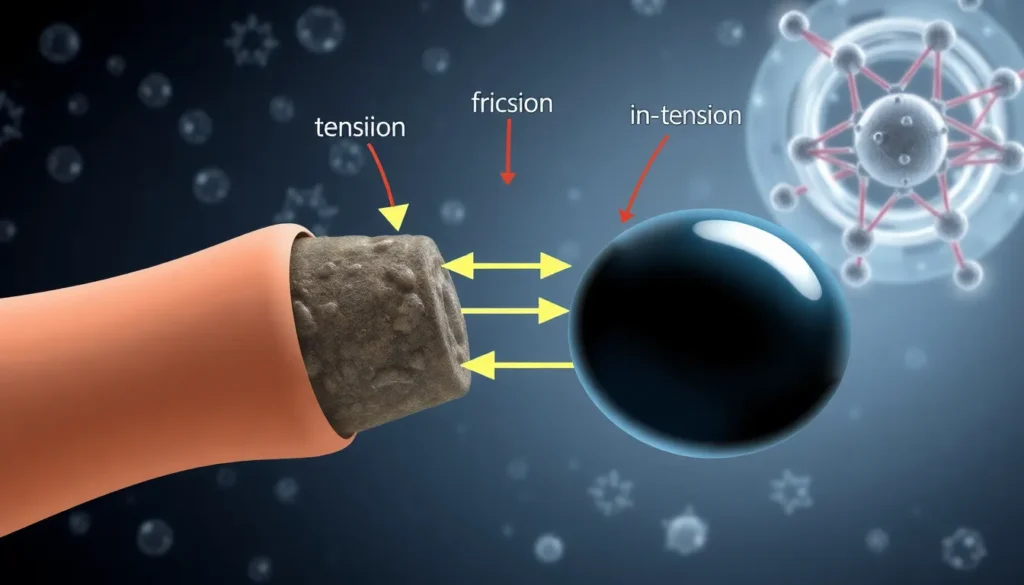
At the microscopic level, contact forces result from interactions between charged particles in the atoms of the contacting materials. When objects touch, their electrons create repulsive electromagnetic forces that prevent interpenetration. The normal force acts perpendicular to the surface of contact, supporting the object against gravity or other forces. Frictional force acts parallel to the surface, opposing relative motion. Tension occurs in strings or cables when they are pulled taut. The resultant force experienced by an object depends on the combination of these contact forces acting on it.
Examples
- When you push a book across a table, the force you apply and the friction opposing the motion are contact forces.
- A person pulling a rope exerts tension, a type of contact force transmitted through the rope.
- The normal force exerted by a chair supports a person sitting, preventing them from falling through.
- Friction between car tires and the road surface allows the vehicle to accelerate and decelerate safely.
Pros and Cons
Pros: Contact forces are essential for everyday activities and engineering applications, enabling motion control, support, and mechanical function. They provide tangible, direct interaction that is easier to manipulate and measure compared to non-contact forces.
Cons: Contact forces can also cause wear and tear, energy loss through friction, and material degradation over time. They may limit motion through resistance and require maintenance in mechanical systems.
Comparison Table
| Aspect | Contact Force | Non-Contact Force |
|---|---|---|
| Meaning | Force exerted through physical contact between objects | Force exerted at a distance without physical contact |
| Examples | Friction, normal force, tension | Gravity, electromagnetic force, magnetic force |
| Action Mechanism | Atomic-level contact and electromagnetic repulsion | Field interactions such as gravitational or electromagnetic fields |
| Requirement | Physical touching of objects | No physical contact needed |
Decision Checklist
- Use this if: You want to understand forces involved in direct physical interactions.
- Avoid this if: You are studying forces that act over distances without contact.
- Check this first: Whether the objects involved are physically touching to determine if contact forces are applicable.
What is the easiest way to understand Contact Force?
The simplest way to understand contact force is to think about pushing a door open. The force you apply to the door handle is a contact force because you and the door must touch for the force to be transmitted. This direct interaction contrasts with forces like gravity, which can act without any physical connection.
FAQ
What distinguishes a contact force from a non-contact force?
A contact force requires physical contact between objects to be exerted, while a non-contact force acts over a distance without direct physical interaction.
Can contact forces act through a medium?
Yes, some contact forces such as tension can act through a medium like a rope or cable, transmitting force from one object to another via physical contact.
Are friction and tension considered contact forces?
Yes, friction and tension are types of contact forces because they involve physical contact between surfaces or materials.


Leave a Reply