
Short Answer
Overview
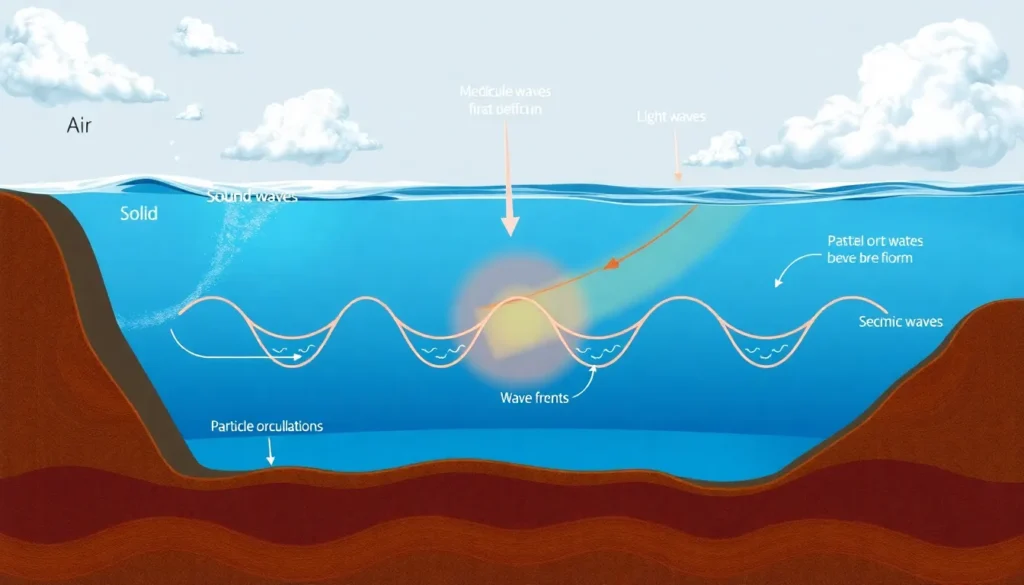
In scientific contexts, a medium refers to any substance or material that facilitates the transmission or propagation of energy, waves, or forces from one point to another. This can include solids, liquids, gases, or even vacuum (in certain electromagnetic contexts where the concept of a medium is nuanced). Understanding what constitutes a medium is essential for interpreting phenomena in physics, chemistry, and engineering, among other disciplines.
Detailed Explanation
A medium serves as the physical environment through which energy travels. For example, in mechanical waves such as sound waves, the medium is typically a material substance like air, water, or a solid through which particles oscillate and transfer vibrational energy. In contrast, electromagnetic waves, such as light, can propagate through a vacuum, although historically, the concept of a luminiferous “ether” was once proposed as a medium for light before being disproven.
The characteristics of the medium — including density, elasticity, and temperature — directly affect the speed, attenuation, and transmission properties of waves passing through it. In quantum mechanics and particle physics, a medium may also refer to the field or environment influencing particle behavior, such as a plasma or a Bose-Einstein condensate.
How It Works
The propagation of waves or energy through a medium typically involves the interaction of particles or fields within that medium. For mechanical waves, particles in the medium oscillate about their equilibrium positions and pass energy to neighboring particles via intermolecular forces. This chain reaction of particle oscillation enables wave propagation without the net movement of matter over large distances.
For electromagnetic waves, the medium may not be required in the classical sense, as these waves can propagate through vacuum. However, when traveling through a physical medium, electromagnetic waves interact with the charged particles therein, resulting in phenomena such as refraction, absorption, and scattering.
Examples
- Air: Acts as a medium for sound waves, enabling the transmission of audible sounds over distances.
- Water: Serves as a medium for both mechanical waves (e.g., water waves, sound waves underwater) and certain electromagnetic phenomena.
- Glass: Used as a medium for light transmission in optics, affecting speed and direction through refraction.
- Vacuum: Considered a medium for electromagnetic waves like light and radio waves, despite lacking matter, due to the electromagnetic field permeating space.
- Solid materials: Act as media for seismic waves during earthquakes, affecting their speed and intensity.
Why It Matters
The concept of a medium is fundamental to understanding how energy and information travel in the natural world. It underpins technologies such as telecommunications, acoustics, and medical imaging. Moreover, analyzing how different media affect wave propagation allows scientists to infer properties of materials and environments, contributing to fields such as geophysics, materials science, and astronomy.
Common Misconceptions
Misconception: Electromagnetic waves require a medium to travel.
Correction: Unlike mechanical waves, electromagnetic waves do not require a physical medium and can propagate through the vacuum of space.
Misconception: A medium always involves matter.
Correction: While most media are material substances, in physics, fields and vacuum can also act as media for certain interactions, such as electromagnetic propagation.
Pros and Cons
Pros: Facilitates the transmission of energy and information; allows the study of wave properties to understand material characteristics; essential for many technological applications.
Cons: The medium can introduce loss or distortion (e.g., attenuation or scattering); some media impose limits on wave speed; certain media may be impractical or unavailable in specific conditions.
Comparison Table
| Aspect | Medium (In Science) | Vacuum (Alternative/Related Concept) |
|---|---|---|
| Meaning | A substance or material through which waves or energy propagate. | Space devoid of matter, yet allowing electromagnetic wave propagation. |
| Requirement for Wave Propagation | Necessary for mechanical waves. | Not required for electromagnetic waves. |
| Effect on Wave Speed | Varies based on medium properties (density, elasticity). | Speed of light is maximum in vacuum. |
| Examples | Air, water, solids. | Outer space. |
Decision Checklist
What is the easiest way to understand a Medium in Science?
The easiest way to understand a medium is to think of it as the “carrier” or “channel” through which waves or energy move. For example, when you hear someone talking, the air around you acts as the medium carrying the sound waves from their mouth to your ears. Without this medium, the sound cannot travel. This simple everyday example illustrates the fundamental role of a medium in wave propagation.
FAQ
What is a medium in science?
A medium is a substance or material through which energy, waves, or forces travel or propagate, enabling the transfer of energy from one point to another.
Do electromagnetic waves need a medium?
No, electromagnetic waves can propagate through a vacuum and do not require a physical medium, unlike mechanical waves which do.
How does the medium affect wave speed?
The properties of the medium, such as density and elasticity, determine the speed at which waves travel through it, with denser or less elastic media usually slowing the wave.

Leave a Reply