
Short Answer
Overview
A physical characteristic is a feature or attribute of a living organism or an object that can be observed or measured directly. It pertains to the outward appearance or inherent physical makeup that does not require chemical or genetic analysis to be identified. Physical characteristics serve as fundamental descriptors in biology, anthropology, forensic science, and various other fields, enabling classification, differentiation, and study of organisms and materials.
Detailed Explanation
Physical characteristics encompass a wide range of observable traits such as color, size, shape, texture, and structure. In biological contexts, these traits include features like eye color, height, hair type, and skin tone, which can be inherited or influenced by environmental factors. Physical characteristics are often contrasted with behavioral or genetic traits, the latter requiring more specialized methods to detect.
In non-living contexts, physical characteristics may refer to properties such as weight, density, hardness, or conductivity. These traits help in identifying materials, categorizing substances, or understanding the physical properties and behavior of objects under various conditions.
How It Works
Physical characteristics are identified through direct observation or measurement. For living organisms, this might involve visual inspection or the use of tools like rulers, scales, or microscopes. In scientific studies, physical traits can be systematically recorded and analyzed to recognize patterns, establish taxonomic classifications, or identify individuals.
Since these characteristics are external and measurable, they provide a practical means for comparison and differentiation. In genetics, physical characteristics are often referred to as phenotypes, which result from the interaction of an organism’s genotype with its environment.
Examples
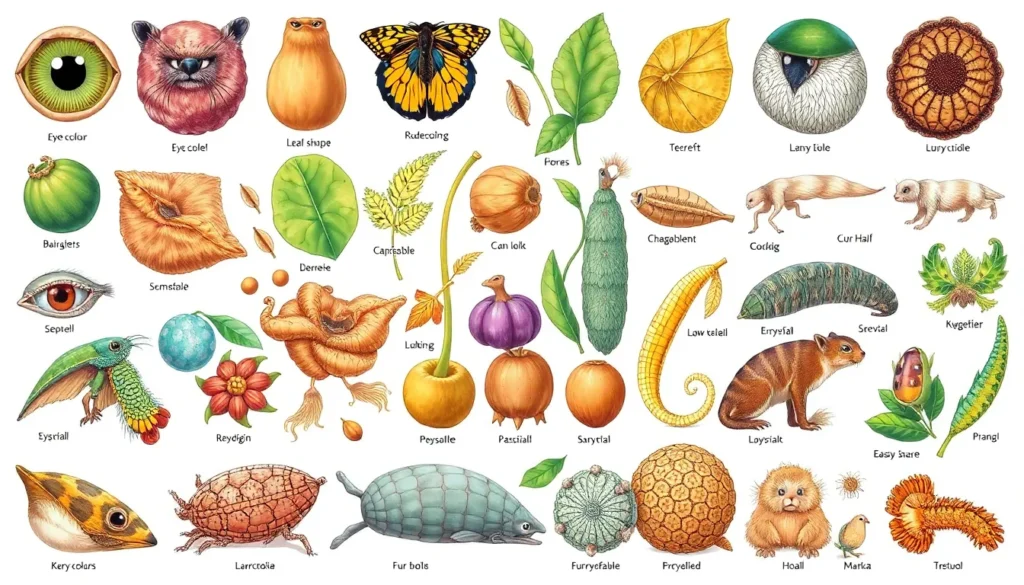
- Human Physical Characteristics: Height, eye color, hair texture, skin pigmentation, and facial features.
- Animal Physical Characteristics: Fur color, pattern, beak shape, wing span, and body size.
- Plant Physical Characteristics: Leaf shape, flower color, stem thickness, and seed size.
- Non-living Objects: Metal hardness, wood grain pattern, fabric texture, and glass transparency.
Why It Matters
Physical characteristics are essential for identification and classification across various disciplines. In biology, they help distinguish species and understand evolutionary relationships. In medicine, recognizing physical traits can assist in diagnosing genetic conditions. In forensic science, physical characteristics can be critical for identifying individuals or materials involved in criminal investigations. Moreover, understanding physical traits supports agricultural practices, environmental monitoring, and material science.
Common Misconceptions
Misconception: Physical characteristics are always genetically determined.
Correction: While many physical traits have a genetic basis, environmental factors can also influence their expression, such as nutrition affecting height.
Misconception: Physical characteristics and behavioral traits are the same.
Correction: Physical characteristics refer to observable physical traits, whereas behavioral traits involve actions or responses, which are not necessarily visible features.
Pros and Cons
Comparison Table
| Aspect | Physical Characteristic | Alternative/Related Topic (Genetic Characteristic) |
|---|---|---|
| Meaning | Observable traits or features visible or measurable directly | Traits determined by an organism’s DNA sequence, often not directly observable |
| Detection | Through direct observation or simple measurement | Requires genetic testing or molecular analysis |
| Influence | Influenced by genetics and environment | Determined solely by genetic makeup |
| Examples | Eye color, height, leaf shape | Blood type, genetic disorders, inherited mutations |
Decision Checklist
- Use this if: You need to identify or describe an organism or object based on visible or measurable traits.
- Avoid this if: You require information about genetic makeup or molecular-level details.
- Check this first: Whether the trait is stable and reliably observable under current conditions.
What is the easiest way to understand Physical Characteristics?
The easiest way to understand physical characteristics is to think of them as the visible or tangible features of an organism or object—such as color, size, or shape—that anyone can observe without special equipment. They represent the outward appearance and measurable properties that help distinguish one entity from another.
FAQ
What distinguishes a physical characteristic from a genetic characteristic?
A physical characteristic is an observable trait such as height or color, while a genetic characteristic refers to the underlying DNA sequence that may or may not be directly observable.
Can physical characteristics change over time?
Yes, some physical characteristics can change due to environmental influences, aging, or health conditions.
Are physical characteristics always inherited?
Not always; while many physical characteristics have a genetic basis, environmental factors can also affect their expression.


Leave a Reply