
Short Answer
Overview
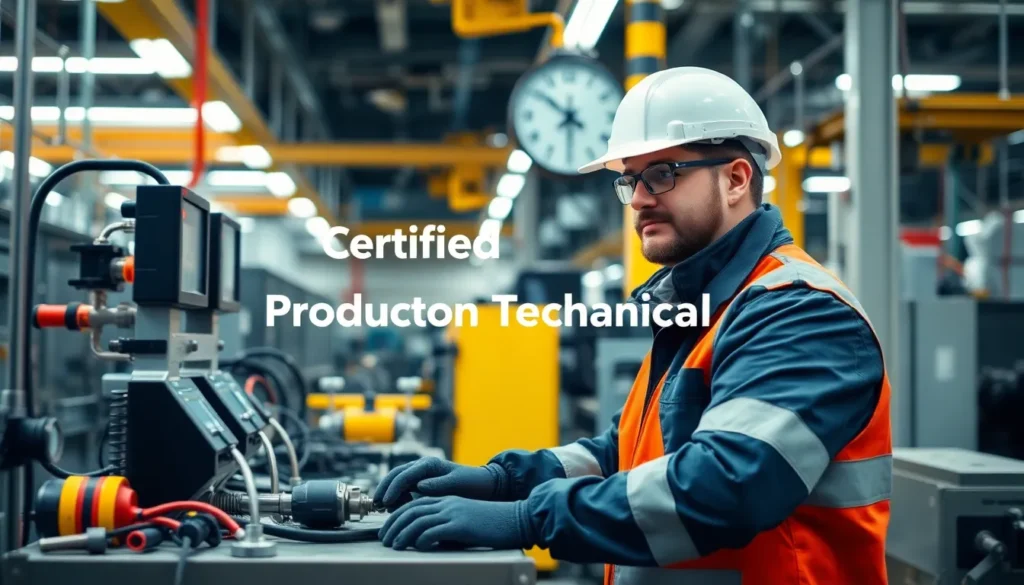
A Certified Production Technician (CPT) is a professional credential intended for individuals working or aspiring to work in manufacturing and production environments. The certification is designed to validate foundational skills and knowledge essential for effective and efficient production operations. It typically covers multiple core areas relevant to manufacturing, including safety protocols, quality control, manufacturing processes, and equipment maintenance.
Detailed Explanation
The CPT credential is often aligned with industry standards and aims to ensure that certified individuals possess a baseline level of technical competence. The certification encompasses several critical domains:
- Safety: Understanding workplace safety regulations and practices to prevent accidents and comply with legal requirements.
- Quality Practices and Measurement: Knowledge of quality control principles, inspection methods, and measurement techniques to maintain product standards.
- Manufacturing Processes and Production: Familiarity with manufacturing workflows, equipment operation, and process optimization.
- Maintenance Awareness: Basic understanding of equipment maintenance to support operational reliability.
The CPT certification is typically awarded after completion of a structured training program and successful passing of an assessment exam that evaluates competency in these areas.
How It Works
The process to become a Certified Production Technician generally involves several steps:
- Training: Candidates engage in educational courses or workshops that cover the CPT core areas. These may be administered by technical schools, community colleges, or industry organizations.
- Assessment: After training, candidates take a comprehensive exam consisting of multiple-choice questions that test knowledge and application skills across the defined content domains.
- Certification: Candidates who meet or exceed the required score receive the CPT credential, which may be valid for a specified period and require renewal.
- Recertification: To maintain certification status, individuals may need to demonstrate continued professional development or retake the assessment periodically.
Examples
- Entry-Level Manufacturing Technician: An individual with a CPT credential may work as a production line operator responsible for machine setup, monitoring, and ensuring product quality.
- Maintenance Assistant: A technician certified as a CPT can assist in routine equipment maintenance, troubleshooting basic mechanical issues, and supporting maintenance teams.
- Quality Control Inspector: CPT holders can perform inspections and measurements on production outputs to ensure compliance with quality standards.
Pros and Cons
- Pros: Enhances employability by validating essential manufacturing skills; supports career advancement; promotes workplace safety and quality awareness; recognized by various industries and employers.
- Cons: Certification may require time and financial investment; periodic recertification can be necessary; may not cover highly specialized technical skills beyond the foundational scope.
Comparison Table
| Aspect | Certified Production Technician (CPT) | Alternative/Related Topic: Manufacturing Technician Certification |
|---|---|---|
| Meaning | A certification validating core skills in safety, quality, production, and maintenance awareness for manufacturing roles. | Broader certifications that may include specialized technical or engineering competencies beyond basic production skills. |
| Focus Areas | Safety, quality practices, manufacturing processes, maintenance awareness. | May include more advanced technical knowledge such as robotics, automation, or engineering design. |
| Target Audience | Entry-level production workers and technicians. | Technicians with specialized or advanced manufacturing roles. |
Decision Checklist
- Use this if: You seek to establish foundational manufacturing skills and improve employability in production roles.
- Avoid this if: You require specialized technical certification beyond foundational production knowledge.
- Check this first: Whether the CPT certification is recognized by your intended employer or industry sector.
What is the easiest way to understand Certified Production Technician?
The easiest way to understand a Certified Production Technician is to view it as a professional credential that confirms a person has mastered the essential skills and knowledge needed to work safely and effectively in a manufacturing or production environment. It signals to employers that the individual can handle core tasks related to safety, quality, production processes, and basic maintenance.
FAQ
What skills does a Certified Production Technician have?
A Certified Production Technician has demonstrated skills in workplace safety, quality control, manufacturing processes, and basic maintenance awareness essential for production roles.
How long does it take to become a Certified Production Technician?
The duration varies but generally involves several weeks to months of training followed by an assessment exam.
Is the Certified Production Technician certification recognized by employers?
Yes, many employers in manufacturing industries recognize the CPT certification as a marker of foundational competency and readiness for production roles.






Leave a Reply