
Short Answer
Overview
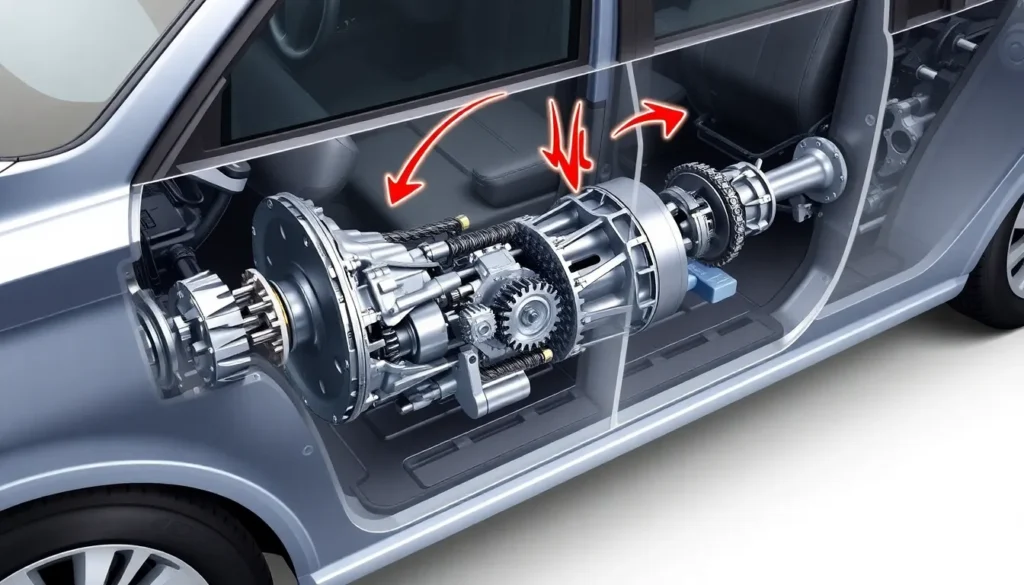
A transfer case is a mechanical component found in vehicles equipped with four-wheel drive (4WD) or all-wheel drive (AWD) systems. Its primary function is to receive power from the transmission and distribute it to both the front and rear axles. This distribution allows the vehicle to engage multiple wheels simultaneously, enhancing traction and driving performance on challenging surfaces such as off-road terrain, snow, or mud.
Detailed Explanation
Typically located behind the transmission, the transfer case is connected to the transmission output shaft. It contains gears and sometimes a chain that splits power between the vehicle’s axles. Some transfer cases provide multiple drive modes, including two-wheel drive, four-wheel drive high range, and four-wheel drive low range, which alters the gear ratio to provide added torque for slow, rugged driving conditions.
Transfer cases can be either part-time or full-time. Part-time transfer cases require the driver to manually engage 4WD mode, while full-time transfer cases automatically distribute power between axles as needed. Certain transfer cases also incorporate a center differential, allowing for differences in rotational speed between the front and rear axles, which improves drivability on paved roads.
How It Works
The transfer case receives rotational power from the transmission output shaft. Internally, it uses gears or a chain system to split this power between two output shafts—one leading to the front axle and the other to the rear axle. In some designs, the transfer case can alter the torque split between front and rear axles, either fixed or variable, to optimize traction.
In vehicles equipped with a low-range gear, the transfer case can engage a reduction gear set to multiply torque at lower speeds, which is particularly useful in off-road situations requiring more power and control. Engagement can be mechanical via a lever, electric via a switch, or automatic in advanced systems.
Examples
- Part-Time 4WD Transfer Case: Common in trucks and SUVs, this type requires the driver to manually shift from 2WD to 4WD using a lever or switch. It usually does not have a center differential, making it most suitable for off-road use.
- Full-Time 4WD Transfer Case: Found in vehicles designed for both on-road and off-road use, this transfer case includes a center differential or viscous coupling, allowing continuous power delivery to both axles with the ability to accommodate different wheel speeds.
- Electronic Transfer Case: Utilized in modern vehicles, these transfer cases use electronic actuators to engage 4WD modes automatically or on-demand, often integrated with traction control and stability systems.
Why It Matters
The transfer case is essential for vehicles that require enhanced traction and control across varying terrain conditions. By distributing engine power to all wheels, it improves vehicle stability, off-road capability, and safety in adverse weather conditions. Without a transfer case, vehicles would be limited to two-wheel drive, which can reduce performance on slippery or uneven surfaces.
Common Misconceptions
Misconception: A transfer case is the same as a differential.
Correction: While both distribute power, a transfer case splits power between front and rear axles, whereas differentials split power between wheels on the same axle.
Misconception: All four-wheel drive vehicles have a transfer case.
Correction: While most traditional 4WD and AWD vehicles have transfer cases, some modern AWD systems use electronic differentials and other components instead.
Pros and Cons
Comparison Table
| Aspect | Transfer Case | Transmission |
|---|---|---|
| Meaning | Component that distributes power between front and rear axles in 4WD/AWD vehicles. | System that transmits engine power to the driveshaft and ultimately to wheels. |
| Function | Splits and manages torque distribution between axles. | Converts engine speed and torque to drive wheels at different speeds. |
| Location | Behind the transmission, connected to output shaft. | Between the engine and transfer case (in 4WD vehicles) or driveshaft. |
| Drive Modes | Enables 2WD, 4WD high, 4WD low (in some models). | Manages gear ratios for different speeds and power. |
Decision Checklist
- Use this if: Your vehicle requires enhanced traction for off-road or slippery conditions.
- Avoid this if: You only drive on paved roads and do not need 4WD/AWD capabilities.
- Check this first: Your vehicle’s drivetrain configuration and whether it already includes a transfer case or equivalent system.
What is the easiest way to understand a Transfer Case on a Car?
The simplest way to understand a transfer case is to think of it as a power splitter that takes the engine’s rotational force and sends it to both the front and rear wheels. This allows the vehicle to drive all four wheels either simultaneously or selectively, which improves traction and control depending on driving conditions.
FAQ
What does a transfer case do in a car?
A transfer case receives power from the transmission and distributes it to both the front and rear axles, enabling four-wheel or all-wheel drive capability.
Can a car operate without a transfer case?
Yes, vehicles with two-wheel drive do not have or need a transfer case, as power is only delivered to either the front or rear wheels.
How often should transfer case fluid be changed?
Transfer case fluid should generally be changed every 30,000 to 60,000 miles, but it varies by manufacturer recommendations and driving conditions.


Leave a Reply