
Short Answer
Overview
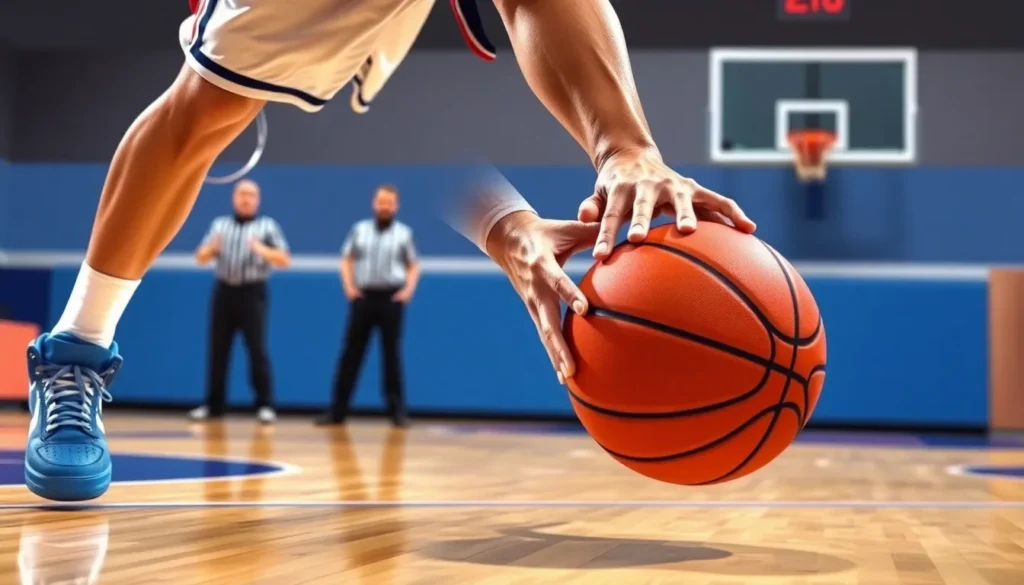
In basketball, a carry (also known as a palming violation) occurs when a player handling the ball violates dribbling rules by momentarily holding, carrying, or resting the ball in their hand while dribbling. It is considered an illegal move as it provides an unfair advantage in ball control and can disrupt the flow of the game. Understanding what constitutes a carry is important for players, coaches, referees, and fans to recognize legal and illegal ball handling.
Detailed Explanation
A carry violation is generally called when the player dribbling the basketball allows the ball to come to rest in one or both hands before continuing the dribble. This often involves the player placing their hand underneath the ball or turning their palm upward, which gives the appearance of “carrying” the ball. The rules governing carries are designed to ensure that dribbling remains a continuous motion without the ball being securely held.
Official basketball rules vary slightly by league (such as NBA, NCAA, and FIBA), but all prohibit carrying because it can give the ball handler an unfair advantage by allowing for better control, deceptive moves, or changes in dribbling speed and direction that are not allowed under legal dribbling.
How It Works
During a dribble, a player must continuously bounce the ball on the floor using one hand without allowing the ball to rest in the hand. A carry violation typically occurs if:
- The hand slides underneath the ball, causing the ball to come to rest momentarily.
- The ball is turned over or rotated excessively while in contact with the hand, breaking the continuous dribble motion.
- The player pauses the dribble by holding the ball before continuing.
Referees watch for these infractions and call a turnover when a carry is detected, awarding the ball to the opposing team.
Examples
- Example 1: A player dribbles the ball, then places their palm under the ball, momentarily holding it before continuing the dribble. This is considered a carry and results in a turnover.
- Example 2: While driving to the basket, a player briefly cupps the ball with both hands during the dribble, gaining better control before releasing the ball again. This is an illegal carry.
- Example 3: A player receives the ball, begins to dribble, but their hand slides underneath the ball as they change direction, causing the ball to stop momentarily. This is a carry violation.
Why It Matters
Carrying disrupts the fairness and flow of basketball by allowing players to gain an advantage in ball control that is not consistent with the intended continuous dribbling motion. Enforcing carry rules helps maintain standardized gameplay, ensuring that all players abide by the same regulations and preserving the integrity of the sport. It also prevents deceptive ball handling that could confuse defenders unfairly.
Common Misconceptions
Misconception: Any slight change in dribbling hand position is a carry.
Correction: Not all changes in hand position are carries; the ball must come to rest or be clearly palmed for it to be a violation.
Misconception: Carry violations always get called at all levels of play.
Correction: The enforcement of carry rules can vary based on referee interpretation and level of play, with some amateur games calling it less strictly than professional leagues.
Pros and Cons
Pros: Enforcing carry rules maintains fairness and uniformity in dribbling; it prevents unfair advantages and keeps the game flowing smoothly.
Cons: The rule can be subjective, leading to inconsistent calls; it may interrupt the natural flow or creativity of some players’ dribbling styles.
Comparison Table
| Aspect | Carry in Basketball | Traveling Violation |
|---|---|---|
| Meaning | Illegal handling of the ball during dribbling by momentarily holding or palming it. | Illegal movement of the feet without dribbling after gaining control of the ball. |
| When Called | During dribbling if the ball is carried or palmed. | When a player takes too many steps without dribbling. |
| Result | Turnover awarded to opposing team. | Turnover awarded to opposing team. |
Decision Checklist
What is the easiest way to understand a Carry in Basketball?
The easiest way to understand a carry is to imagine dribbling as a smooth, continuous bouncing of the ball without ever holding or stopping it in your hand. If you catch the ball or let it rest in your palm before bouncing again, that’s a carry.
FAQ
What exactly constitutes a carry in basketball?
A carry occurs when the player dribbling the basketball allows the ball to come to rest in one or both hands or places the hand underneath the ball, resulting in an illegal pause in the dribble.
Is a carry the same as a travel?
No, a carry is related to illegal handling of the ball during dribbling, while traveling involves illegal movement of the feet without dribbling the ball.
How do referees detect a carry?
Referees look for moments when the ball appears to stop or rest in the player's hand, or when the player's hand slides underneath the ball during a dribble, indicating a carry violation.





Leave a Reply