
Short Answer
Overview
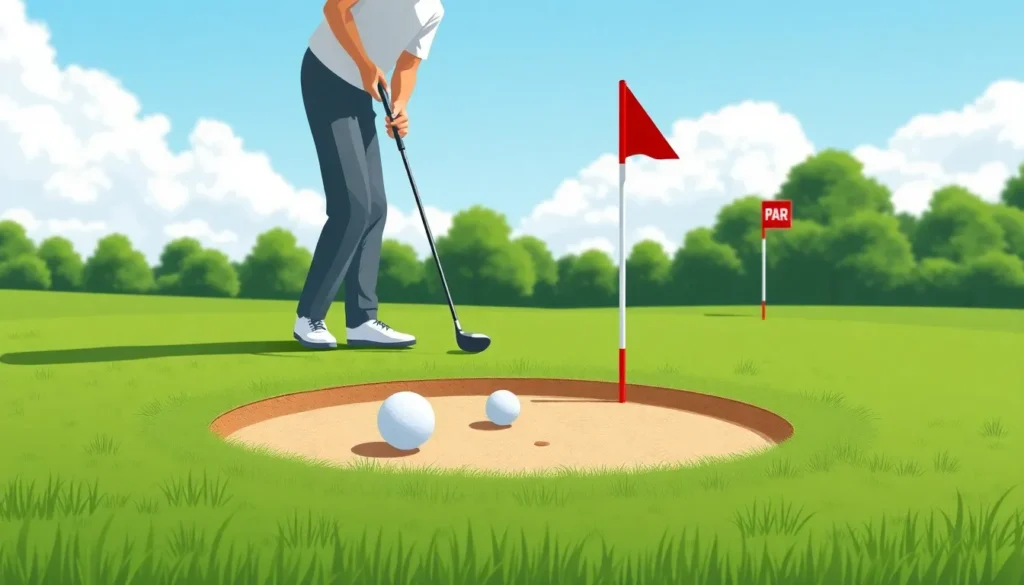
In golf, par is the predetermined number of strokes that a skilled golfer is expected to require to complete a hole, a round, or a tournament. It acts as a standard scoring measure, allowing players to compare their performance against an established benchmark. Par values for individual holes are typically set based on the hole’s length and difficulty, reflecting the number of shots an expert player should need to reach the green and complete the hole.
Detailed Explanation
Each golf hole is assigned a par value, usually ranging from three to five strokes. The total par for an 18-hole golf course is commonly between 70 and 72, although this can vary. The assignment of par takes into account the distance from the tee box to the hole, as well as additional factors such as terrain, hazards, and elevation changes.
Holes classified as par 3 are generally shorter, where a golfer is expected to reach the green with a single stroke and then complete the hole in two putts. Par 4 and par 5 holes are longer, with par 4 holes often requiring two strokes to reach the green, and par 5 holes typically requiring three strokes to reach the green, followed by putting strokes to hole out.
How It Works
Par functions as a scoring target for each hole. Players aim to complete the hole in the fewest strokes possible, with their score expressed in relation to par:
- Birdie: One stroke under par
- Par: Equal to the designated par value
- Bogey: One stroke over par
- Double Bogey: Two strokes over par, and so forth
These terms help quantify a player’s performance relative to the expected standard. The cumulative score across all holes is often expressed as total strokes over or under par for the round.
Examples
- Par 3 Hole: A 150-yard hole where an expert golfer is expected to use one stroke to reach the green and then two putts to hole out, totaling three strokes.
- Par 4 Hole: A 400-yard hole where the golfer is expected to drive the ball close to the green in two strokes and then complete the hole with two putts.
- Par 5 Hole: A longer hole of about 550 yards where three strokes are expected to reach the green, followed by two putts.
Why It Matters
Par provides a universal standard that facilitates comparison of scores between players and across different golf courses. It aids in handicapping, tournament play, and casual scoring, establishing a common language for assessing golfing skill and performance. Without par, it would be difficult to gauge how well a player performs relative to the expected challenge of each hole and course.
Common Misconceptions
Misconception: Par is a fixed number for all holes.
Correction: Par varies by hole based on length and difficulty; not all holes have the same par value.
Misconception: Par represents an average score for all golfers.
Correction: Par is set according to expert or scratch golfers’ expected strokes, not the average player.
Pros and Cons
Comparison Table
| Aspect | Par | Stroke Index |
|---|---|---|
| Meaning | Expected number of strokes for expert completion | Ranking of hole difficulty for handicap purposes |
| Purpose | Benchmark for scoring | Determines handicap stroke allocation |
| Variability | Varies by hole length and difficulty | Varies by course design and setup |
Decision Checklist
- Use this if: You want to understand scoring standards in golf.
- Avoid this if: You are looking for average player scores rather than expert benchmarks.
- Check this first: The par rating of a course before comparing scores or handicaps.
What is the easiest way to understand Par?
Think of par as a target number of strokes that a very skilled golfer is expected to need to complete each hole. Scoring below par indicates better-than-expected performance, while scoring above par indicates a greater number of strokes than anticipated.
FAQ
What does par mean in golf?
Par is the number of strokes an expert golfer is expected to take to complete a hole or a round, serving as a scoring benchmark.
How is par determined for each hole?
Par is assigned based primarily on the hole's length, as well as factors like terrain and hazards, reflecting the expected number of strokes to reach the green and hole out.
Can par change on a golf course?
Yes, par can vary based on course design and setup, but it generally remains consistent unless a course is redesigned or altered.



Leave a Reply