
Short Answer
Overview
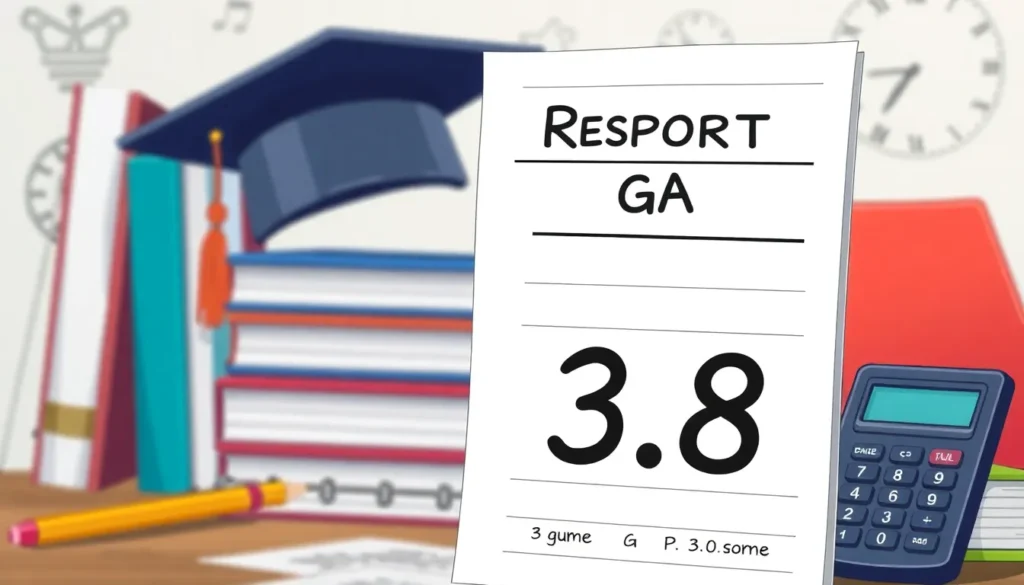
A 3.8 GPA (Grade Point Average) is a numerical representation of a student’s average performance across their courses, typically on a 4.0 scale. It indicates a high level of academic achievement, generally corresponding to mostly A grades with occasional A- or B+ grades. GPA is widely used in educational institutions in the United States to evaluate students’ academic standing and eligibility for programs, scholarships, and college admissions.
Detailed Explanation
The GPA system quantifies academic performance by assigning point values to letter grades. On the common 4.0 scale, an A is usually worth 4.0 points, an A- 3.7, a B+ 3.3, and so forth. A 3.8 GPA is therefore slightly below a perfect 4.0, suggesting that the student earned mostly As with few grades slightly lower than an A. This GPA is considered excellent and places the student well above average in most educational contexts.
How It Works
To calculate a GPA, each course grade is converted into grade points based on the grading scale used by the institution. These points are then averaged, often weighted by the number of credit hours per course, to produce the overall GPA. For example, if a student takes four courses with grades A (4.0), A- (3.7), A (4.0), and B+ (3.3), the average would be (4.0 + 3.7 + 4.0 + 3.3) / 4 = 3.75, close to a 3.8 GPA.
Examples
- A student with grades mostly of A and a few A- grades might have a 3.8 GPA.
- A high school senior applying to competitive colleges with a 3.8 GPA is generally considered a strong candidate.
- Some universities use weighted GPAs where honors or Advanced Placement (AP) classes add extra points, so a 3.8 weighted GPA might reflect even higher academic rigor.
Pros and Cons
Pros: A 3.8 GPA signifies strong academic performance, increasing opportunities for scholarships, college admissions, and competitive programs. It reflects consistent dedication and understanding of course material.
Cons: The GPA scale varies between institutions, and a 3.8 in one school may not exactly equate to the same academic standing in another. Additionally, focusing solely on GPA may overlook other important aspects of education such as extracurricular activities or personal development.
Comparison Table
| Aspect | 3.8 GPA | 4.0 GPA (Perfect) |
|---|---|---|
| Meaning | High academic achievement, mostly A grades with some slightly lower grades | Perfect academic achievement, all A grades |
| Typical Grade Range | Mostly A and A- grades | All A grades |
| Academic Standing | Excellent | Outstanding |
Decision Checklist
- Use this if you want to assess or communicate strong academic performance that is just below perfect.
- Avoid this if you require a precise measure of perfect academic achievement or are comparing across different grading scales without standardization.
- Check this first by confirming the grading scale used by the institution, as GPA calculations and scales can vary.
What is the easiest way to understand a 3.8 GPA?
The simplest way to understand a 3.8 GPA is to think of it as earning mostly A grades with a few grades slightly lower, such as A- or B+. It reflects a student who performs very well academically, close to the top of their class.
FAQ
Is a 3.8 GPA considered good?
Yes, a 3.8 GPA is considered very good and reflects strong academic performance, typically placing a student near the top of their class.
How is a 3.8 GPA calculated?
It is calculated by averaging the grade points assigned to each course grade, usually on a 4.0 scale, weighted by course credits if applicable.
Does a 3.8 GPA guarantee college admission?
While a 3.8 GPA is competitive, admission decisions also depend on other factors such as standardized test scores, extracurricular activities, essays, and institutional criteria.



Leave a Reply