
Short Answer
Overview
A fact family is a group of related mathematical operations that use the same set of numbers to show the relationship between addition and subtraction or multiplication and division. These families illustrate how numbers are connected through these inverse operations, helping learners understand the fundamental properties of arithmetic. Fact families are commonly used in elementary mathematics education to build number sense and fluency.
Detailed Explanation
Fact families consist of a set of three numbers that are related through addition and subtraction or multiplication and division. For addition and subtraction, a fact family includes two addition sentences and two subtraction sentences that use the same three numbers. Similarly, for multiplication and division, a fact family includes two multiplication sentences and two division sentences involving the same numbers.
These families emphasize the inverse relationship between the paired operations. For example, addition undoes subtraction, and multiplication undoes division. Understanding fact families aids in recognizing these relationships and applying them to solve problems more efficiently.
How It Works
To form a fact family, select three numbers where one number is the sum or product of the other two numbers. For addition/subtraction:
- Identify two addends and their sum.
- Write two addition sentences using the addends and sum.
- Write two subtraction sentences using the sum and addends.
For multiplication/division:
- Identify two factors and their product.
- Write two multiplication sentences using the factors and product.
- Write two division sentences using the product and factors.
These sentences together form the fact family, demonstrating how the numbers interrelate.
Examples
Addition and Subtraction Fact Family:
- Numbers: 3, 5, 8
- Addition: 3 + 5 = 8, 5 + 3 = 8
- Subtraction: 8 – 3 = 5, 8 – 5 = 3
Multiplication and Division Fact Family:
- Numbers: 2, 6, 12
- Multiplication: 2 × 6 = 12, 6 × 2 = 12
- Division: 12 ÷ 2 = 6, 12 ÷ 6 = 2
These examples clearly show how the same three numbers are used in four related equations that form a fact family, illustrating the inverse nature of the operations.
Why It Matters
Fact families are important in mathematics education because they promote a deeper understanding of the relationships between numbers and operations. By recognizing these connections, students develop number sense, improve their mental math skills, and gain confidence in solving arithmetic problems. Fact families also serve as a foundation for algebraic thinking by introducing the concept of inverse operations and equations.
Common Misconceptions
Misconception: Fact families only apply to addition and subtraction.
Correction: Fact families also apply to multiplication and division, as both pairs of operations are inverses of each other.
Misconception: A fact family can include any numbers.
Correction: Fact families must include three numbers where one number is the sum or product of the other two, ensuring the operations are valid and related.
Pros and Cons
Comparison Table
| Aspect | Fact Family | Individual Operations |
|---|---|---|
| Meaning | Set of related addition/subtraction or multiplication/division facts using the same numbers | Single arithmetic operations without explicit connection to related operations |
| Focus | Relationships between inverse operations | Computation of individual operations |
| Educational Use | Teaching number sense and arithmetic connections | Practicing calculation skills |
Decision Checklist
- Use this if: Teaching basic arithmetic concepts and inverse relationships.
- Avoid this if: Working with advanced mathematical operations beyond basic arithmetic.
- Check this first: Ensure the three numbers form a valid arithmetic relationship (sum/product and addends/factors).
What is the easiest way to understand Fact Families?
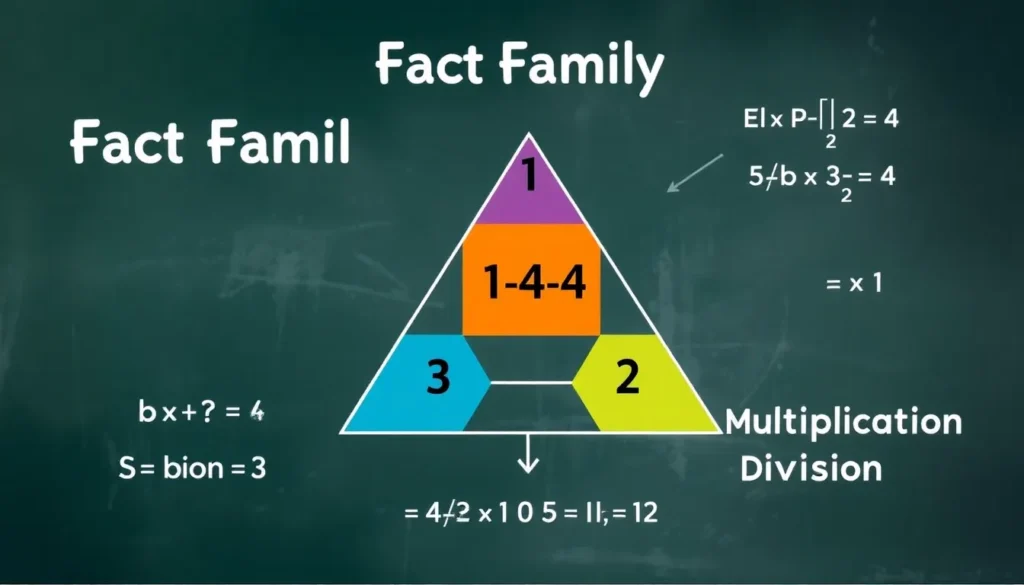
The easiest way to understand fact families is through concrete examples using small numbers. Start with simple addition and subtraction sets, like 2, 3, and 5, and write out all related addition and subtraction equations. Seeing how these numbers connect in multiple ways helps solidify the concept. Visual aids such as number bonds or fact family triangles can also make the relationships clearer and more intuitive.
FAQ
What is the main purpose of a fact family?
The main purpose of a fact family is to help learners understand the relationship between numbers and the inverse operations of addition/subtraction or multiplication/division.
Can fact families include more than three numbers?
Typically, fact families involve exactly three numbers to show the direct relationship between two addends/factors and their sum/product. Larger sets are not considered traditional fact families.
How do fact families help with learning math?
Fact families reinforce the concept of inverse operations, improve number sense, and support mental math skills by showing how numbers relate to each other in multiple ways.


Leave a Reply