
Short Answer
Overview
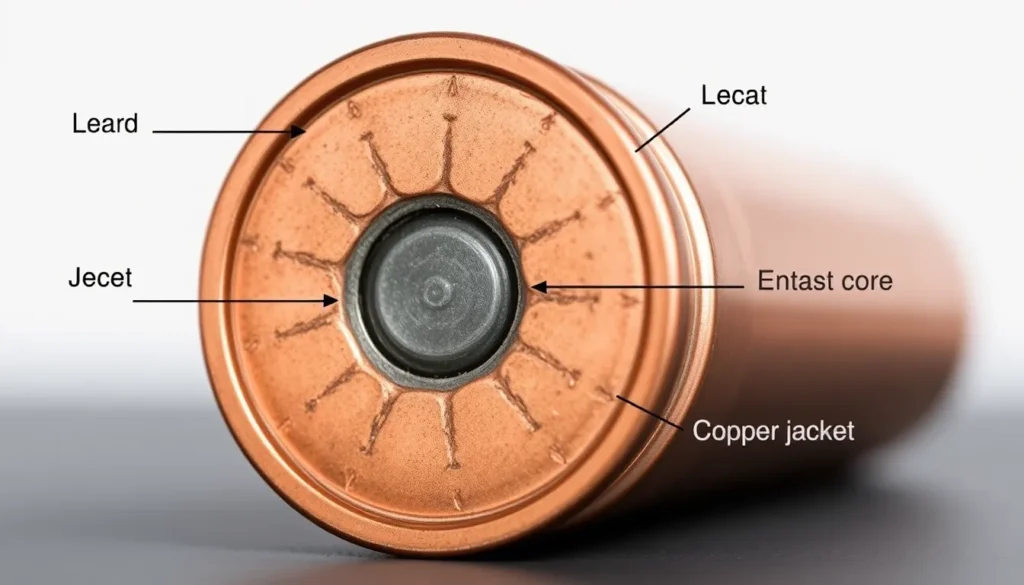
A jacketed bullet is a type of ammunition projectile that consists of a softer core material, typically lead, enclosed within a harder metal outer layer known as the jacket. This design is widely used in modern ammunition to improve ballistic performance, reduce barrel fouling, and enhance terminal effects upon impact. The jacket is often made from copper or copper alloys and serves multiple functions to optimize the bullet’s behavior during firing and impact.
Detailed Explanation
The core of a jacketed bullet is usually composed of lead because of its high density and malleability, which allows for better energy transfer upon impact. The outer jacket, made of copper, gilding metal, or similar alloys, encases the core and serves to protect it during firing. This jacket prevents the core from deforming prematurely and reduces the amount of lead deposited inside the gun barrel, a phenomenon known as barrel fouling.
Jacketed bullets come in various designs, including full metal jacket (FMJ), soft point (SP), and hollow point (HP), each tailored for specific ballistic characteristics and intended uses such as target shooting, hunting, or law enforcement.
How It Works
When a jacketed bullet is fired, the expanding gases from the gunpowder propel it through the firearm barrel. The harder jacket maintains the bullet’s shape and structural integrity as it travels, reducing deformation caused by the rifling inside the barrel. This helps maintain accuracy and velocity. Upon impact, the behavior of the bullet depends on its design: FMJ bullets typically penetrate targets deeply with minimal expansion, while soft point and hollow point bullets are designed to expand or fragment to increase stopping power and reduce over-penetration.
Examples
- Full Metal Jacket (FMJ): A lead core completely enclosed in a copper alloy jacket, commonly used in military and target shooting due to its reliable feeding and penetration.
- Soft Point (SP): Features a partially exposed lead tip with the remainder of the bullet jacketed, designed to expand upon impact for hunting applications.
- Hollow Point (HP): Incorporates a hollowed-out tip to promote controlled expansion and energy transfer, often used in self-defense and law enforcement ammunition.
Pros and Cons
- Pros: Enhanced bullet integrity during firing, reduced barrel fouling, improved accuracy, and tailored terminal performance depending on design.
- Cons: Typically more expensive to manufacture than non-jacketed bullets, potential for over-penetration in some designs, and environmental concerns regarding metal content.
Comparison Table
| Aspect | Jacketed Bullet | Non-Jacketed Bullet (Lead) |
|---|---|---|
| Meaning | A bullet with a metal jacket encasing a softer core | A bullet made entirely of lead without an outer jacket |
| Barrel Fouling | Minimal due to jacket preventing lead residue | Higher due to lead depositing inside the barrel |
| Accuracy | Generally higher because of maintained bullet shape | Potentially lower due to deformation during firing |
| Cost | Higher manufacturing cost | Lower manufacturing cost |
| Terminal Performance | Varies with design; can control expansion or penetration | Less controlled expansion and penetration |
Decision Checklist
- Use this if: You require consistent accuracy, reduced barrel fouling, or specific terminal effects for hunting, target shooting, or defense.
- Avoid this if: You prioritize lower ammunition cost or have environmental concerns about metal jackets.
- Check this first: The firearm’s compatibility with jacketed bullets and the intended application (e.g., hunting regulations may restrict bullet types).
What is the easiest way to understand Jacketed Bullets?
The simplest way to understand a jacketed bullet is to think of it as a lead bullet wrapped in a metal shell. This shell helps the bullet keep its shape when fired and controls how it behaves when it hits a target, making it more effective and less damaging to the firearm.
FAQ
Why do jacketed bullets reduce barrel fouling?
Jacketed bullets reduce barrel fouling because the harder metal jacket prevents the softer lead core from depositing material inside the firearm barrel during firing, maintaining cleaner barrels and consistent accuracy.
Are jacketed bullets better than lead bullets?
Jacketed bullets generally offer better performance in terms of accuracy, reduced barrel fouling, and controlled terminal effects. However, they are more expensive and may not be necessary for all shooting applications.
What are the typical materials used for bullet jackets?
Bullet jackets are commonly made from copper or copper alloys such as gilding metal, chosen for their hardness and malleability, which protect the core and improve bullet performance.




Leave a Reply