

Short Answer
Overview
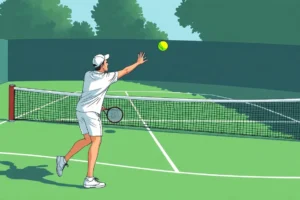
An ace in tennis refers to a serve that the receiving player cannot touch with their racket, resulting directly in a point for the server. It is considered a highly effective serve as it requires no subsequent shots to win the point. An ace is a testament to the server’s skill, combining speed, placement, and sometimes spin to make the ball unreachable.
Detailed Explanation
In competitive tennis, the serve is the starting shot for every point. When a player delivers an ace, the ball lands within the service box and travels too fast or is placed too accurately for the opponent to return. The opponent’s failure to touch the ball distinguishes an ace from a winning serve that may involve a return attempt. Aces can vary in style, including flat, slice, or kick serves, each designed to maximize difficulty for the receiver.
How It Works
To achieve an ace, the server must combine several factors. These include:
- Speed: Faster serves reduce the reaction time of the receiver.
- Placement: Serving close to the edges of the service box or corners makes the ball harder to reach.
- Spin: Certain spins can cause the ball to bounce unpredictably.
During a match, an ace is recorded as a point immediately awarded to the server. It is also tracked statistically as an indicator of serving effectiveness.
Examples
- A player serving at 130 miles per hour lands the ball just inside the service box near the opponent’s sideline, and the opponent fails to react in time, resulting in an ace.
- Using a kick serve that bounces high and away from the receiver’s reach, the server scores an ace despite the opponent’s attempt to move into position.
- In professional matches, players like Serena Williams and Roger Federer have been noted for their high number of aces, showcasing their serving prowess.
Pros and Cons
Pros:
- Gains a quick point without extended rallies.
- Can boost the server’s confidence and momentum.
- Applies pressure on the opponent’s serve return game.
Cons:
- Attempting aces may increase the risk of double faults if the serve misses the service box.
- Overreliance on aces can reduce consistency.
- Some courts or conditions may limit the effectiveness of aces.
Comparison Table
| Aspect | Ace in Tennis | Double Fault |
|---|---|---|
| Meaning | A serve untouched by the receiver, winning the point instantly. | Two consecutive failed serves, resulting in loss of point. |
| Outcome | Point to server. | Point to opponent. |
| Risk | Medium, requires accuracy and speed. | High, causes immediate loss of point. |
| Frequency | Varies by player skill and style. | Generally low, but can increase under pressure. |
Decision Checklist
- Use this if: You want to gain a quick point and have a strong, accurate serve.
- Avoid this if: You are inconsistent with your serve placement or under high pressure that may cause faults.
- Check this first: Your serving technique, current match conditions, and opponent’s return skills.
What is the easiest way to understand an Ace In Tennis?
The simplest way to understand an ace is to think of it as a serve that your opponent cannot touch at all, immediately winning you the point. It is the most direct way to score from a serve in tennis.
FAQ
Can an ace occur on any serve?
Yes, an ace can occur on any valid serve that lands within the service box and is not touched by the receiver.
Is an ace always a fast serve?
Not necessarily; while speed helps, precise placement and spin can also produce an ace.
Are aces more common in men's or women's tennis?
Aces tend to be more frequent in men's tennis due to generally higher serve speeds, but many female players also excel at serving aces.




Leave a Reply