
Short Answer
Overview
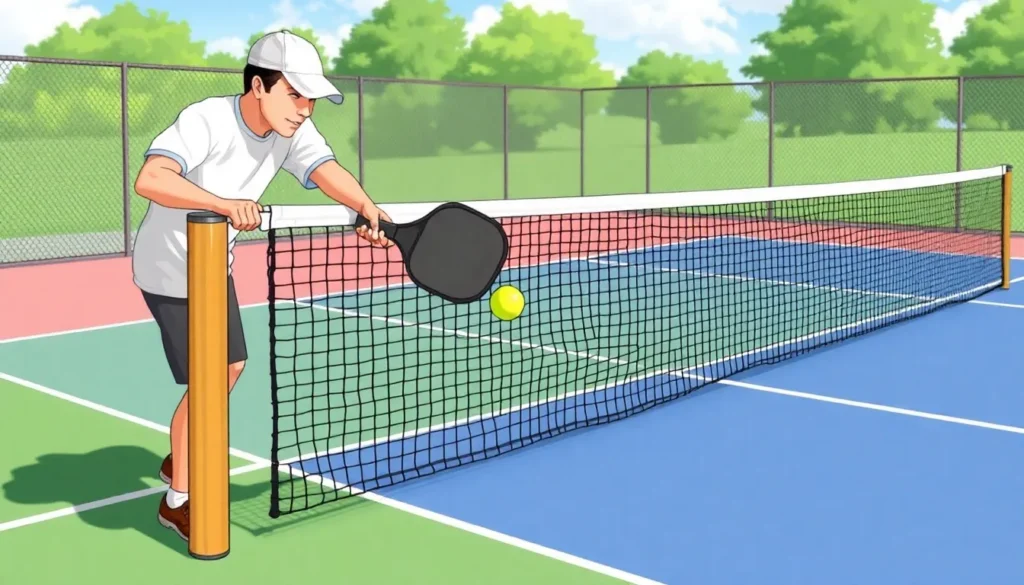
In pickleball, a “dink” refers to a soft, strategic shot played near the net that lands within the opponent’s non-volley zone (also called the kitchen). It is designed to be low and slow to limit the opponent’s offensive options, often encouraging errors or setting up a more advantageous position for the dinking player or their partner. The dink shot is a fundamental skill in pickleball, emphasizing control and placement over power.
Detailed Explanation
The dink is characterized by its gentle, controlled trajectory and low bounce, typically executed with a paddle close to the net. Unlike aggressive groundstrokes or volleys, dinks require precision and patience. The shot is usually performed when both teams are near the net, engaging in a subtle exchange often referred to as a “dinking battle.” The goal is to maintain the ball in play while minimizing the opponent’s ability to generate a strong return.
How It Works
Players use the dink to strategically place the ball in the opponent’s non-volley zone, forcing them to respond with a delicate shot or risk hitting the ball out of bounds or into the net. Because players in this zone cannot volley the ball (hit it in the air before it bounces), the dink exploits this rule by making it difficult to attack. Executing an effective dink involves soft wrist action, controlled paddle movement, and careful positioning to keep the ball low and within the kitchen.
Examples
- A player at the net softly taps the ball just over the net to land in the opponent’s kitchen, preventing an aggressive return.
- During a doubles match, partners engage in a series of dinks, each attempting to place the ball where the opposing team is less prepared to respond.
- A player uses a dink to move the opponent laterally along the net, creating an opening for a subsequent offensive shot.
Pros and Cons
Pros:
- Encourages strategic play and precision.
- Reduces opponent’s ability to execute powerful shots.
- Can create openings by forcing errors or weak returns.
- Essential for effective net play and doubles strategy.
Cons:
- Requires significant control and practice to master.
- Can be less effective against highly skilled opponents adept at dinking.
- May slow down the pace of the game, which some players may find less engaging.
- Incorrect execution can result in easy points for the opponent.
Comparison Table
| Aspect | Dink in Pickleball | Alternative/Related Shot (Drive) |
|---|---|---|
| Meaning | A soft shot landing in the non-volley zone to create tactical advantage. | An aggressive, fast-paced groundstroke aimed to overpower the opponent. |
| Purpose | To control the pace and force errors. | To win points by power and speed. |
| Execution | Soft paddle contact with controlled placement. | Strong paddle swing with power. |
| Typical Location | Near the net, landing inside the non-volley zone. | Further back on the court, typically beyond the non-volley zone. |
Decision Checklist
- Use this if you want to slow down the rally and force your opponent into a difficult return.
- Avoid this if you lack control or the opponent is aggressively skilled at dinking.
- Check this first your positioning and paddle control to ensure the dink remains low and within the kitchen.
What is the easiest way to understand a Dink in Pickleball?
The easiest way to understand a dink is to think of it as a soft, gentle tap that barely clears the net and lands in the opponent’s non-volley zone. It’s less about power and more about finesse, designed to limit the opponent’s options and create strategic opportunities during net play.
FAQ
What is the main purpose of a dink in pickleball?
The main purpose of a dink is to place the ball softly into the opponent's non-volley zone to reduce their ability to make an aggressive return, forcing errors or weak shots.
Can you volley a dink shot?
No, by definition, a dink lands in the non-volley zone, where players are not allowed to volley; the ball must bounce before being played.
Is the dink shot used more in singles or doubles?
While dinks are used in both formats, they are especially strategic and common in doubles, where net play and controlling the kitchen are integral to the game.





Leave a Reply