
Short Answer
Overview
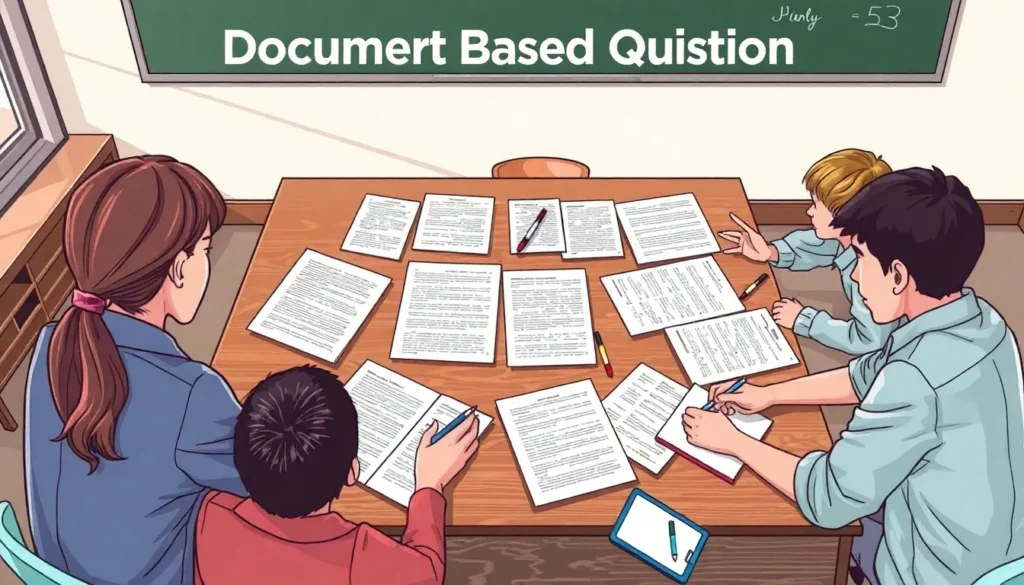
A Document Based Question (DBQ) is a type of assessment commonly used in educational settings, particularly in history and social studies courses. It challenges students to examine and interpret a set of provided documents—such as texts, images, charts, or speeches—and use evidence from these sources to answer a specific question or prompt. The DBQ format emphasizes critical thinking, analytical skills, and the ability to integrate multiple pieces of information into a structured written response.
Detailed Explanation
The DBQ typically consists of a prompt or question related to a particular historical event, theme, or issue, accompanied by a collection of several primary and/or secondary source documents. These documents serve as evidence that students must analyze, compare, and contrast to develop a well-reasoned argument or explanation. Unlike traditional essay questions that may rely heavily on students’ prior knowledge, the DBQ provides the source material needed to support an answer, requiring students to engage directly with historical evidence.
DBQs are designed to assess multiple skills simultaneously, including document analysis, synthesis of information, contextual understanding, and written communication. They encourage students to interpret the author’s perspective, identify bias or point of view, and understand the historical context surrounding the documents.
How It Works
Students begin by carefully reading the prompt to understand the question being asked. They then review each document, noting key information, perspective, purpose, and relevance to the prompt. Effective DBQ responses integrate multiple documents to support a central thesis or argument.
The process often involves the following steps:
- Reading and analyzing: Examine each document for content, perspective, and context.
- Grouping documents: Organize documents by themes or arguments to structure the essay.
- Developing a thesis: Formulate a clear response or argument based on the evidence.
- Writing the essay: Introduce the thesis, use evidence from the documents to support claims, and provide analysis linking the documents to the prompt.
- Citing documents: Reference documents appropriately to demonstrate engagement with the sources.
Examples
- Historical DBQ: A DBQ asking students to analyze causes of the American Revolution using excerpts from colonial newspapers, letters from British officials, and political pamphlets.
- Social Studies DBQ: Analyzing the impact of the Industrial Revolution through factory records, worker diaries, and government reports.
- Literature DBQ: Examining authors’ perspectives on war using letters, speeches, and poems from different time periods.
Why It Matters
The DBQ format is significant because it promotes critical engagement with primary sources, which helps students develop historical thinking skills. It moves beyond rote memorization to encourage interpretation and evaluation of evidence, skills that are valuable in academic and real-world contexts. Additionally, DBQs prepare students for standardized assessments and college-level writing by combining research, analysis, and argumentation.
Common Misconceptions
Misconception: A DBQ is just a summary of the documents.
Correction: A DBQ requires more than summarizing; it demands analysis, synthesis, and the construction of a cohesive argument supported by the documents.
Misconception: External knowledge is not necessary for a DBQ.
Correction: While the provided documents are central, incorporating relevant outside knowledge can strengthen the argument and provide important context.
Pros and Cons
Comparison Table
| Aspect | Document Based Question (DBQ) | Traditional Essay Question |
|---|---|---|
| Meaning | Assessment requiring analysis of provided documents to answer a question. | Assessment based primarily on prior knowledge and reasoning without provided documents. |
| Source Material | Includes several primary and/or secondary source documents. | Relies on student’s existing knowledge and memory. |
| Skills Tested | Document analysis, synthesis, critical thinking, argumentation. | Argumentation and writing skills, less emphasis on source analysis. |
| Use Case | Common in history and social studies assessments. | Common across many subjects, including literature and science. |
Decision Checklist
- Use this if: You want to assess students’ ability to analyze and synthesize information from multiple sources.
- Avoid this if: Students have limited reading or analytical skills, or if time constraints are severe.
- Check this first: Ensure students understand document analysis techniques and have sufficient background knowledge.
What is the easiest way to understand a Document Based Question?
The easiest way to understand a DBQ is to view it as a guided research project: you are given a set of documents as your evidence and asked to answer a question by interpreting that evidence. Start by carefully reading the prompt and each document, then think about how they relate to each other and to the question. Organize your thoughts around a clear argument supported by the information found in the documents.
FAQ
What is the main purpose of a Document Based Question?
The main purpose of a DBQ is to assess a student's ability to analyze and synthesize information from provided documents to develop a coherent argument in response to a specific question.
Are DBQs only used in history classes?
While DBQs are most common in history and social studies classes, they can also be used in other subjects that involve analysis of documents, such as literature or political science.
How can students prepare for DBQs?
Students can prepare by practicing document analysis skills, learning to identify author perspective and bias, improving their essay writing abilities, and gaining familiarity with historical context relevant to the documents.





Leave a Reply