
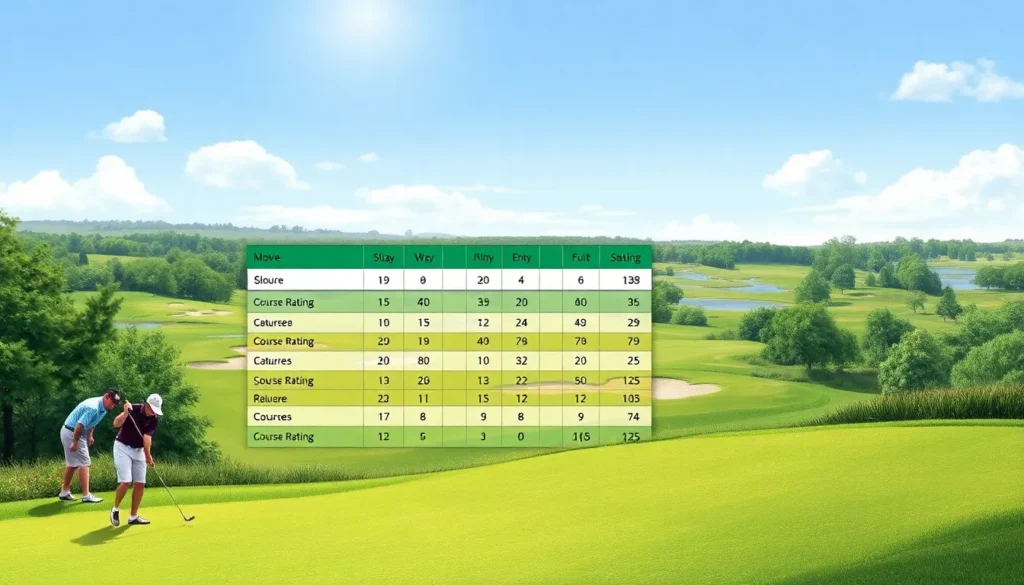
Short Answer
Overview
The slope rating of a golf course is a standardized numerical value that reflects the relative difficulty of a golf course for a bogey golfer compared to a scratch golfer. It is used primarily in the United States and Canada as part of the USGA Course Rating System to help golfers gauge how challenging a particular course will be based on its design, length, and hazards. The slope rating assists players in adjusting their handicaps when playing different courses, ensuring fair competition.
Detailed Explanation
The slope rating is expressed as an integer value ranging from 55 to 155, with 113 designated as the standard average slope. A slope rating of 113 implies that the course presents average difficulty relative to other golf courses. Values above 113 indicate a course is more challenging for the typical bogey golfer relative to a scratch golfer, while values below 113 suggest an easier course for the bogey golfer.
This rating is derived through a detailed assessment of the course by authorized evaluators who consider factors such as the length of each hole, the presence and severity of hazards (e.g., bunkers, water hazards), green speed and size, fairway width, rough height, elevation changes, and overall course layout. The goal is to quantify how these elements affect a higher-handicap player compared to a low-handicap player.
How It Works
The slope rating is part of the broader USGA Handicap System and works alongside the course rating, which estimates the expected score for a scratch golfer under normal playing conditions. While the course rating focuses on expert players, the slope rating measures the additional difficulty a bogey golfer faces.
When a golfer plays a course, their handicap index can be adjusted based on the slope rating to calculate a course handicap. This adjustment allows players of different skill levels to compete fairly by accounting for how much more difficult a course might be for an average player versus an expert.
Mathematically, the slope rating is used in the following formula to compute the course handicap:
Course Handicap = (Handicap Index) × (Slope Rating / 113) + (Course Rating - Par)
This formula ensures that the player’s handicap is scaled according to the relative difficulty indicated by the slope rating.
Examples
- Example 1: A golf course has a slope rating of 120. For a player with a handicap index of 15, the course handicap would be slightly higher than 15 due to the increased difficulty compared to the standard slope of 113.
- Example 2: Another course has a slope rating of 90, indicating it is easier than average for a bogey golfer. A player with a handicap index of 20 would receive a lower course handicap when playing this course.
- Example 3: A championship-level course might have a slope rating near 155, the maximum value, signifying a very challenging course for average players, often due to length and numerous hazards.
Why It Matters
The slope rating is important because it helps level the playing field among golfers of varying skill levels. Without it, players might have an unfair advantage or disadvantage when playing courses that are significantly easier or harder than average. By incorporating slope ratings into handicap calculations, golfers can compete more equitably, regardless of the course they play.
Common Misconceptions
A higher slope rating means the course is more difficult for all golfers.
A higher slope rating specifically indicates greater difficulty for bogey golfers relative to scratch golfers, not necessarily for all skill levels equally.
The slope rating measures absolute difficulty.
The slope rating measures relative difficulty between bogey and scratch golfers, while the course rating estimates absolute difficulty for scratch golfers.
Pros and Cons
- Pros:
- Provides a standardized measure of course difficulty for average golfers.
- Enables fair handicap adjustments across different courses.
- Helps golfers select courses that match their skill level.
- Cons:
- May be confusing to casual players unfamiliar with handicap systems.
- Does not reflect difficulty for players outside the bogey and scratch golfer comparison.
- Dependent on accurate course evaluation, which may vary over time or conditions.
Comparison Table
| Aspect | Slope Rating | Course Rating |
|---|---|---|
| Meaning | Relative difficulty of a course for bogey golfers compared to scratch golfers | Expected score for a scratch golfer under normal playing conditions |
| Range | 55 to 155 (113 is average) | Typically between 67 and 77, depending on course difficulty |
| Primary Use | Adjust handicap for players of varying skill levels | Estimate course difficulty for expert players |
Decision Checklist
- Use this if: You need to adjust your handicap when playing on different golf courses.
- Avoid this if: You are only interested in the absolute difficulty level for scratch golfers.
- Check this first: Confirm the slope rating of the course before calculating your course handicap.
What is the easiest way to understand Slope Rating of a Golf Course?
The easiest way to understand slope rating is to think of it as a difficulty multiplier that shows how much harder a golf course is for an average player compared to a highly skilled player. A slope rating above 113 means the course is tougher for the average golfer, while below 113 means it is easier. This helps golfers adjust their handicaps so everyone can compete fairly regardless of the course.
FAQ
What does a slope rating of 113 mean?
A slope rating of 113 is considered the standard or average difficulty level for a golf course relative to the difference in skill between bogey and scratch golfers.
How is slope rating different from course rating?
Course rating measures the expected score for a scratch golfer, while slope rating measures how much more difficult the course is for a bogey golfer compared to a scratch golfer.
Can slope rating change over time?
Yes, slope ratings can be updated if significant changes to the course occur, such as modifications to length, hazards, or layout, to ensure accurate difficulty assessment.




Leave a Reply