
Short Answer
Overview
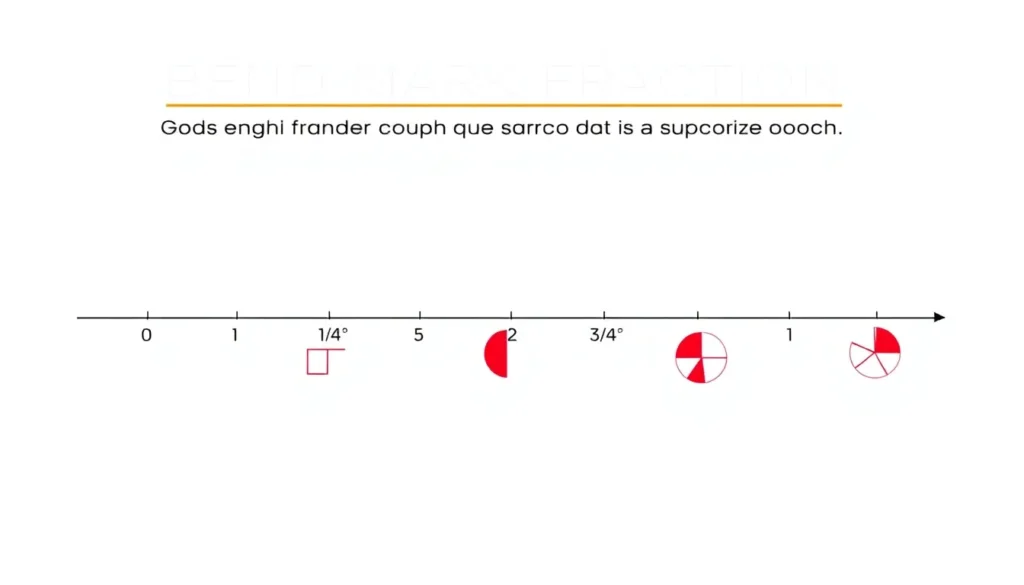
Benchmark fractions are specific fractions that serve as standard or reference points to facilitate the understanding, comparison, and estimation of other fractions. These fractions are typically simple, well-known values such as 1/2, 1/4, and 3/4, which are used in educational settings to help students develop a better sense of fraction size and relationships. By using benchmark fractions, learners can more easily make judgments about the size of unfamiliar fractions and perform mental calculations.
Detailed Explanation
Benchmark fractions are chosen because they are easy to visualize and commonly encountered in everyday contexts. They are often fractions with denominators of 2, 4, or 8, although others like 1/3 or 2/3 may also be used. These fractions act as fixed points on the number line, allowing individuals to estimate where other fractions lie in relation to these benchmarks. This method aids in developing numerical intuition and supports skills such as fraction comparison, addition, subtraction, and estimation.
How It Works
When working with benchmark fractions, a learner compares a given fraction to a nearby benchmark to determine its approximate value. For example, to gauge the size of 5/8, one might recognize that it is slightly more than 1/2 (which is 4/8) but less than 3/4 (which is 6/8). This technique reduces the cognitive load involved in complex fraction operations by providing a clear frame of reference.
Examples
- 1/2: Often the primary benchmark fraction, representing the middle point between 0 and 1.
- 1/4 and 3/4: Useful for dividing the whole into quarters; 1/4 is less than 1/2, and 3/4 is greater than 1/2.
- 1/3 and 2/3: Common benchmarks for thirds, helpful for estimating fractions like 4/9 or 5/9.
- 2/5 and 3/5: Less common but sometimes used to benchmark fractions with denominators close to 5.
Why It Matters
Benchmark fractions are important in mathematics education because they provide a foundational tool for understanding fractions conceptually rather than procedurally. They help learners develop estimation skills, number sense, and the ability to compare fractions without requiring exact calculations. This understanding supports more advanced mathematical concepts such as ratios, proportions, and algebraic thinking.
Common Misconceptions
Misconception: Benchmark fractions are exact answers.
Correction: Benchmark fractions are reference points used for estimation and comparison, not precise solutions.
Misconception: Only 1/2 is a benchmark fraction.
Correction: While 1/2 is a common benchmark, other fractions like 1/4, 3/4, and 1/3 also serve as benchmarks depending on the context.
Pros and Cons
Comparison Table
| Aspect | Benchmark Fractions | Alternative/Related Topic (Common Fractions) |
|---|---|---|
| Meaning | Reference fractions used for estimation and comparison. | Any fraction representing part of a whole, not necessarily used as a reference. |
| Purpose | To simplify fraction understanding and comparisons. | To represent exact quantities or parts of a whole. |
| Examples | 1/2, 1/4, 3/4, 1/3 | 5/8, 7/12, 11/20 |
| Use in Education | Widely used to teach fraction concepts and estimation. | Used for precise calculations and operations. |
Decision Checklist
- Use this if you need to estimate or compare fractions quickly.
- Avoid this if precise fraction values or calculations are required.
- Check this first when teaching fractions to beginners to build intuitive understanding.
What is the easiest way to understand Benchmark Fractions?
The easiest way to understand benchmark fractions is to visualize them on a number line and recognize their relative positions. Starting with familiar benchmarks like 1/2 and 1/4 helps learners quickly estimate where other fractions fall and understand their size in relation to these simple, well-known points.
FAQ
What are benchmark fractions used for?
Benchmark fractions are used to estimate, compare, and understand the size of other fractions by providing easy reference points.
Are benchmark fractions always the same?
While common benchmark fractions include 1/2, 1/4, and 3/4, other fractions can also serve as benchmarks depending on context and educational goals.
Can benchmark fractions be used for exact calculations?
No, benchmark fractions are primarily tools for estimation and comparison, not for precise calculations.



Leave a Reply