
Short Answer
Overview
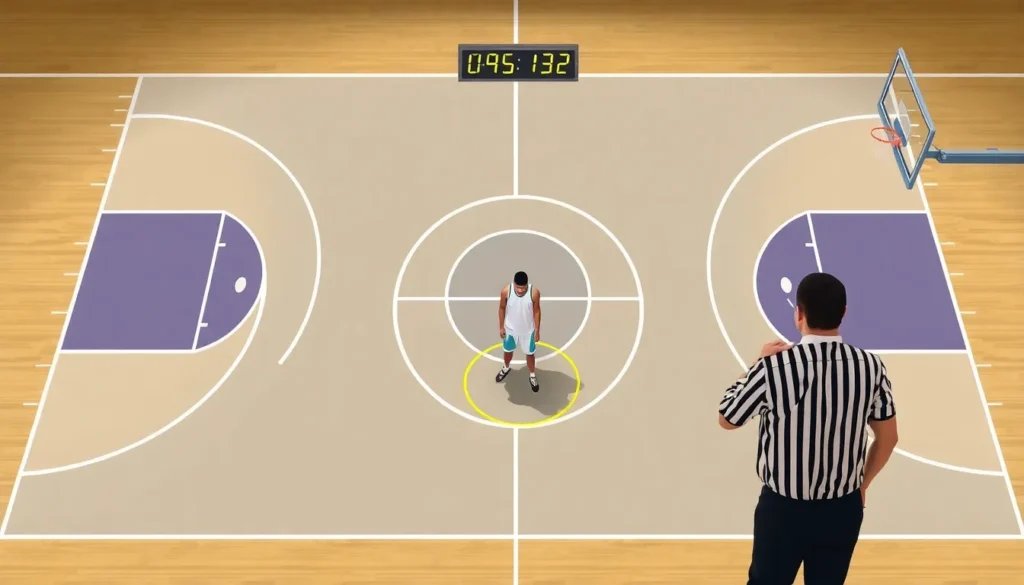
A 3 second violation, also known as the three-second rule, is a common infraction in basketball. It occurs when an offensive player remains in the key (the painted area near the basket, known as the lane) for more than three consecutive seconds while their team is in possession of the ball. This rule exists to prevent players from gaining an unfair positional advantage close to the basket and to promote continuous movement during the game.
Detailed Explanation
The 3 second violation is specifically concerned with the offensive player’s position in the restricted area known as the key or paint. This rectangular area extends from the baseline to the free throw line and is bounded by the lane lines. When an offensive player enters this zone, a timer begins counting. If the player remains in the key for longer than three seconds without actively exiting, the referee will call a violation.
Importantly, the count resets if the offensive player leaves the key or if a shot attempt is made. Defensive players, however, are not restricted by this rule and may stay in the key indefinitely. The rule is enforced at various levels of basketball, including the NBA, NCAA, and FIBA, though slight variations in timing or enforcement may exist.
How It Works
Once the offensive team gains possession of the ball in the frontcourt, the count for any player standing in the key begins. The referee or an official keeps track of the time an offensive player spends in the restricted area. If the count reaches three seconds, the official signals a violation, resulting in a turnover. The opposing team then gains possession of the ball.
The violation encourages offensive players to move out of the key to avoid penalties, which helps maintain dynamic play and prevents crowding near the basket. The referee’s judgment plays a critical role, as the count must be paused or reset when relevant events occur, such as a shot attempt or the player exiting the key.
Examples
- Example 1: An offensive player posts up near the basket and stands still inside the paint for four seconds without the ball being shot or the player moving out of the lane. The referee calls a 3 second violation, awarding possession to the defensive team.
- Example 2: During a play, an offensive player remains in the key for two seconds, then steps out briefly before returning. The count resets and the player is allowed another three seconds before a violation is called.
- Example 3: An offensive player is in the paint for three seconds, but the team attempts a shot just before the count reaches three. The count is reset, and no violation is called.
Why It Matters
The 3 second violation plays a significant role in regulating offensive positioning and promoting fairness in basketball. It ensures that players cannot gain an unfair advantage by lingering near the basket, which could otherwise lead to easy scoring opportunities. The rule encourages offensive movement, spacing, and strategic playmaking. Defensively, it provides relief by preventing offensive players from clogging the paint indefinitely.
Common Misconceptions
Misconception: The 3 second violation applies to defensive players.
Correction: Only offensive players are subject to the 3 second rule; defenders can remain in the key without restriction.
Misconception: The count continues even if the player is moving within the key.
Correction: The violation is based on time spent inside the key regardless of movement, but if the player exits and re-enters, the count can reset.
Pros and Cons
Comparison Table
| Aspect | 3 Second Violation | 24 Second Shot Clock Violation |
|---|---|---|
| Meaning | Offensive player illegally stays in the key for more than three seconds | Offensive team fails to attempt a shot within 24 seconds |
| Purpose | Prevent players from gaining unfair positional advantage near basket | Encourage prompt offensive action and scoring attempts |
| Penalty | Turnover, possession awarded to defense | Turnover, possession awarded to defense |
Decision Checklist
- Use this if you want to understand why offensive players must keep moving in the key.
- Avoid this if you are looking for defensive positioning rules.
- Check this first when analyzing offensive strategies related to paint play and lane violations.
What is the easiest way to understand 3 Second Violation?
The easiest way to understand the 3 second violation is to think of the key as a timed zone where an offensive player can only stay briefly. If they linger too long without leaving or the ball being shot, it results in a penalty. This rule keeps the game flowing and prevents players from camping near the basket.
FAQ
Does the 3 second violation apply to defensive players?
No, the 3 second rule applies only to offensive players. Defensive players can remain in the key for any duration without penalty.
What happens if a player leaves the key before three seconds?
If an offensive player exits the key before the three-second count is completed, the count resets and they may re-enter with a new three-second allowance.
Can the 3 second violation be called during a shot?
No, the count pauses or resets if a shot attempt is made, so a violation cannot be called during the act of shooting.





Leave a Reply