
Short Answer
Overview
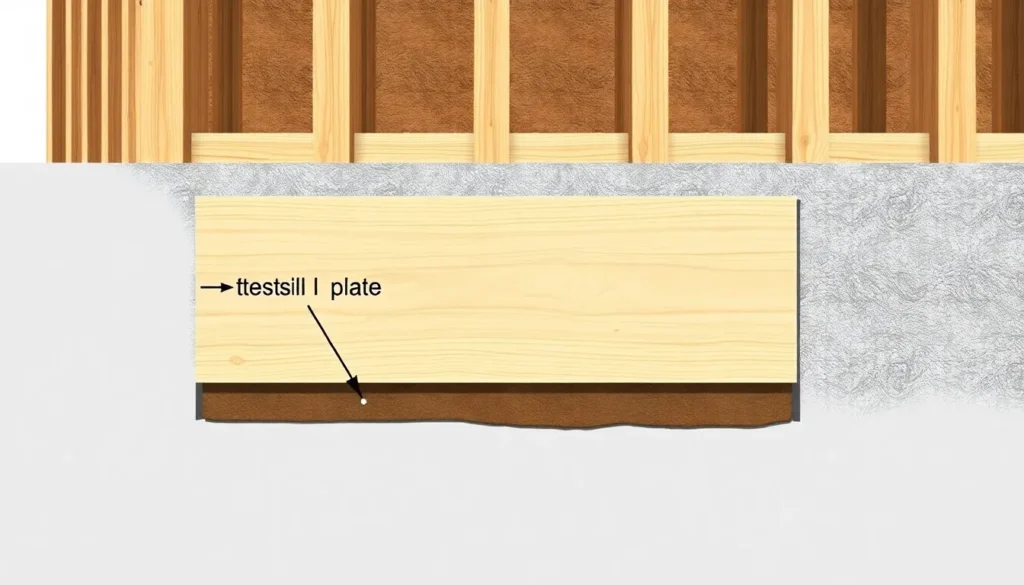
A sill plate, also known as a sole plate, is a fundamental element in the framing of a building. It is a horizontal timber or engineered wood member that rests directly on the foundation wall or slab and serves as the base to which vertical wall studs are attached. The sill plate acts as the interface between the foundation and the structural framing above, providing a level and secure surface for the construction of walls and floors.
Detailed Explanation
Sill plates are typically made from treated lumber to resist moisture and termite damage, as they are in direct contact with the foundation or concrete slab. They are anchored to the foundation using bolts or straps to prevent lateral movement and uplift, which can occur during high winds or seismic events. The thickness and width of sill plates usually correspond with standard framing lumber dimensions, and they must be precisely installed to ensure the building’s stability and alignment.
In platform framing, the sill plate sits on the foundation, and the floor joists or subfloor rest on or are attached to it. In some construction methods, a sill gasket or sealant is applied beneath the sill plate to prevent air infiltration and moisture penetration.
How It Works
The sill plate serves several key functions in building construction. First, it distributes the weight of the walls and roof evenly across the foundation. Second, it provides a flat, level surface for the attachment of wall studs, ensuring the wall is straight and plumb. Third, by being anchored to the foundation, the sill plate helps resist lateral forces such as wind or seismic activity, contributing to the overall structural integrity of the building.
Installation involves placing the sill plate on the foundation after applying a moisture barrier or sill gasket. Anchor bolts embedded in the foundation are aligned with pre-drilled holes in the sill plate and secured with nuts. This connection forms a continuous load path from the roof to the foundation, essential for withstanding various structural stresses.
Examples
- In residential wood-frame construction, a typical sill plate is a 2×6 or 2×8 treated lumber piece secured to a concrete foundation wall.
- In slab-on-grade construction, the sill plate is anchored directly to the concrete slab using embedded bolts, creating a base for walls built on the slab.
- Engineered wood products like laminated veneer lumber (LVL) can also be used as sill plates in specific applications requiring greater load-bearing capacity.
Pros and Cons
Pros:
- Provides a stable and level base for wall framing
- Helps anchor the structure to the foundation, improving resistance to wind and seismic forces
- Treated sill plates offer protection against moisture and pests
- Facilitates load transfer from walls to foundation
Cons:
- If improperly installed, can lead to structural misalignment or instability
- Untreated lumber sill plates are susceptible to rot and insect damage
- Improper sealing can allow moisture intrusion, potentially leading to mold or wood decay
Comparison Table
| Aspect | Sill Plate | Bottom Plate (Wall Plate) |
|---|---|---|
| Meaning | Horizontal member anchored to foundation, base for wall framing | Horizontal member at bottom of wall framing, rests on sill plate or floor |
| Location | Between foundation and wall framing | At base of wall framing, above sill plate or subfloor |
| Material | Treated lumber or engineered wood | Usually untreated lumber |
| Function | Anchors framing to foundation, distributes loads | Secures wall studs, forms bottom of framed wall |
Decision Checklist
- Use this if you need a secure, level base to connect wall framing to a foundation.
- Avoid this if the foundation surface is uneven and cannot be leveled before installation.
- Check this first to ensure the sill plate is treated for moisture resistance and properly anchored to the foundation.
What is the easiest way to understand a Sill Plate?
The easiest way to understand a sill plate is to think of it as the “starting point” or “foundation interface” for the walls of a house. It is the horizontal piece of wood that sits directly on the foundation and acts as the base to which all wall studs are attached, providing stability and a connection between the building’s structure and its foundation.
FAQ
What is the difference between a sill plate and a bottom plate?
A sill plate is the horizontal timber that rests directly on the foundation and anchors the framing to it, while a bottom plate (or sole plate) is the horizontal member at the base of the wall framing that rests on the sill plate or subfloor.
Why is the sill plate treated with preservatives?
Sill plates are treated to resist moisture, decay, and insect damage because they are in close contact with the foundation and potentially exposed to damp conditions.
How is a sill plate anchored to the foundation?
Sill plates are anchored using embedded anchor bolts or straps that pass through pre-drilled holes in the plate and are secured with nuts, creating a strong connection to prevent movement.





Leave a Reply