
Short Answer
Overview
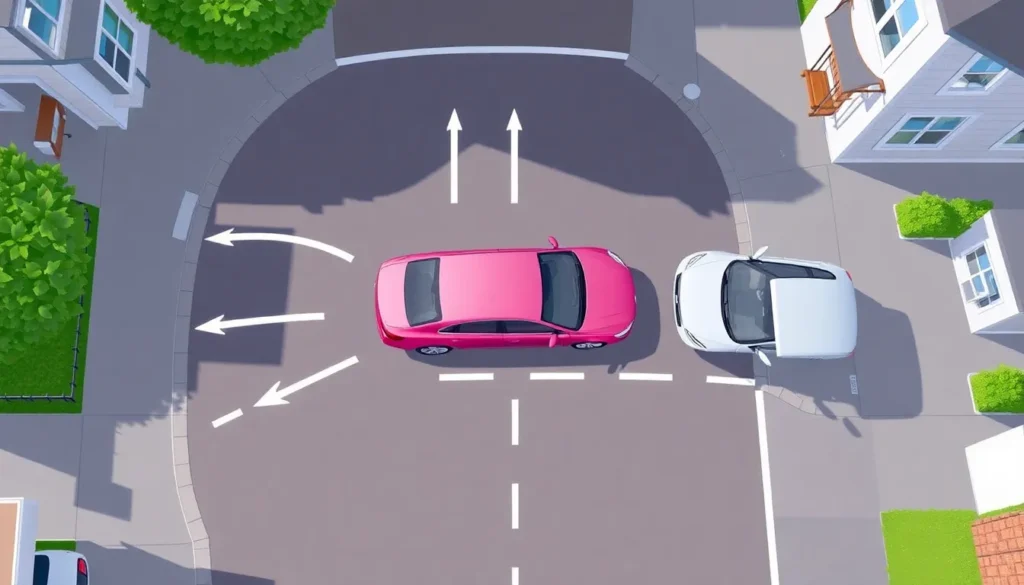
A 3 point turnabout, commonly known as a three-point turn or K-turn, is a driving technique used to reverse the direction of a vehicle in a limited space. The maneuver involves a series of precise forward and backward movements to change the vehicle’s orientation by approximately 180 degrees. It is particularly useful on narrow or busy roads where a U-turn is not feasible, allowing the driver to safely and efficiently change direction.
Detailed Explanation
The 3 point turnabout is a methodical process that requires control, spatial awareness, and adherence to traffic rules. It typically involves three distinct phases or points: first moving forward while turning the steering wheel towards the curb or roadside, then reversing while steering in the opposite direction, and finally moving forward again to complete the turn. This maneuver is often taught in driver education and assessed during driving tests as a fundamental skill.
How It Works
The process of executing a 3 point turnabout is as follows:
- First Point: The driver signals and checks for traffic, then moves forward while steering sharply towards the curb or side of the road.
- Second Point: After stopping near the curb, the driver shifts into reverse, turns the steering wheel in the opposite direction, and backs up carefully, creating space for the final turn.
- Third Point: The driver shifts back into drive, steers straight or slightly towards the road, and completes the turn, now facing the opposite direction.
Safety precautions such as signaling, checking mirrors, and monitoring blind spots are vital throughout the maneuver to avoid collisions.
Examples
- Urban Street: On a narrow residential street where making a U-turn is impossible due to parked cars on both sides, a 3 point turn allows the driver to reverse direction safely.
- Parking Lot: When a vehicle is positioned in a dead-end section of a parking lot without space for a U-turn, a 3 point turnabout helps the driver maneuver out efficiently.
- Driving Tests: Many driving licensing authorities require learners to demonstrate proficiency in performing a 3 point turn as part of their practical examination.
Why It Matters
The 3 point turnabout is an essential driving skill that enhances a driver’s ability to navigate constrained environments safely. It provides a controlled method to reverse direction without requiring large or dangerous maneuvers. Mastery of this technique contributes to overall road safety by reducing the risk of collisions and traffic disruptions.
Common Misconceptions
Misconception: A 3 point turn is the same as a U-turn.
Correction: Unlike a U-turn, which involves turning the vehicle in a single continuous arc, a 3 point turn uses multiple forward and reverse moves to change direction in limited space.
Misconception: It can be performed anywhere without regard for traffic rules.
Correction: A 3 point turn must only be performed where it is legal and safe, with full awareness of other road users.
Pros and Cons
Pros: Enables direction change in tight spaces; requires minimal road width; increases driver control and safety.
Cons: Can be time-consuming; requires careful observation; may be difficult for novice drivers or large vehicles.
Comparison Table
| Aspect | 3 Point Turnabout | U-turn |
|---|---|---|
| Meaning | A maneuver involving three movements (forward, backward, forward) to reverse direction in a confined area. | A continuous turning maneuver to reverse direction in a single movement. |
| Space Required | Less road width needed; suitable for narrow roads. | Requires wider road space for a smooth turn. |
| Complexity | More complex; involves multiple gear changes and steering adjustments. | Simpler; usually one continuous turn. |
Decision Checklist
What is the easiest way to understand a 3 Point Turnabout?
The easiest way to understand a 3 point turnabout is to visualize it as a controlled three-step process that involves moving forward, then backward, then forward again to turn the vehicle around in a small space. It can be thought of as using a zigzag pattern to rotate the car when a regular U-turn is impossible.
FAQ
What is the purpose of a 3 point turn?
The purpose of a 3 point turn is to reverse the direction of a vehicle in a confined space safely and efficiently when a U-turn is not possible.
Is a 3 point turn legal everywhere?
No, a 3 point turn must be performed only where it is legal and safe to do so, as some roads or jurisdictions may prohibit stopping or reversing maneuvers in certain areas.
How many steps are involved in a 3 point turn?
A standard 3 point turn involves three steps: moving forward while turning, reversing with opposite steering, and moving forward again to complete the turn.



Leave a Reply