
Short Answer
Overview
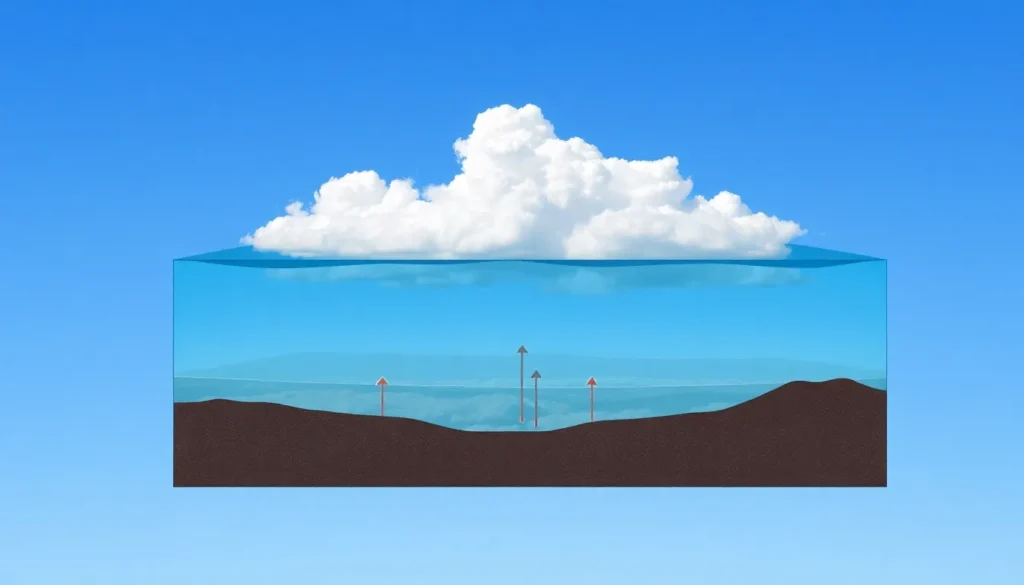
Stable air is a term used in meteorology to describe an atmospheric condition where vertical motion of air parcels is suppressed. This stability arises when the environmental lapse rate—the rate at which temperature decreases with altitude—is less than the adiabatic lapse rate of the air parcel. In such conditions, displaced air parcels tend to return to their original position rather than continue rising or sinking, which limits vertical mixing and cloud development.
Detailed Explanation
Atmospheric stability depends on the temperature profile of the atmosphere. When the surrounding air cools slowly with height (a condition known as temperature inversion or a lapse rate lower than the dry adiabatic lapse rate), air parcels that are displaced vertically become cooler and denser than the surrounding air. Because cooler, denser air resists upward motion, it tends to sink back to its original level. This creates a stable environment where vertical air motions are dampened.
Stable air layers inhibit the formation of cumulus clouds and strong weather systems, often resulting in clear skies or stratiform clouds. This stability can also lead to the accumulation of pollutants near the Earth’s surface due to limited vertical dispersion.
How It Works
The stability of air is primarily governed by lapse rates. The dry adiabatic lapse rate is approximately 9.8°C per kilometer, representing the rate at which a dry air parcel cools as it rises. If the environmental lapse rate is less than this, the atmosphere is considered stable. In this scenario, an air parcel lifted upward will be cooler and heavier than the surrounding air and will tend to sink back.
In contrast, if the environmental lapse rate exceeds the adiabatic lapse rate, the atmosphere is unstable, promoting vertical movement and convection.
Examples
- Nighttime temperature inversion: After sunset, the Earth’s surface cools rapidly, cooling the air near the ground more than the air aloft. This temperature inversion results in stable air, often causing fog or haze.
- Subsidence inversion: Large-scale sinking of air in the atmosphere can warm a layer aloft, creating a stable air layer that suppresses cloud formation and leads to clear skies.
- Marine layer stability: Over oceans, cool air trapped under a warm inversion layer can stabilize the atmosphere, producing stratocumulus clouds.
Why It Matters
Understanding the characteristic of stable air is crucial for predicting weather conditions, air quality, and aviation safety. Stability influences cloud formation, precipitation potential, and the dispersion of pollutants. Stable air conditions typically lead to calm weather but can also cause air pollution to concentrate near the surface, affecting health and visibility.
Common Misconceptions
Misconception: Stable air means no wind.
Correction: Stable air suppresses vertical motion but does not necessarily eliminate horizontal wind, which can still be strong.
Misconception: Stable air always results in clear skies.
Correction: While stable air inhibits convective clouds, it can support stratified clouds or fog under certain conditions.
Pros and Cons
Pros: Stable air contributes to calm weather, reduces turbulence, and can improve flight conditions at certain altitudes.
Cons: It inhibits vertical mixing, which can trap pollutants near the surface leading to poor air quality, and suppresses precipitation formation, potentially prolonging dry conditions.
Comparison Table
| Aspect | Stable Air | Unstable Air |
|---|---|---|
| Meaning | Atmosphere resists vertical motion; air parcels return to original position | Atmosphere encourages vertical motion; air parcels continue rising or sinking |
| Temperature Profile | Environmental lapse rate less than adiabatic lapse rate | Environmental lapse rate greater than adiabatic lapse rate |
| Weather | Calm, stratified clouds or clear skies | Convection, cumulus clouds, thunderstorms |
| Pollutant Dispersion | Limited vertical mixing; pollutants accumulate | Enhanced mixing; pollutants disperse |
Decision Checklist
What is the easiest way to understand a Characteristic of Stable Air?
The easiest way to understand stable air is to imagine a parcel of air pushed upward in the atmosphere. If the surrounding air is warmer and less dense, the parcel will sink back down, showing the atmosphere is stable. Conversely, if it continues to rise, the air is unstable. Thus, stable air resists vertical movement and maintains calm conditions.
FAQ
What happens to air parcels in stable air?
In stable air, air parcels that are displaced vertically tend to become cooler and denser than the surrounding air, causing them to sink back to their original position.
How does stable air affect weather?
Stable air limits vertical air movement, leading to calm weather conditions, suppression of thunderstorm development, and often clear skies or stratiform clouds.
Can stable air cause pollution problems?
Yes, because stable air suppresses vertical mixing, pollutants can accumulate near the surface, leading to poor air quality and reduced visibility.






Leave a Reply