
Short Answer
Overview
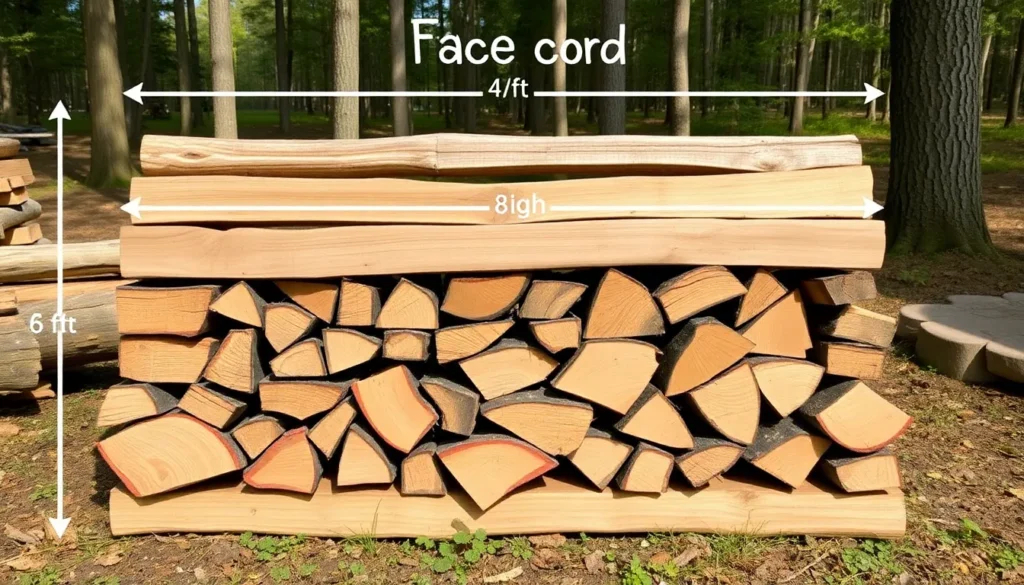
A face cord of wood is a term commonly used in the sale and measurement of firewood. It describes a stack of wood that is typically 4 feet high and 8 feet long, but the depth (or length of the individual pieces) is not standardized and can vary. Because of this, the volume of wood in a face cord can differ significantly, making it less precise than the full cord measurement. The term is especially popular in North America and is often encountered in informal transactions.
Detailed Explanation
The concept of a face cord originates from the more formal measurement known as a full cord, which is defined as a stack of wood measuring 4 feet high, 8 feet long, and 4 feet deep, totaling 128 cubic feet. A face cord maintains the height and length dimensions of a full cord (4 feet by 8 feet) but does not specify the depth, which is usually the length of the firewood pieces stacked.
Commonly, firewood is cut to lengths of 16 inches, 18 inches, or 24 inches, so the depth of a face cord often corresponds to one of these lengths. For example, if the wood pieces are 16 inches long, the depth of the stack is 16 inches, resulting in about one-third of a full cord (approximately 42.7 cubic feet). However, since there is no industry-wide standard for the depth of a face cord, the actual volume can vary depending on the seller and region.
How It Works
When purchasing firewood, a face cord is often used as a convenient way to describe the amount of wood being sold without requiring the buyer to measure the entire stack. The seller typically stacks the wood in a pile that is 4 feet high and 8 feet long, then the depth is determined by the length of the wood pieces. Because firewood lengths vary, the buyer must confirm the depth or length of the pieces to estimate the actual volume of wood.
In practice, a face cord is a visual and rough guide that helps buyers and sellers discuss quantities without dealing with cubic measurements. However, it is important to understand that a face cord is not equivalent to a full cord, and buyers should be cautious to ensure they are receiving the amount of wood they expect.
Examples
- 16-inch wood length: A face cord of wood stacked 4 feet high, 8 feet long, and 16 inches deep equals approximately one-third of a full cord (about 42.7 cubic feet).
- 18-inch wood length: A face cord with pieces 18 inches long results in a volume of about 48 cubic feet, roughly 37.5% of a full cord.
- 24-inch wood length: A face cord with 24-inch long pieces has a depth of 2 feet, resulting in a half cord volume (64 cubic feet).
Why It Matters
Understanding what a face cord of wood represents is important for consumers and sellers to communicate clearly about quantities and pricing. Since a face cord is not a standardized volume, misunderstandings can lead to disputes or dissatisfaction regarding the amount of firewood purchased. Knowledge of the differences between a face cord and a full cord helps buyers make more informed decisions and compare prices more accurately.
Common Misconceptions
Misconception: A face cord is the same volume as a full cord.
Correction: A face cord usually represents a smaller volume than a full cord because its depth is less than 4 feet, often corresponding to the length of the firewood pieces.
Misconception: The dimensions of a face cord are standardized everywhere.
Correction: The depth of a face cord varies by region and seller, so it is not a fixed or legally defined measurement.
Pros and Cons
Comparison Table
| Aspect | Face Cord of Wood | Full Cord of Wood |
|---|---|---|
| Meaning | A stack of wood 4 feet high, 8 feet long, with variable depth depending on wood length. | A standardized stack of wood 4 feet high, 8 feet long, and 4 feet deep (128 cubic feet). |
| Volume | Varies, typically between one-third to one-half of a full cord. | Exactly 128 cubic feet. |
| Standardization | Not standardized; depends on wood length and seller. | Standardized and legally recognized in many jurisdictions. |
| Use | Informal measurement for firewood sales. | Formal measurement used for precise volume calculation. |
Decision Checklist
- Use this if: You want a quick, informal reference to the amount of firewood, and you know the length of the wood pieces.
- Avoid this if: You require an exact volume measurement or are comparing prices for legal or commercial purposes.
- Check this first: Confirm the length of the wood pieces to estimate the actual volume represented by a face cord.
What is the easiest way to understand a Face Cord of Wood?
The simplest way to understand a face cord is to think of it as a stack of firewood that is always 4 feet tall and 8 feet long, but the depth depends on the length of the firewood pieces. Since firewood is often cut shorter than 4 feet, a face cord usually contains less wood than a full cord. To accurately estimate how much wood you are getting, measure or ask the length of the pieces and calculate the volume accordingly.
FAQ
Is a face cord the same as a full cord?
No, a face cord is not the same as a full cord. A full cord measures 4 feet high, 8 feet long, and 4 feet deep (128 cubic feet), while a face cord only specifies the height and length, with depth varying based on wood length.
How much wood is in a face cord?
The volume of wood in a face cord depends on the length of the firewood pieces. For example, if the wood is 16 inches long, the face cord contains about one-third of a full cord, or roughly 42.7 cubic feet.
Why do face cords vary in size?
Face cords vary because there is no standardized depth measurement. The depth is determined by the length of the firewood pieces, which can differ between sellers and regions.






Leave a Reply