
Short Answer
Overview
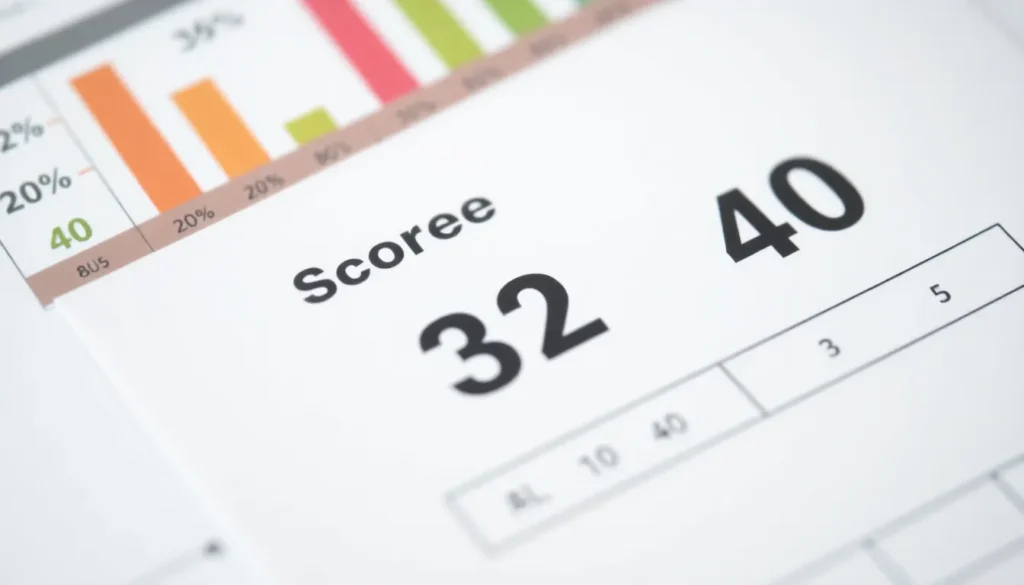
A score of 32 out of 40 is a numerical value commonly used in various evaluation, grading, and scoring systems. It indicates that 32 points were earned out of a possible 40 points, which can be converted into percentages or grades to assess performance. This form of scoring is widely employed in educational assessments, standardized tests, and rating systems.
Detailed Explanation
The score 32 out of 40 is a fraction representing the portion of total possible points earned. When expressed as a decimal, it equals 0.8, and when converted to a percentage, it is 80%. This score can indicate a level of achievement or proficiency depending on the criteria set by the scoring system in use. For example, in an academic context, 32 out of 40 might correspond to a letter grade such as a B or B+ depending on the grading scale.
How It Works
To understand a 32 out of 40 score, one must know the total possible score and the points earned. The process involves:
- Identifying the total points available, which in this case is 40.
- Determining the points earned, here 32.
- Calculating the percentage by dividing the earned points by the total points and multiplying by 100 (32 ÷ 40 × 100 = 80%).
- Interpreting this percentage within the context of the grading or evaluation system to determine the qualitative meaning of the score.
Examples
- Academic Grading: A student scores 32 out of 40 on a test. If the grading scale defines 80% as a B grade, the student receives a B.
- Performance Evaluation: An employee receives 32 points out of a possible 40 on a performance review, indicating an 80% performance rating.
- Sports or Competitions: A participant earns 32 points in a contest with a maximum of 40 points, reflecting a high level of performance.
Pros and Cons
Pros:
- Provides a clear quantitative measure of performance.
- Easy to convert to percentages for standardization.
- Allows comparison across different tests or evaluations with the same total points.
Cons:
- Without context, the score’s significance may be unclear.
- Grading scales vary, so the same score can have different qualitative meanings.
- Does not provide detailed feedback on specific strengths or weaknesses.
Comparison Table
| Aspect | 32 Out of 40 | Alternative: Percentage Score |
|---|---|---|
| Meaning | 32 points earned from 40 total points | 80% score derived from calculation |
| Format | Fraction or raw score | Percentage format |
| Use | Direct scoring in tests or evaluations | Standardized comparison across different tests |
Decision Checklist
- Use this if: You want to represent raw scores directly without converting.
- Avoid this if: The audience is unfamiliar with fractional grading or prefers percentages.
- Check this first: The grading scale or evaluation criteria to ensure correct interpretation.
What is the easiest way to understand a 32 out of 40 score?
The simplest way is to convert it into a percentage by dividing 32 by 40 and multiplying by 100, yielding 80%. This percentage can then be interpreted according to the relevant grading or evaluation standards.
FAQ
How do you convert 32 out of 40 to a percentage?
Divide 32 by 40 and multiply the result by 100, which gives 80%. This is the percentage score equivalent.
Is 32 out of 40 considered a good score?
This depends on the grading scale or context. Generally, 80% is considered a good or above-average score in many educational systems.
Can 32 out of 40 be converted to a letter grade?
Yes, but the corresponding letter grade varies by institution. For example, an 80% might correspond to a B or B+ in many grading schemes.






Leave a Reply