
Short Answer
Overview
A “20 out of 30” score is a way to express performance or achievement as a fraction of a total possible score. It indicates that 20 points were obtained from a maximum of 30 points available. This format is widely used in various scoring systems such as exams, quizzes, tests, ratings, and evaluations to quantify results.
Detailed Explanation
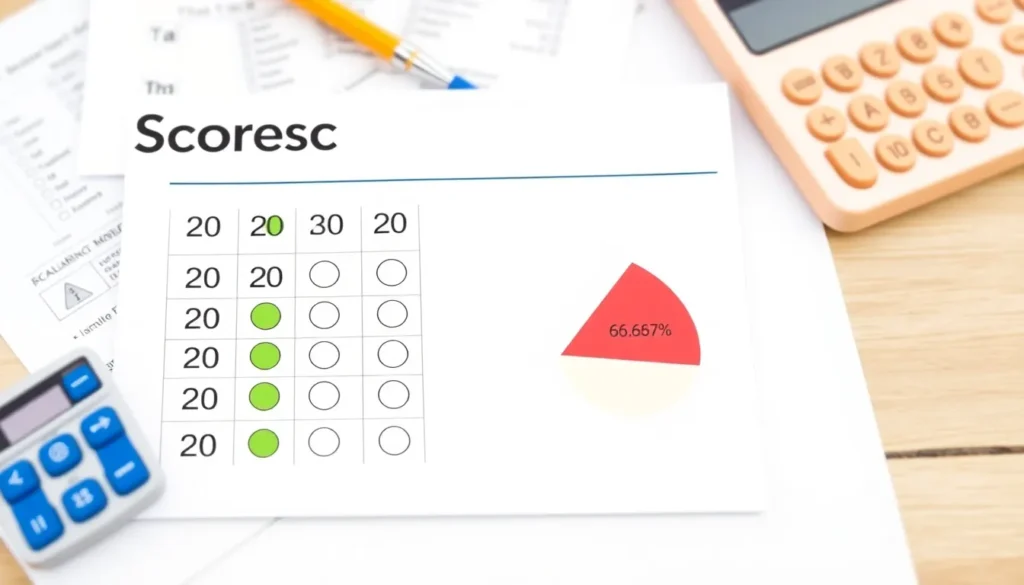
The score “20 out of 30” is a fraction representing the ratio of points earned to the total points possible. Numerically, it can be expressed as 20/30, which simplifies to 2/3 or approximately 66.67%. This percentage can serve as a basis for determining grades, rankings, or levels of proficiency.
Depending on the context, a 20 out of 30 score might be considered passing, average, or below average. Its interpretation relies heavily on the grading scale or standards set by the evaluating authority.
How It Works
When a test or evaluation is scored out of 30 points, each question or task is assigned a certain number of points summing up to 30. A participant’s performance is assessed by awarding points for correct or satisfactory responses. The total points earned—here, 20—are then compared to the maximum to determine the overall score.
This score can be converted into a percentage by dividing the points earned by the total points and multiplying by 100:
Percentage Score = (Points Earned / Total Points) × 100 = (20 / 30) × 100 ≈ 66.67%
This percentage can then be mapped to a grading scale or used to compare performance across different assessments.
Examples
- Academic Test: A student scores 20 out of 30 on a math quiz. Depending on the grading policy, this might translate to a grade of C or D.
- Employee Evaluation: An employee achieves 20 points out of 30 in a performance review, indicating room for improvement but meeting some expectations.
- Game Scoring: In a game scored out of 30 points, a player earning 20 points might be ranked in the upper-middle range.
Pros and Cons
- Pros: Provides a clear and straightforward method to quantify performance; allows easy conversion to percentages; flexible across various contexts.
- Cons: Without context, the score alone may not clearly indicate performance quality; the significance of 20 out of 30 varies by grading standards.
Comparison Table
| Aspect | 20 Out of 30 | Alternative/Related Topic |
|---|---|---|
| Meaning | Score representing 20 points earned out of 30 possible | Percentage Score (e.g., 66.67%) |
| Use | Assessment results, grading, evaluation | Letter Grades (e.g., B or C) |
| Interpretation | Depends on context and grading scale | Standardized grading scales for consistency |
Decision Checklist
- Use this if you need a simple point-based score with a maximum of 30 points.
- Avoid this if the scoring system requires percentage or letter grades exclusively.
- Check this first to understand the grading scale or standards applied to interpret the score properly.
What is the easiest way to understand a 20 out of 30 score?
The easiest way to understand a 20 out of 30 score is to convert it into a percentage: 20 divided by 30 equals approximately 66.67%. This percentage can then be compared to common grading scales or benchmarks to determine what the score signifies in terms of performance.
FAQ
Is 20 out of 30 a passing score?
Whether 20 out of 30 is passing depends on the specific grading criteria or standards set by the educational institution or organization. In many systems, it would be considered around a 66.67%, which might be passing or borderline.
How do I convert a 20 out of 30 score to a percentage?
Divide 20 by 30 and multiply the result by 100: (20/30) × 100 = approximately 66.67%.
Can a 20 out of 30 score be considered good?
The quality of a 20 out of 30 score depends on the context and grading scale. In some cases, it might be acceptable or average, while in others it could be below the expected standard.




Leave a Reply