
Short Answer
Overview
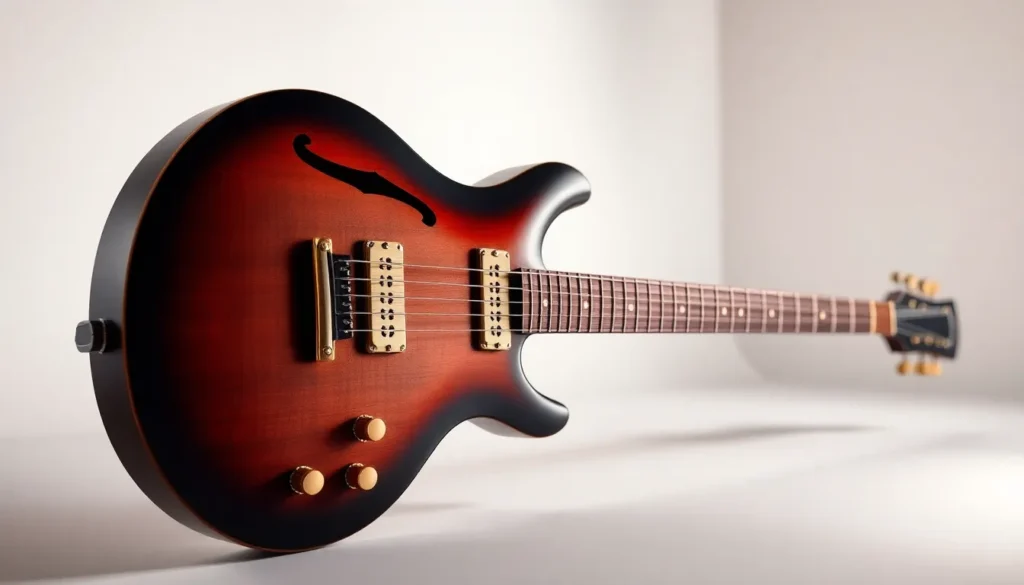
A baritone guitar is a specialized type of guitar characterized by its longer scale length and ability to be tuned to lower pitches compared to a standard guitar. Typically, the scale length of a baritone guitar ranges from approximately 27 to 30.5 inches, longer than the usual 24.75 to 25.5 inches found on standard guitars. This design enables the instrument to produce tones that are deeper and richer, often filling a sonic space between a traditional guitar and a bass guitar. Baritone guitars are utilized across various musical styles, including rock, metal, jazz, and country, to provide a distinctive tonal palette.
Detailed Explanation
The baritone guitar was initially developed to meet the needs of musicians seeking lower tunings without sacrificing string tension or clarity. Standard guitars, when tuned below their typical E-A-D-G-B-E tuning, may experience floppy strings and poor intonation. The longer scale length of baritone guitars allows them to maintain proper string tension at lower tunings, commonly ranging from B standard (B-E-A-D-F♯-B) down to A or even G standard tunings.
Baritone guitars can be either electric or acoustic, with electric versions often featuring heavier gauge strings to complement the lower tuning. The tonal characteristics include a deeper, fuller sound with increased sustain and resonance, making them suitable for creating atmospheric or heavy musical textures.
How It Works
The key functional difference in a baritone guitar is its longer scale length, which refers to the distance between the nut and the bridge saddle. A longer scale increases the string tension at a given pitch, enabling players to tune the instrument lower without compromising playability or tone quality. This extended length also affects the instrument’s resonance and harmonic content, contributing to its characteristic deep and rich sound.
In addition to longer scale length, baritone guitars often use heavier string gauges to further facilitate lower tunings. The combination of scale length and string gauge ensures that notes remain clear and defined, avoiding muddiness that might occur with standard guitars tuned down.
Examples
- Electric Baritone Guitar: Commonly used in genres like metal and alternative rock, electric baritone guitars often feature solid bodies and pickups designed to handle lower frequencies effectively.
- Acoustic Baritone Guitar: These have a larger body and longer scale, producing deep acoustic tones favored in country and folk music.
- Baritone Guitar Tunings: Typical tunings include B standard (B-E-A-D-F♯-B), A standard, and occasionally G standard, all lower than the conventional guitar tuning.
Pros and Cons
- Pros: Allows lower tunings with clear tone; expands tonal range; provides unique sonic textures; suitable for diverse genres.
- Cons: Requires adjustment in playing technique; heavier strings can be more physically demanding; less common, so fewer instructional resources may be available.
Comparison Table
| Aspect | Baritone Guitar | Standard Guitar |
|---|---|---|
| Meaning | Guitar with longer scale and lower tuning | Guitar with typical scale length and standard tuning |
| Scale Length | 27–30.5 inches | 24.75–25.5 inches |
| Typical Tuning | B standard or lower | E standard (E-A-D-G-B-E) |
| String Gauge | Heavier strings | Standard strings |
| Musical Range | Extended lower range | Standard range |
Decision Checklist
- Use this if: You want to explore lower tunings without losing string tension or clarity.
- Avoid this if: You prefer traditional guitar tone or are not comfortable adapting to longer scale instruments.
- Check this first: Your musical style and whether a baritone guitar’s deeper tonal qualities align with your artistic goals.
What is the easiest way to understand a Baritone Guitar?
The simplest way to understand a baritone guitar is to think of it as a guitar designed to play lower notes than a standard guitar. It achieves this by having a longer neck and heavier strings, allowing musicians to tune the instrument down while maintaining good playability and clear sound. It bridges the gap between a standard guitar and a bass guitar in pitch range.
FAQ
What distinguishes a baritone guitar from a standard guitar?
A baritone guitar has a longer scale length and is designed to be tuned lower than a standard guitar, producing deeper tones.
Can I use a baritone guitar for standard tuning?
While possible, baritone guitars are optimized for lower tunings and may feel different or less comfortable when tuned to standard guitar pitch.
Are baritone guitars suitable for beginners?
Generally, baritone guitars are better suited for players who have experience with standard guitars, as they require adaptation to longer scale and heavier strings.




Leave a Reply