
Short Answer
Overview
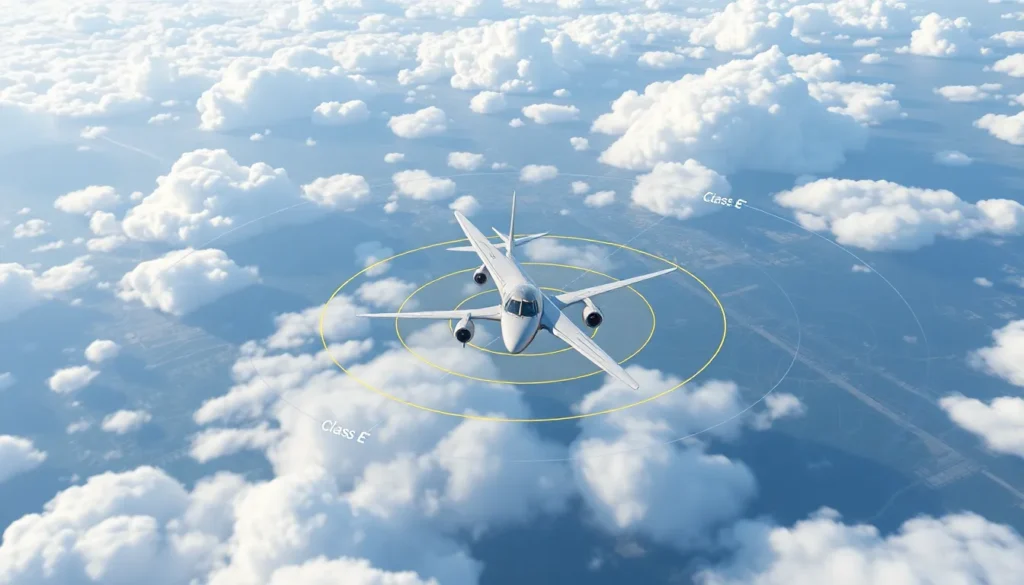
Class E airspace is a classification of controlled airspace in the United States, designated by the Federal Aviation Administration (FAA). It is designed to accommodate both Visual Flight Rules (VFR) and Instrument Flight Rules (IFR) operations, providing a controlled environment for aircraft to operate safely while maintaining separation from other traffic. Class E airspace typically begins at either 700 or 1,200 feet above ground level (AGL) and extends upward to 18,000 feet mean sea level (MSL), where Class A airspace begins.
Detailed Explanation
Class E airspace serves as a flexible and extensive category of controlled airspace. Unlike Class A or Class B airspace, it does not usually extend to the surface level except in specific cases. It acts as a transition zone between uncontrolled airspace (Class G) near the surface and the higher altitude controlled airspace above. This classification is important for protecting IFR traffic, especially during approaches and departures at airports without control towers or with limited radar coverage.
The FAA defines various segments of Class E airspace depending on their purpose and location. These include:
- Surface areas designated for airports without control towers to ensure IFR protection.
- Extensions to surface areas to cover instrument approach and departure paths.
- Transition areas beginning at 700 or 1,200 feet AGL, which help separate IFR traffic from uncontrolled airspace below.
- En route domestic airspace extending upward to 18,000 feet MSL.
How It Works
Class E airspace is controlled, meaning that air traffic control (ATC) provides separation services primarily for IFR flights. VFR flights are permitted to operate within Class E airspace without ATC clearance but must comply with specific weather minimums and visibility requirements. Pilots operating under IFR must obtain clearance from ATC to enter and operate within this airspace.
ATC services in Class E airspace include issuing clearances, providing traffic advisories, and managing IFR traffic separation. The airspace is depicted on aeronautical charts using magenta or blue segmented lines, with the boundaries and floor altitudes clearly indicated to assist pilots in navigation and compliance with regulations.
Examples
- In many areas, Class E airspace begins at 700 feet above ground level surrounding airports to protect instrument approach procedures. For example, an airport without an operating control tower might have Class E airspace starting at 700 feet AGL to facilitate IFR arrivals and departures.
- Class E airspace also commonly begins at 1,200 feet AGL over large rural areas or between controlled airspace regions, providing a buffer between uncontrolled surface airspace and higher controlled airspace.
- En route domestic airspace, which extends from 14,500 feet MSL up to but not including 18,000 feet MSL, is categorized as Class E, allowing controlled IFR operations in these flight levels.
Why It Matters
Class E airspace plays a crucial role in the overall airspace system by providing controlled airspace in areas where full control tower services are not available. This allows for the safe integration of IFR and VFR traffic, enhances safety during instrument approaches and departures, and supports the efficient flow of air traffic. It helps prevent midair collisions and ensures that pilots operating under different flight rules have clear guidelines for operating safely.
Common Misconceptions
Misconception: Class E airspace always starts at the surface.
Correction: Class E airspace usually starts at 700 or 1,200 feet AGL, except for designated surface areas around some airports.
Misconception: Pilots must always have ATC clearance to fly in Class E airspace.
Correction: VFR pilots do not need ATC clearance to operate in Class E airspace but must comply with visibility and cloud clearance requirements.
Pros and Cons
Comparison Table
| Aspect | Class E Airspace | Class G Airspace |
|---|---|---|
| Meaning | Controlled airspace primarily for IFR and VFR flights starting at 700 or 1,200 feet AGL up to 18,000 feet MSL. | Uncontrolled airspace generally from the surface up to 700 or 1,200 feet AGL where ATC does not provide separation services. |
| ATC Clearance Required | Required for IFR; not required for VFR. | Not required for any flights. |
| Typical Use | Instrument approaches, en route IFR traffic, transition areas. | Visual flight, low altitude uncontrolled operations. |
| Weather Minimums | VFR minimums apply; vary depending on altitude and area. | VFR minimums are generally more lenient. |
Decision Checklist
- Use this if: You are flying IFR or operating near airports with instrument procedures but without control towers.
- Avoid this if: You are flying VFR in poor weather conditions that do not meet the minimum visibility and cloud clearance requirements for Class E airspace.
- Check this first: Review sectional charts to determine the floor and ceiling of Class E airspace in your flight area and ensure compliance with ATC and weather requirements.
What is the easiest way to understand Class E Airspace?
The easiest way to understand Class E airspace is to think of it as a flexible and widely used controlled airspace category that starts above the uncontrolled surface level airspace, providing protection primarily for IFR flights while allowing VFR flights under certain visibility conditions. It acts as a middle layer in the airspace system, connecting lower uncontrolled airspace with higher controlled airspace.
FAQ
What altitude does Class E airspace start at?
Class E airspace typically starts at either 700 or 1,200 feet above ground level, depending on the area, and extends up to 18,000 feet mean sea level.
Do I need ATC clearance to fly in Class E airspace?
Pilots operating under Instrument Flight Rules (IFR) must have ATC clearance to enter Class E airspace. Visual Flight Rules (VFR) pilots do not need clearance but must comply with specific weather minimums.
How is Class E airspace depicted on aeronautical charts?
Class E airspace boundaries are shown using magenta or blue segmented lines, with floors and ceilings labeled to indicate the vertical limits of the controlled airspace.






Leave a Reply