
Short Answer
Overview
A passive disabling device is a type of mechanism or system that inhibits or prevents the operation of equipment, machinery, or other devices without requiring active control or ongoing input from a user. These devices are typically designed to function automatically under specific conditions, serving roles that include enhancing safety, security, or regulatory compliance. Unlike active disabling devices, which require deliberate activation or user intervention, passive disabling devices operate through inherent design features or environmental triggers.
Detailed Explanation
Passive disabling devices are engineered to ensure that certain equipment cannot be used in an unsafe or unauthorized manner. They are commonly found in various industries and applications, such as automotive safety, industrial machinery, and electronic devices. The passive nature of these devices means they are built into the system in a way that does not require manual activation; rather, they rely on physical, mechanical, or environmental factors to restrict functionality automatically.
How It Works
The operation of passive disabling devices typically depends on design elements that respond to specific conditions without the need for electrical power or manual input. For example, a mechanical interlock that physically blocks the operation of a machine unless certain safety conditions are met is a passive disabling device. Similarly, a device that automatically disables a vehicle’s ignition when an unauthorized key is inserted functions passively by design. These devices often use mechanisms such as locks, physical barriers, or environmental sensors to trigger the disabling function.
Examples
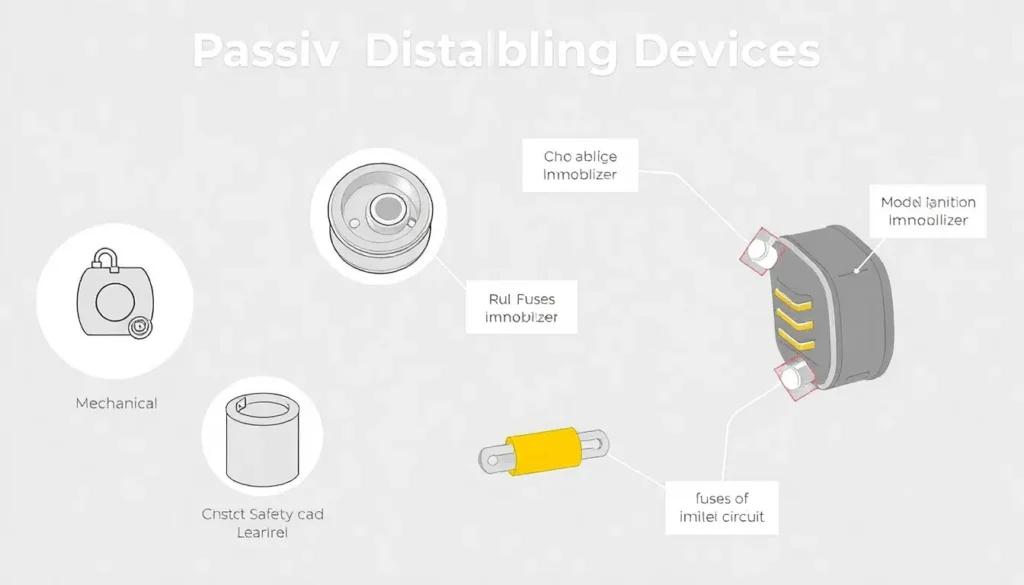
- Automotive Ignition Immobilizers: These are embedded in vehicles to prevent engine start unless the correct key or electronic code is present.
- Safety Interlocks in Machinery: Mechanical guards that prevent operation of dangerous equipment unless safety covers are in place.
- Child Safety Caps: Caps on medicine bottles that require specific pressure or alignment to open, effectively disabling access passively.
- Fuse or Circuit Breakers: Electrical components that cut power automatically when a certain threshold is exceeded, preventing damage or hazards.
Why It Matters
Passive disabling devices play a critical role in preventing accidents, unauthorized use, and equipment damage. Their automatic and fail-safe design helps reduce human error by eliminating the need for conscious activation. This contributes to greater overall safety in workplaces, homes, and public environments. Additionally, they support regulatory compliance by ensuring that devices meet safety standards without requiring continuous monitoring or intervention.
Common Misconceptions
Misconception: Passive disabling devices require user activation.
Correction: These devices operate automatically without requiring active user input.
Misconception: Passive disabling devices always rely on electronic components.
Correction: Many passive disabling devices are mechanical or purely physical and do not require electricity.
Pros and Cons
Comparison Table
| Aspect | Passive Disabling Device | Active Disabling Device |
|---|---|---|
| Meaning | Automatically disables equipment without user intervention. | Requires deliberate activation or control by the user or system. |
| Operation | Functions inherently through mechanical or environmental triggers. | Depends on electrical signals or manual input. |
| Reliability | Generally highly reliable due to simplicity. | Can fail due to user error or system faults. |
| Power Dependence | Often does not require external power. | Usually requires power or active control systems. |
Decision Checklist
- Use this if you need automatic, fail-safe prevention of device operation without relying on user action.
- Avoid this if you require flexible or conditional control that needs user input or active management.
- Check this first if the device or system requires compliance with safety regulations mandating passive safety features.
What is the easiest way to understand a Passive Disabling Device?
The simplest way to understand a passive disabling device is to think of it as a built-in safety feature that stops a device from working under unsafe or unauthorized conditions without needing anyone to turn it on or off. It acts automatically, like a mechanical lock that only lets a machine work when everything is safe.
FAQ
What distinguishes a passive disabling device from an active one?
A passive disabling device operates automatically without requiring user input, while an active disabling device needs deliberate activation or control by a user or system.
Are passive disabling devices always mechanical?
Not always, but many passive disabling devices rely on mechanical or physical principles rather than electronic systems to function.
Can passive disabling devices fail?
Like any device, passive disabling mechanisms can fail if damaged or poorly maintained, but their simplicity generally makes them reliable.



Leave a Reply