
Short Answer
Overview
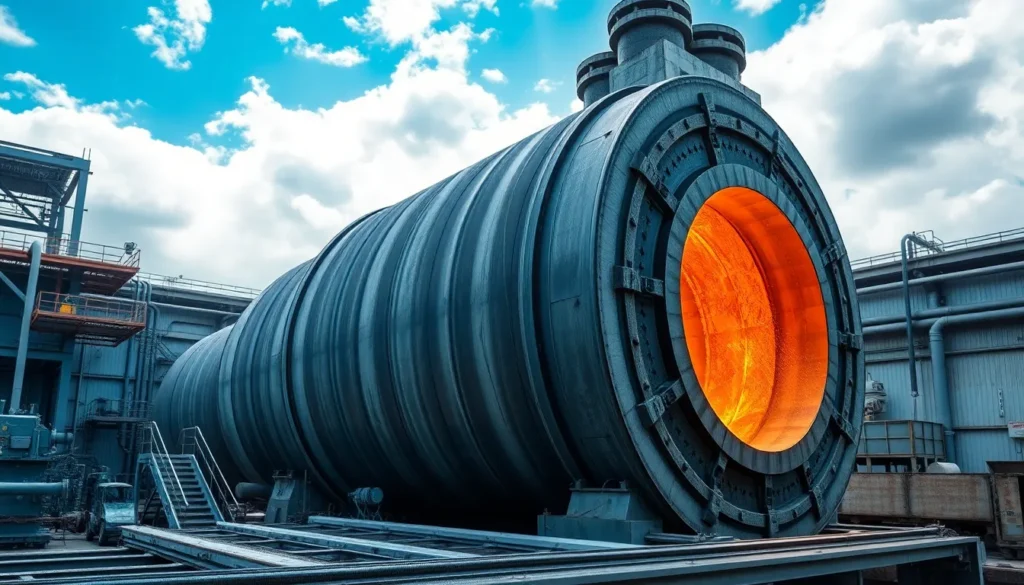
A rotary kiln is a large, cylindrical, rotating furnace used for thermal processing of materials at elevated temperatures. Typically inclined slightly from the horizontal, it rotates slowly and is lined internally with heat-resistant refractory materials. Rotary kilns are widely utilized in various industrial sectors to carry out chemical reactions or physical changes in raw materials, such as calcination, sintering, pyroprocessing, and drying. Their design allows continuous material feeding and discharge, making them suitable for large-scale production processes.
Detailed Explanation
Rotary kilns function as versatile thermal processing units capable of handling a broad range of materials including ores, minerals, chemicals, and waste products. The kiln generally consists of a cylindrical steel shell that rotates on support rollers or tyres. Inside, refractory bricks or castables protect the shell from high temperatures and abrasion while maintaining heat efficiency. The inclination and rotation enable the material to move from the feed end to the discharge end gradually while being exposed to controlled temperature and atmosphere conditions.
The internal environment of the kiln may be oxidizing, reducing, or neutral, depending on the process requirements. Fuel sources for heating include coal, oil, natural gas, or electrical heating, and the heat is transferred primarily through radiation and conduction. The process parameters such as temperature profile, residence time, rotation speed, and atmosphere are optimized according to the desired chemical or physical transformations.
How It Works
The operation of a rotary kiln involves several interrelated steps:
- Material Feeding: Raw materials are introduced at the higher end of the inclined kiln, often via a feeder or conveyor.
- Rotation and Movement: The kiln slowly rotates, typically between 1 to 5 revolutions per minute, causing the material to move down the length of the kiln by gravity and friction.
- Heating: Heated gases flow through the kiln, transferring energy to the material. The temperature can range from 800°C to over 1600°C depending on the process.
- Chemical or Physical Changes: Materials undergo transformations such as calcination (removal of CO2), sintering (particle bonding), or reduction reactions.
- Discharge: Processed material exits the lower end of the kiln, ready for further handling or packaging.
Some rotary kilns are equipped with additional features like internal lifters or flights to improve mixing and heat transfer. Control systems regulate fuel supply, airflow, and rotation speed to ensure consistent operation.
Examples
- Cement Industry: Rotary kilns are essential in cement manufacturing, where limestone and other raw materials are heated to produce clinker through calcination and sintering.
- Metallurgy: Used for roasting ores, reducing metal oxides, or producing ferrites and other materials.
- Chemical Processing: Employed in the production of lime, alumina, activated carbon, and various catalysts.
- Waste Treatment: Certain rotary kilns process hazardous or medical waste by incineration or thermal decomposition.
Pros and Cons
- Pros: Continuous operation suitable for large-scale production; versatile for various materials and processes; efficient heat transfer; ability to control atmosphere and temperature precisely.
- Cons: High capital and operational costs; requires skilled operation and maintenance; potential for refractory wear and mechanical issues; energy-intensive process.
Comparison Table
| Aspect | Rotary Kiln | Alternative – Fixed Bed Furnace |
|---|---|---|
| Meaning | A rotating cylindrical furnace for continuous thermal processing. | A stationary furnace where materials are processed in a fixed position. |
| Operation | Continuous material feed and discharge with rotation. | Batch or semi-batch operation without rotation. |
| Applications | Large-scale calcination, sintering, pyroprocessing. | Smaller scale or batch thermal processes. |
| Flexibility | Can handle diverse materials and process conditions. | Limited flexibility; suited to specific batches. |
| Maintenance | Requires regular refractory and mechanical maintenance. | Generally simpler maintenance but less efficient. |
Decision Checklist
- Use this if you require continuous high-temperature processing of large volumes of material with controlled atmosphere.
- Avoid this if your process is small-scale, batch-oriented, or requires minimal mechanical complexity.
- Check this first if the material characteristics and thermal requirements align with rotary kiln operation, and if investment and operational costs are justified.
What is the easiest way to understand Rotary Kiln?
One of the simplest ways to understand a rotary kiln is to imagine a slowly rotating metal drum, slightly tilted so that when raw materials are fed into the higher end, they gradually move to the lower end while being heated by a flame or hot gases inside. This continuous movement combined with high heat causes chemical and physical changes to the materials, similar to how baking transforms dough into bread but at significantly higher temperatures and industrial scale.
FAQ
What materials can be processed in a rotary kiln?
Rotary kilns can process a wide variety of materials including limestone, ores, chemicals, clays, and waste materials. The specific material depends on the industry and intended thermal process.
How is the temperature controlled in a rotary kiln?
Temperature is controlled by regulating fuel supply, airflow, and sometimes by adjusting the rotation speed. Thermocouples and sensors monitor temperatures along the kiln length to maintain desired profiles.
What are the main advantages of a rotary kiln over other furnaces?
Rotary kilns provide continuous processing, handle large material volumes, offer flexible temperature and atmosphere control, and facilitate efficient heat transfer through rotation and material movement.


Leave a Reply