
Short Answer
Overview
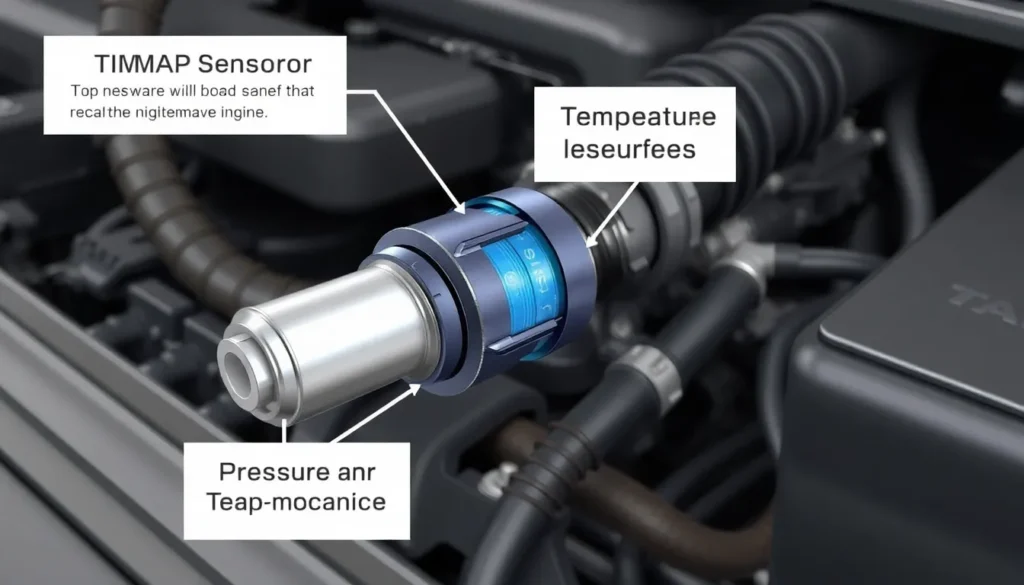
A TMAP sensor, short for Temperature and Manifold Absolute Pressure sensor, is an integrated automotive sensor that measures the absolute pressure inside the intake manifold as well as the temperature of the incoming air. It is a critical component in modern internal combustion engines, used primarily by the engine control unit (ECU) to optimize fuel injection, ignition timing, and overall engine performance.
Detailed Explanation
The TMAP sensor combines two sensor functions into a single device: the measurement of absolute pressure within the intake manifold and the measurement of the temperature of the air entering the engine. The manifold absolute pressure (MAP) indicates the engine load by measuring the vacuum or pressure inside the intake manifold, while the temperature sensor provides data on the density of the air, which varies with temperature.
By integrating these two measurements, the TMAP sensor allows the engine control system to more precisely calculate the mass flow of air entering the engine. This data is essential for determining the correct amount of fuel to inject, ensuring optimal combustion efficiency and reducing emissions.
How It Works
The TMAP sensor typically consists of a pressure-sensitive element, often a piezoelectric or capacitive sensor, and a temperature-sensitive element such as a thermistor. The pressure sensor measures the absolute pressure in the intake manifold relative to a vacuum, while the temperature sensor measures the air temperature at the same location.
The sensor converts these physical parameters into electrical signals, which are sent to the vehicle’s ECU. The ECU processes these signals to adjust fuel delivery and ignition timing dynamically. When the engine is under high load, the manifold pressure increases, and the sensor detects this change. Conversely, during idle or low load, the pressure decreases, and the sensor reflects this as well. Temperature readings help correct for air density changes caused by ambient temperature variations.
Examples
- Automotive Engine Management: Many modern vehicles use TMAP sensors to replace separate manifold pressure and intake air temperature sensors, streamlining sensor arrays and reducing wiring complexity.
- Tuning and Diagnostics: Performance tuners and mechanics use data from TMAP sensors to diagnose engine issues such as vacuum leaks, sensor malfunctions, or improper fuel-air mixtures.
- Turbocharged Engines: In forced induction engines, TMAP sensors provide critical data to control boost pressure and prevent engine knock by adjusting fuel and ignition timing.
Why It Matters
The TMAP sensor plays a vital role in ensuring efficient engine operation by providing accurate data for air mass calculation. This leads to better fuel economy, reduced emissions, and improved engine responsiveness. Its combined functionality reduces the need for multiple sensors, which simplifies engine design and can lower manufacturing costs. In addition, precise measurement of manifold pressure and temperature enables advanced engine control strategies, including variable valve timing and boost control.
Common Misconceptions
Misconception: A TMAP sensor only measures pressure.
Correction: A TMAP sensor measures both manifold absolute pressure and air temperature, integrating two sensor functions.
Misconception: TMAP sensors are interchangeable with MAP or MAF sensors.
Correction: While related, TMAP sensors differ from MAF (Mass Air Flow) sensors in measurement principles. MAF sensors measure actual air mass flow directly, whereas TMAP sensors infer air mass based on pressure and temperature.
Pros and Cons
Comparison Table
| Aspect | TMAP Sensor | Alternative/Related Topic |
|---|---|---|
| Meaning | Measures both manifold absolute pressure and intake air temperature. | MAP Sensor measures manifold absolute pressure only; MAF Sensor measures mass air flow directly. |
| Function | Provides pressure and temperature data for air mass calculation. | MAP provides pressure data; MAF provides direct air mass flow measurement. |
| Use Case | Engine management systems requiring combined data for fuel control. | MAP used in simpler systems; MAF used when precise air mass measurement is needed. |
Decision Checklist
- Use this if: You need precise air density data with simplified sensor integration in an engine management system.
- Avoid this if: Your application requires direct measurement of air mass flow or if sensor accuracy under rapidly changing airflows is critical.
- Check this first: Compatibility with your vehicle’s ECU and the sensor’s environmental tolerance before installation.
What is the easiest way to understand a TMAP sensor?
The easiest way to understand a TMAP sensor is to think of it as a combined device that measures how much air pressure is inside the engine’s intake and how warm that air is, so the engine can calculate how much air is entering and adjust fuel delivery accordingly for better performance and efficiency.
FAQ
What does a TMAP sensor measure?
A TMAP sensor measures both the manifold absolute pressure and the intake air temperature to provide data essential for calculating the mass of air entering the engine.
How is a TMAP sensor different from a MAF sensor?
While a TMAP sensor measures pressure and temperature to infer air mass, a MAF sensor directly measures the mass flow of air entering the engine using a heated wire or film.
Can a TMAP sensor improve fuel efficiency?
Yes, by providing accurate pressure and temperature data to the ECU, a TMAP sensor helps optimize fuel injection and ignition timing, which can improve fuel efficiency and reduce emissions.



Leave a Reply