
Short Answer
Overview
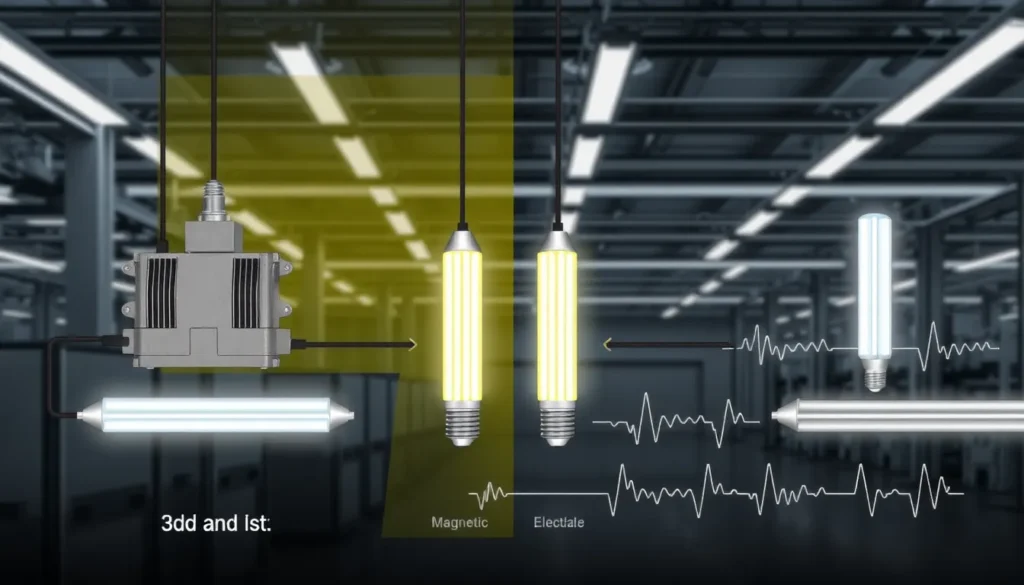
A ballast for lighting is an electrical component designed to control the starting and operating current of gas-discharge lamps, such as fluorescent, high-intensity discharge (HID), and neon lamps. These lamps require a specific voltage to ignite and then a regulated current to maintain steady illumination. Without a ballast, the lamp would draw excessive current, potentially causing damage or reducing its operational life.
Detailed Explanation
Gas-discharge lamps operate by ionizing gas inside the lamp tube, which produces light. Unlike incandescent bulbs, these lamps have a negative resistance characteristic, meaning their electrical resistance decreases as current increases. This makes it necessary to have a device to limit the current flow to a safe and stable level once the lamp is operating. The ballast serves this function by providing an initial high voltage to start the lamp and then limiting the current to prevent overheating or damage.
Ballasts can be broadly categorized into two types: magnetic and electronic. Magnetic ballasts utilize inductors (coils) to limit current and are generally heavier and less efficient. Electronic ballasts use solid-state electronic circuits to provide better energy efficiency, reduced flicker, and quieter operation.
How It Works
When the lamp is switched on, the ballast provides a high voltage pulse to ionize the gas inside the lamp, initiating the lighting process. Once the lamp is lit, the ballast regulates the current to a constant, safe level. For magnetic ballasts, this is achieved by the inductive reactance of the coil, which limits the current flow.
Electronic ballasts operate at higher frequencies (typically 20 kHz to 60 kHz), which improves efficiency and reduces flicker. They contain components such as transistors, capacitors, and transformers to convert the incoming electrical power to the required voltage and current characteristics for the lamp.
Examples
- Magnetic Ballasts: Commonly used in older fluorescent lighting systems, these ballasts are simple, reliable, and relatively inexpensive but can cause humming noise and flickering.
- Electronic Ballasts: Found in modern lighting fixtures, they offer energy savings, reduced noise, and improved lamp life due to higher frequency operation.
- Hybrid Ballasts: Combine features of magnetic and electronic ballasts, sometimes used in specific applications where benefits from both types are desired.
Why It Matters
The ballast is essential for the safe and efficient operation of many types of lighting systems, particularly fluorescent and HID lamps. It prevents damage to the lamp by controlling the electrical current, thereby extending lamp life and reducing energy consumption. Additionally, the type of ballast used can impact the overall performance, cost, and environmental footprint of lighting installations.
Common Misconceptions
Misconception: Ballasts are only needed for fluorescent lights.
Correction: While ballasts are most commonly associated with fluorescent lamps, they are also necessary for other gas-discharge lamps like HID and neon lamps to regulate current.
Misconception: Electronic ballasts are always better than magnetic ballasts.
Correction: Electronic ballasts offer several advantages such as efficiency and noise reduction, but magnetic ballasts can still be suitable in applications requiring simplicity and lower upfront cost.
Pros and Cons
Comparison Table
| Aspect | Ballast for Lighting | Transformer |
|---|---|---|
| Meaning | Device regulating current and voltage to start and operate gas-discharge lamps safely. | Electrical device that changes voltage levels without regulating current for lighting. |
| Purpose | Provides starting voltage and limits operating current. | Steps voltage up or down for electrical devices. |
| Common Usage | Fluorescent, HID, neon lamps. | General electrical power supply adjustment. |
| Operating Frequency | Typically 50/60 Hz for magnetic; 20 kHz+ for electronic ballasts. | Usually 50/60 Hz. |
Decision Checklist
- Use this if you need to operate gas-discharge lamps safely and efficiently.
- Avoid this if you are working with incandescent or LED lamps that do not require current regulation.
- Check this first for lamp compatibility and the type of ballast recommended by the lamp manufacturer.
What is the easiest way to understand a Ballast for Lighting?
The simplest way to understand a ballast is to think of it as a current controller for certain types of lamps. It helps start the lamp by giving it a high voltage pulse and then ensures it receives just the right amount of current to keep shining without damage or flickering.
FAQ
Why is a ballast necessary for fluorescent lamps?
Fluorescent lamps require a high voltage to start and a regulated current to maintain operation. A ballast provides the initial voltage and limits the current to prevent damage and ensure stable light output.
What is the difference between magnetic and electronic ballasts?
Magnetic ballasts use coils to limit current and operate at mains frequency, which can cause flicker and noise. Electronic ballasts use solid-state electronics to operate at higher frequencies, improving efficiency and reducing flicker and noise.
Can I use an electronic ballast with all types of fluorescent lamps?
Not all fluorescent lamps are compatible with electronic ballasts. It is important to verify compatibility based on the lamp type and manufacturer recommendations before installation.



Leave a Reply