
Short Answer
Overview
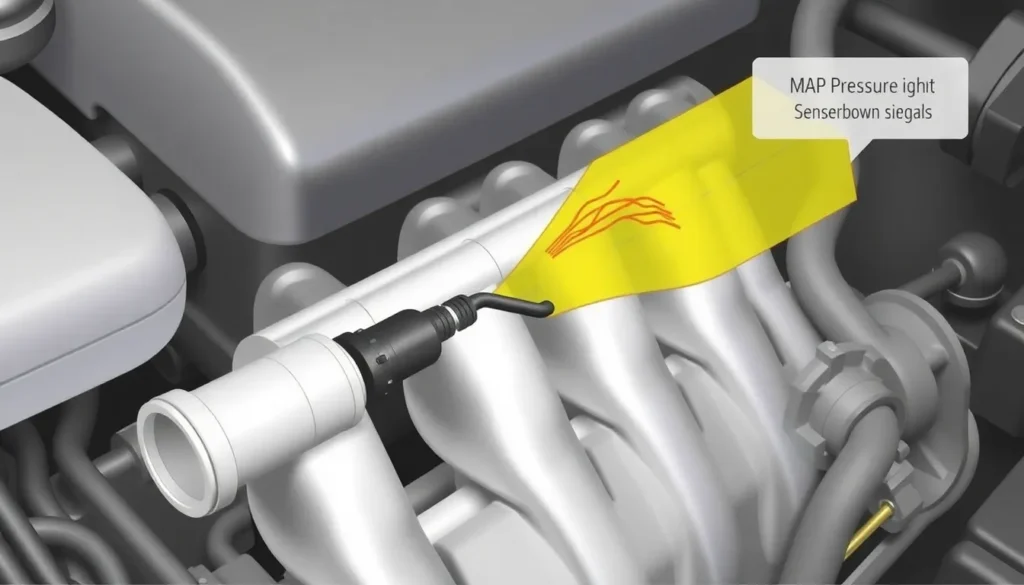
A MAP sensor, short for Manifold Absolute Pressure sensor, is an essential automotive component used primarily in internal combustion engines. It measures the absolute pressure inside the intake manifold, which is critical data for the engine control unit (ECU) to optimize engine performance. By monitoring manifold pressure, the MAP sensor assists in calculating air density and determining the engine’s air mass flow rate, enabling precise fuel delivery and ignition timing adjustments.
Detailed Explanation
The MAP sensor is typically mounted on or near the intake manifold of a vehicle’s engine. It detects the pressure in the manifold, which varies according to engine load, throttle position, and atmospheric conditions. The sensor provides an electrical signal to the ECU that corresponds to the manifold pressure. This information is vital for the ECU to compute the correct amount of fuel to inject into the combustion chamber, ensuring efficient combustion and reducing emissions.
Because manifold pressure is influenced by various factors like altitude and temperature, the MAP sensor’s data allows the engine to adapt to changing environmental conditions. Some modern vehicles use MAP sensors in conjunction with other sensors such as the Mass Air Flow (MAF) sensor or oxygen sensors to achieve more precise engine management.
How It Works
The MAP sensor operates by measuring the absolute pressure inside the intake manifold relative to a vacuum or atmospheric pressure baseline. It usually uses a piezoelectric, capacitive, or strain gauge element that converts pressure variations into electrical signals. When the engine throttle opens, the manifold pressure increases, and the sensor detects this change, sending corresponding voltage or frequency signals to the ECU.
The ECU interprets these signals to adjust fuel injection rates and ignition timing to match the engine’s current operating conditions. For instance, at high manifold pressure (near atmospheric pressure), the engine requires more fuel, whereas at low pressure (high vacuum), less fuel is needed. This adjustment helps optimize engine performance, fuel economy, and emissions.
Examples
- Fuel Injection Control: In fuel-injected engines, the MAP sensor data enables the ECU to calculate the air density and determine the precise amount of fuel to inject, improving combustion efficiency.
- Ignition Timing Adjustment: The sensor’s readings allow the ECU to modify ignition timing based on engine load, enhancing power output and preventing engine knocking.
- Turbocharged Engines: In turbocharged or supercharged engines, the MAP sensor monitors boost pressure, ensuring the engine operates within safe parameters.
Why It Matters
The MAP sensor plays a crucial role in modern engine management systems. By providing real-time data on manifold pressure, it allows for accurate fuel metering and ignition control, which leads to improved fuel efficiency, reduced emissions, and enhanced engine performance. Malfunctioning or inaccurate MAP sensor readings can result in poor engine performance, increased fuel consumption, and higher emissions, making it a critical component for maintaining vehicle health.
Common Misconceptions
Misconception: The MAP sensor measures airflow directly.
Correction: The MAP sensor measures manifold pressure, not airflow. Airflow is typically measured by a Mass Air Flow (MAF) sensor.
Misconception: A MAP sensor is only used in older or carbureted engines.
Correction: MAP sensors are widely used in modern fuel-injected engines, including those with turbochargers and advanced engine management systems.
Pros and Cons
Pros:
- Provides critical data for precise fuel and ignition control.
- Helps improve fuel efficiency and reduce emissions.
- Supports engine adaptation to altitude and environmental changes.
- Compact and relatively simple sensor design.
Cons:
- Can malfunction due to dirt, vacuum leaks, or electrical issues, affecting engine performance.
- Less direct measurement of airflow compared to MAF sensors in some applications.
- May require calibration or replacement over time.
Comparison Table
| Aspect | MAP Sensor | MAF Sensor |
|---|---|---|
| Meaning | Measures manifold absolute pressure inside engine intake manifold. | Measures the mass of air entering the engine. |
| Function | Helps compute air density and engine load for fuel and ignition control. | Directly measures air flow for fuel injection control. |
| Sensor Type | Pressure sensor (often piezoelectric or capacitive). | Flow sensor (hot-wire or vane meter). |
| Typical Use | Common in engines with speed-density fuel control. | Common in engines with mass air flow-based fuel control. |
| Susceptibility | Affected by vacuum leaks and pressure changes. | Can be affected by dirt on sensor elements. |
Decision Checklist
What is the easiest way to understand a MAP Sensor?
The easiest way to understand a MAP sensor is to think of it as a device that measures the “pressure” inside the engine’s air intake system. This pressure tells the engine computer how much air is entering the engine, which helps it decide how much fuel to add for efficient combustion. It’s like checking the air pressure in a balloon to know how much air is inside.
FAQ
What does a MAP sensor do in a car?
A MAP sensor measures the absolute pressure inside the engine's intake manifold and sends this information to the engine control unit (ECU) to optimize fuel delivery and ignition timing.
How can I tell if my MAP sensor is faulty?
Symptoms of a faulty MAP sensor include poor engine performance, rough idling, increased fuel consumption, and engine warning lights. Diagnostic tools can check sensor voltage signals for accuracy.
Is a MAP sensor the same as a MAF sensor?
No, a MAP sensor measures pressure inside the intake manifold, while a MAF sensor measures the actual mass of air entering the engine. Both provide data to the ECU but operate differently.





Leave a Reply