
Short Answer
Overview
A firewood cord is a traditional unit of measurement used primarily in North America to quantify firewood. It represents a specific volume of stacked wood, typically defined as 128 cubic feet, arranged in a way that includes the wood pieces and the air spaces between them. This unit helps buyers and sellers communicate clearly about the amount of firewood being transacted.
Detailed Explanation
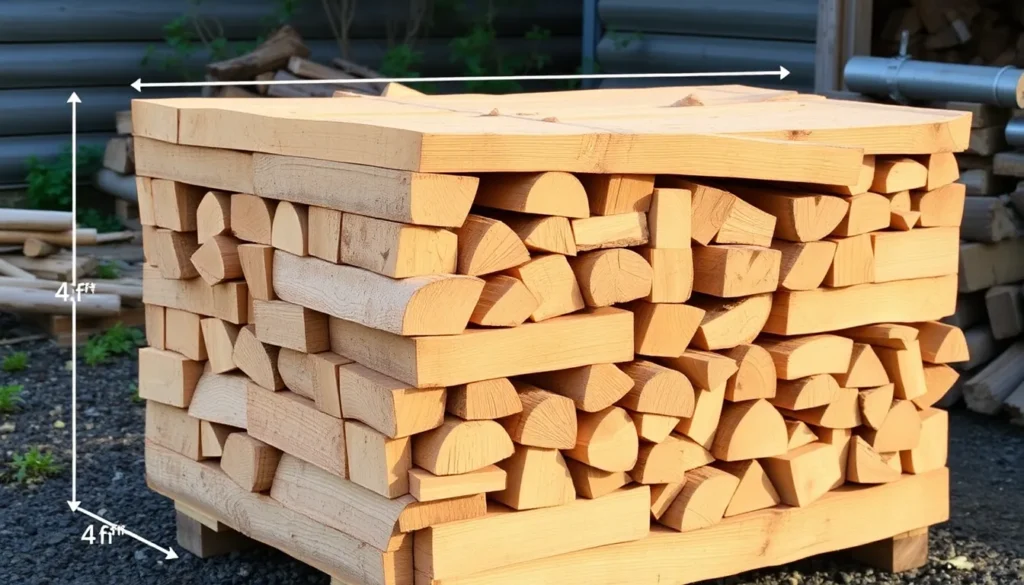
The standard firewood cord measures 4 feet in height, 8 feet in length, and 4 feet in depth (4′ x 8′ x 4′), totaling 128 cubic feet. This measurement includes both the solid wood and the air gaps between the logs when they are neatly stacked. Because wood pieces vary in size and how tightly they are stacked, the actual volume of solid wood in a cord is usually less than 128 cubic feet.
Variations exist in some regions, where smaller units such as the “face cord” or “rick” are used. These smaller measurements typically involve stacking wood to a height of 4 feet and a depth equal to the length of the firewood pieces, which can vary, often resulting in a volume less than a full cord.
How It Works
To measure a firewood cord, the firewood is stacked in a compact and orderly manner to form a rectangular prism with the dimensions of 4 feet high, 8 feet long, and 4 feet deep. The measurement does not account for the irregular shapes or bark thickness of the wood pieces but assumes a relatively even stacking to approximate the total volume.
Because of the air spaces between logs, the actual amount of wood by weight or solid volume is less than the total cubic footage. The density and species of wood also affect the mass and heat output of a cord of firewood.
Examples
- A full cord of oak firewood stacked 4 feet high, 8 feet long, and 4 feet deep.
- A face cord consisting of wood pieces 16 inches long, stacked 4 feet high and 8 feet long, typically one-third of a full cord.
- A half cord, which is half the volume of a full cord, often used for smaller firewood purchases.
Why It Matters
Understanding what constitutes a firewood cord is important for consumers, sellers, and regulators to ensure fair trade and accurate pricing. It also aids in estimating the heat potential and energy content of the wood, which is critical for heating efficiency and fuel planning.
Common Misconceptions
Misconception: A cord refers only to the wood itself.
Correction: A cord includes both the solid wood and the air spaces between the stacked wood pieces.
Misconception: All cords are the same size everywhere.
Correction: While the standard cord is 128 cubic feet, some regions use different measurements such as face cords or ricks, which vary in size.
Pros and Cons
Pros: Provides a standardized measurement for firewood volume; facilitates fair transactions; helps estimate fuel needs.
Cons: Actual wood volume varies due to stacking method and wood size; air gaps can make comparisons with weight-based measures misleading.
Comparison Table
| Aspect | Firewood Cord | Face Cord |
|---|---|---|
| Meaning | A standardized volume measure of firewood, 4′ x 8′ x 4′, totaling 128 cubic feet | A partial cord, typically 4′ high and 8′ long with depth equal to the length of firewood pieces, often 16 inches |
Decision Checklist
What is the easiest way to understand a firewood cord?
Think of a firewood cord as a neatly stacked pile of wood measuring 4 feet high, 8 feet long, and 4 feet deep, roughly the size of a large pickup truck bed filled with wood. This visualization helps grasp the volume it represents, including the space between the logs.
FAQ
What exactly is a firewood cord?
A firewood cord is a standardized unit of volume measurement for firewood, defined as a neatly stacked pile measuring 4 feet high by 8 feet long by 4 feet deep, totaling 128 cubic feet including air spaces.
How does a face cord differ from a full cord?
A face cord is usually a smaller portion of a full cord, often 4 feet high and 8 feet long but only as deep as the length of the wood pieces (commonly 16 inches), resulting in about one-third the volume of a full cord.
Why is the volume of solid wood in a cord less than 128 cubic feet?
Because a cord measurement includes the air spaces between stacked logs, the actual solid wood content is less than the total cubic footage of the stack.





Leave a Reply