
Short Answer
Overview
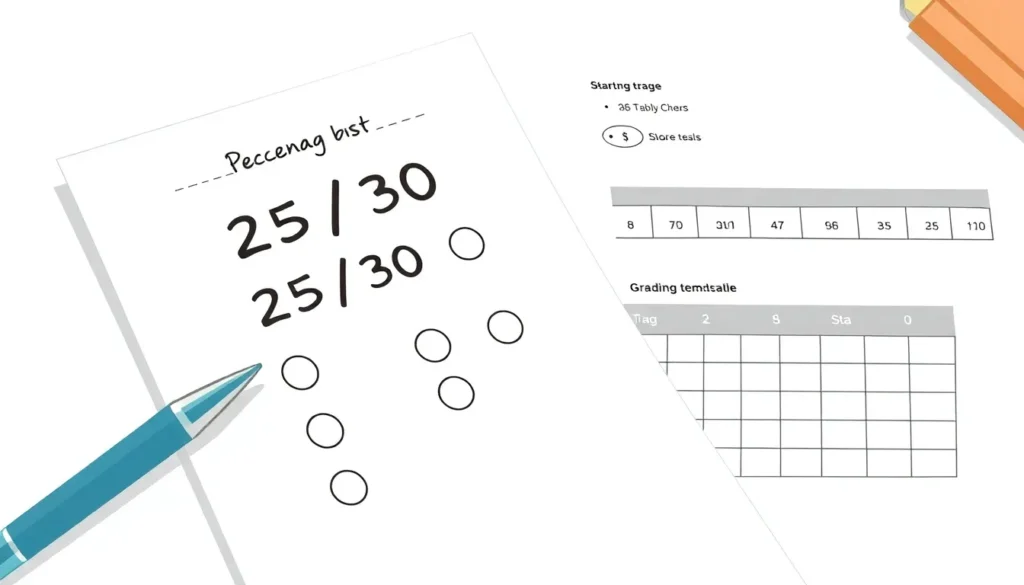
A score of 25 out of 30 typically represents a result in a scoring system where the total possible points are 30, and the individual or entity has earned 25 points. This form of scoring is common in academic tests, quizzes, evaluations, or other assessments where performance is measured quantitatively. The score provides a basis for evaluating proficiency, understanding, or achievement in a particular subject or task.
Detailed Explanation
The “25 out of 30” score expresses a ratio of the points earned to the points possible. Numerically, it means that the individual achieved 25 points while the maximum achievable was 30 points. This can be converted into a percentage by dividing 25 by 30 and multiplying by 100, resulting in approximately 83.33%. This percentage can then be interpreted according to grading scales or benchmarks relevant to the context in which the score is used.
Depending on the system, a 25/30 might correspond to various letter grades or qualitative assessments. For example, in many academic grading systems, this percentage could be considered a B or B+, indicating above-average performance but potentially short of excellent.
How It Works
In practice, scoring systems like “25 out of 30” involve assigning points to correct answers, completed tasks, or fulfilled criteria. Each item within the assessment has a designated point value, and the total possible points sum to 30. The individual’s performance is evaluated by totaling the points earned. The resulting score is typically used to gauge mastery, inform feedback, or determine eligibility for advancement or certification.
Such scoring is straightforward and allows for easy comparison across different assessments or participants. Additionally, it provides a clear numerical representation of performance, which can be used for record-keeping and statistical analysis.
Examples
- Academic test: A student answers 25 questions correctly out of 30 on a math quiz, resulting in a 25/30 score.
- Language proficiency: On a language test with 30 points possible, a test taker earns 25 points, indicating a strong grasp of the material.
- Skill assessment: A practical skills evaluation awards points for each completed step, with the participant scoring 25 out of 30.
Why It Matters
Understanding what a 25 out of 30 score represents is important for interpreting results accurately. It provides a quantitative measure of performance that can influence decisions such as academic progression, qualification for programs, or identification of areas needing improvement. Clear comprehension of the score’s meaning helps stakeholders—students, educators, employers—make informed judgments.
Common Misconceptions
Misconception: A 25 out of 30 score always means a perfect grade.
Correction: While 25 out of 30 is a high score, it is not perfect; it represents approximately 83.33%, which is generally considered good but not flawless.
Misconception: All grading systems interpret 25 out of 30 the same way.
Correction: Grading scales vary by institution, region, and context, so the same score may correspond to different grades or evaluations.
Pros and Cons
Pros: Provides a clear, quantifiable measure of performance; easy to calculate and interpret; facilitates comparison across assessments.
Cons: May not capture qualitative aspects of performance; interpretation can vary depending on grading standards; can oversimplify complex assessments.
Comparison Table
| Aspect | 25 Out of 30 | Alternative/Related Topic (Percentage Score) |
|---|---|---|
| Meaning | Earned 25 points from a possible 30 | Score expressed as a percentage, e.g., 83.33% |
| Interpretation | Context-dependent; often a B or above average | Standardized scale with letter grades or descriptors |
| Use | Raw score in assessments | Normalized performance metrics |
Decision Checklist
What is the easiest way to understand a 25 Out of 30 score?
The easiest way to understand a 25 out of 30 score is to convert it into a percentage by dividing 25 by 30 and multiplying by 100, yielding approximately 83.33%. This percentage can then be compared to familiar grading scales or benchmarks to assess performance.
FAQ
How do I convert 25 out of 30 to a percentage?
Divide 25 by 30 to get approximately 0.8333, then multiply by 100 to get 83.33%.
Is 25 out of 30 considered a good score?
Generally, 25 out of 30 is considered a good score, often reflecting above-average performance, but exact interpretations depend on the grading scale.
Can 25 out of 30 be converted to a letter grade?
Yes, many institutions convert numerical scores into letter grades, with 25/30 often corresponding to a B or B+ grade, depending on the specific grading criteria.





Leave a Reply