
Short Answer
Overview
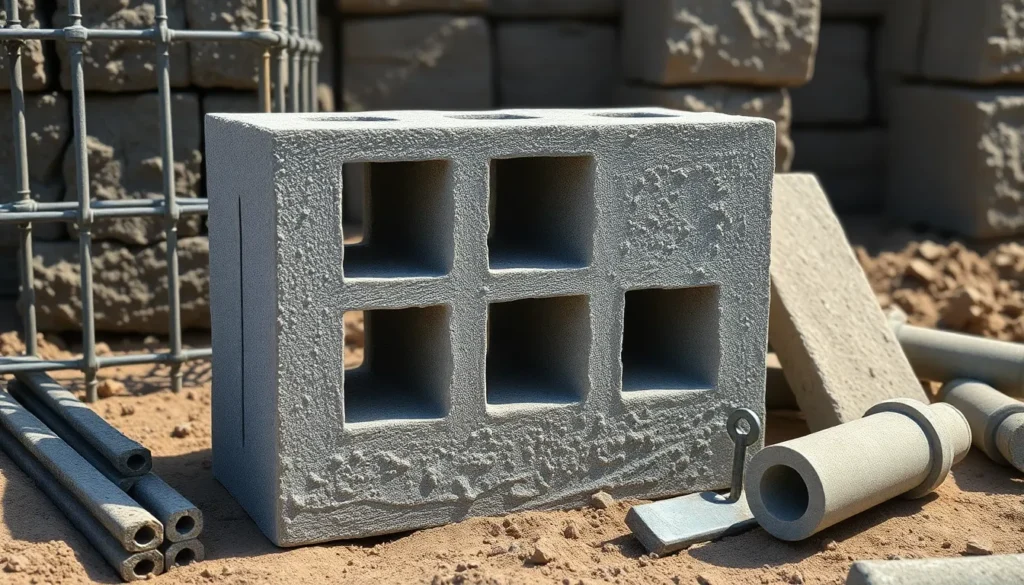
A cinder block is a type of concrete masonry unit (CMU) primarily used in construction projects such as building walls, foundations, and retaining structures. Typically rectangular and hollow, these blocks are made from a mixture of concrete and lightweight aggregates, often including coal cinders, slag, or other industrial byproducts. Their hollow cores allow for reinforcement with steel and filling with concrete, enhancing structural strength.
Detailed Explanation
Cinder blocks originated as a byproduct solution to utilize coal cinders produced during coal combustion. Modern cinder blocks are similar to concrete blocks but traditionally used coal cinders as the aggregate, which made them lighter than standard concrete blocks. Today, the term is often used interchangeably with concrete blocks, though technically cinder blocks contain coal cinder aggregates while concrete blocks use heavier stone or gravel aggregates.
The typical dimensions of a cinder block are approximately 16 inches long, 8 inches high, and 8 inches deep, though sizes can vary based on regional standards and specific applications. The hollow cores serve multiple purposes: reducing weight for easier handling, providing insulation properties, and creating cavities for reinforcing bars (rebar) and grout, which increase the block’s load-bearing capability.
How It Works
Cinder blocks work as modular building components that can be stacked and bonded with mortar to create durable structures. The hollow spaces inside the blocks allow them to accommodate reinforcement materials such as steel rebar. When these cavities are filled with grout or concrete, the resulting composite structure gains significant strength and stability, suitable for load-bearing walls and foundations.
Additionally, the lightweight nature of cinder blocks reduces the overall weight of the structure compared to solid bricks or concrete blocks, which can be beneficial in certain building situations. Their porous nature also provides some degree of thermal insulation, contributing to energy efficiency.
Examples
- Residential Foundations: Cinder blocks are commonly used in building the foundation walls of houses due to their strength and durability.
- Retaining Walls: Their modularity and ability to be reinforced make cinder blocks suitable for constructing retaining walls in landscaping and civil engineering.
- Fire Pits and Outdoor Structures: Their heat resistance and ease of stacking make them popular for outdoor fire pits and garden walls.
Pros and Cons
Pros:
- Lightweight compared to solid concrete blocks, easing handling and transportation.
- Cost-effective material using industrial byproducts.
- Hollow cores allow for reinforcement and insulation.
- Durable and resistant to fire, pests, and weathering.
Cons:
- Lower compressive strength compared to solid concrete blocks.
- Porosity may allow moisture penetration if not properly sealed.
- Appearance is considered less aesthetically pleasing for exposed surfaces without additional finishing.
- Variability in quality depending on the specific aggregates used.
Comparison Table
| Aspect | Cinder Block | Concrete Block |
|---|---|---|
| Meaning | A masonry unit made from concrete mixed with coal cinders or lightweight aggregates. | A masonry unit made from concrete mixed with heavier aggregates such as gravel or crushed stone. |
| Weight | Lighter due to use of cinders or lightweight materials. | Heavier due to dense aggregates. |
| Strength | Moderate compressive strength; suitable for non-load bearing to medium load-bearing structures. | Generally higher compressive strength; used in load-bearing applications. |
| Insulation | Better thermal insulation due to porous nature. | Lower insulation; denser material conducts heat more readily. |
| Cost | Often less expensive because of recycled materials. | Typically more costly due to heavier aggregates and higher strength. |
Decision Checklist
- Use this if: Lightweight construction, moderate strength, and insulation are priorities; or when cost savings are important.
- Avoid this if: Maximum strength and durability are required, such as in high-load structural walls.
- Check this first: Local building codes and material availability, as terminology and materials can vary regionally.
What is the easiest way to understand a Cinder Block?
The simplest way to understand a cinder block is to think of it as a hollow, rectangular building block made from concrete mixed with lightweight industrial byproducts. It is designed to be stacked and reinforced to form walls and structures that are both durable and relatively lightweight compared to solid concrete blocks.
FAQ
What materials are used to make cinder blocks?
Cinder blocks are typically made from a mixture of concrete and coal cinders or other lightweight aggregates such as slag or ash.
Are cinder blocks the same as concrete blocks?
While often used interchangeably, cinder blocks traditionally contain coal cinders as aggregate, making them lighter, whereas concrete blocks use heavier aggregates like gravel.
Can cinder blocks be used for load-bearing walls?
Yes, cinder blocks can be used for load-bearing walls when reinforced with steel rebar and filled with grout, though they generally have lower compressive strength than solid concrete blocks.





Leave a Reply